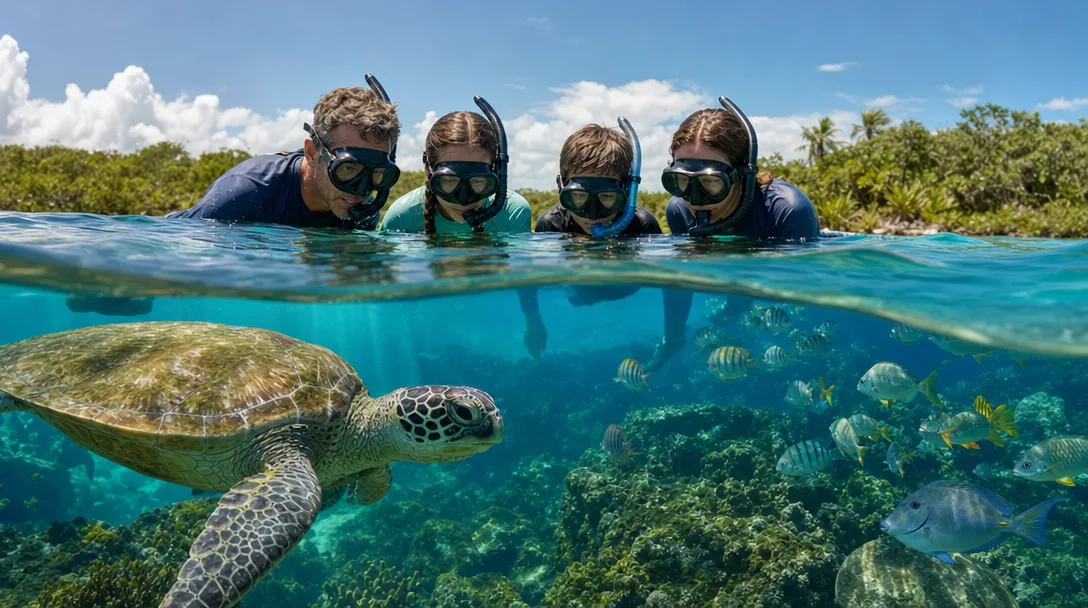
Akumal vs Yal-Ku Lagoon: Which Snorkeling Trip Fits Your Group?
Akumal vs Yal-Ku Lagoon: choose turtles and structure at Akumal Bay or calm, self-paced snorkeling at Yal-Ku for your group.
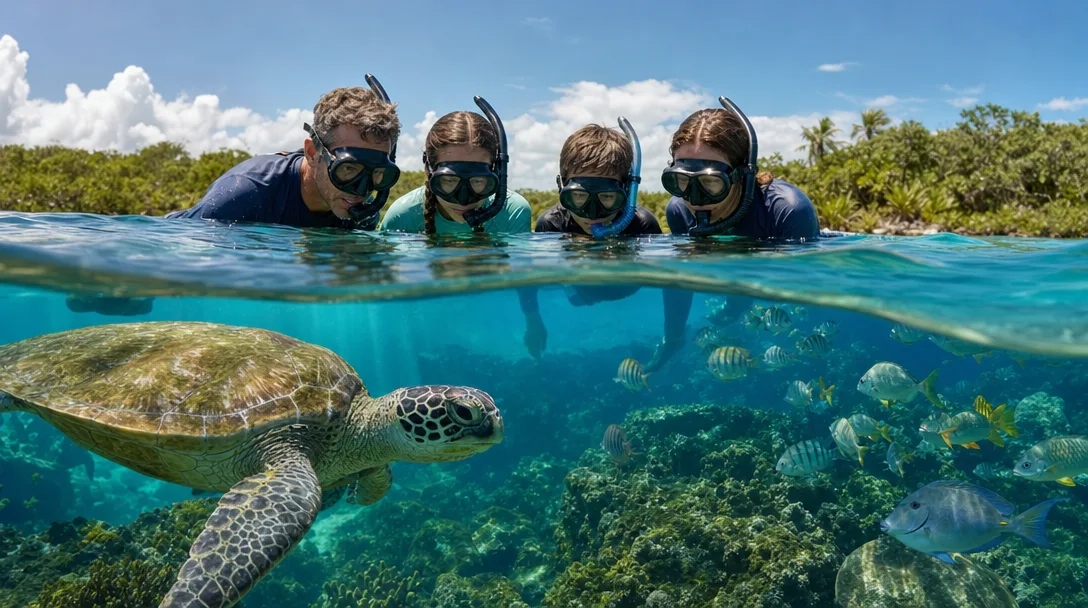
Is Akumal Bay or Yal-Ku Lagoon Better for Snorkeling?
Akumal Bay is the better choice for groups that want a regulated, guide-led encounter with green sea turtles, while Yal-Ku Lagoon fits groups that want calmer, self-paced snorkeling among tropical fish and mangroves. The Akumal vs Yal-Ku Lagoon decision comes down to turtles and structure versus flexibility and ease, in the same stretch of Riviera Maya coast.
Both sites sit in Quintana Roo, a short drive apart near the town of Akumal, but they solve different vacation problems. Akumal Bay built its reputation on shallow seagrass beds where green sea turtles feed close to shore, and AquaCore Adventures' 2026 Riviera Maya reef-snorkel comparison puts morning turtle sighting odds at 90-95%, before wind and stirred-up sand reduce visibility later in the day. That reliability comes with rules: access to the deeper turtle zone requires a licensed guide and a life vest.
Yal-Ku Lagoon trades that structure for independence. It's a brackish, cenote-fed inlet where fresh water meets the sea, creating a wave-free pool full of small reef fish and mangrove scenery. The same AquaCore Adventures comparison lists Yal-Ku's visibility at 8-15 meters, depending on recent rain, and most visitors snorkel it on their own schedule rather than following a guide through the water.
Neither site is objectively "better." A group chasing a turtle photo belongs in Akumal Bay. A group with nervous swimmers, young kids, or anyone who wants to linger past a short, guided window belongs in Yal-Ku Lagoon.
Akumal Bay vs Yal-Ku Lagoon: Depth, Visibility, and Access Rules at a Glance
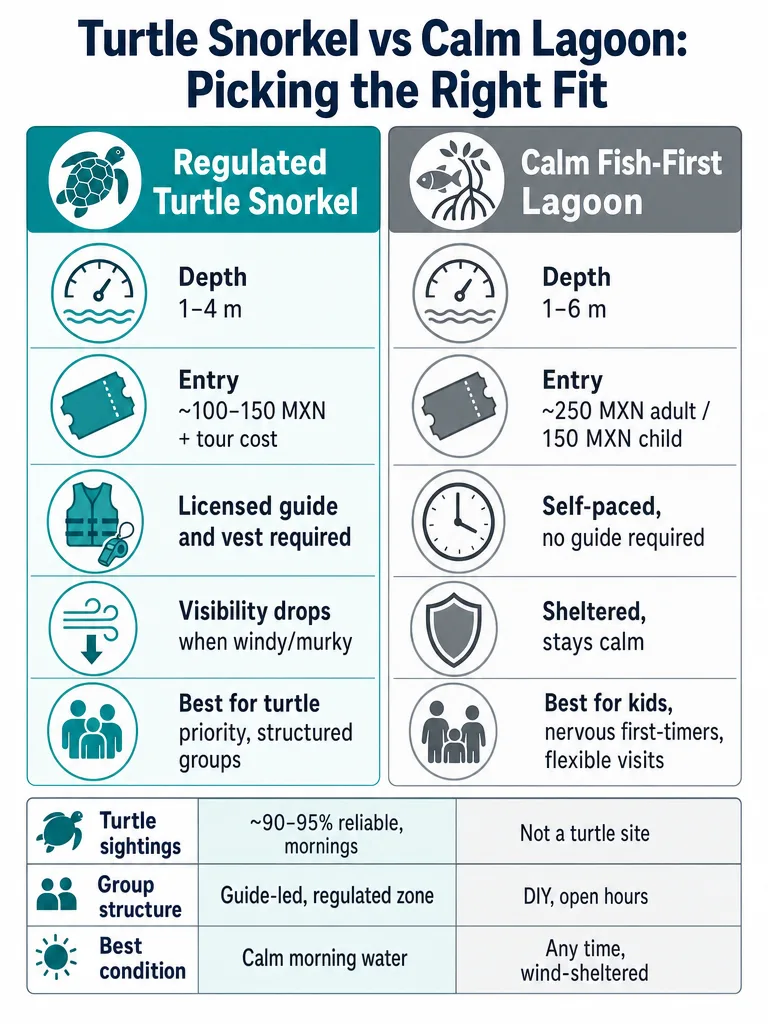
Akumal Bay runs shallower and more current-controlled than Yal-Ku Lagoon, with a licensed guide required in its turtle zone, while Yal-Ku stays deeper in places but is mostly a self-guided visit. AquaCore Adventures' 2026 Riviera Maya reef-snorkel comparison, which also covers nearby Xpu-Ha, lays out the operating differences side by side.
| Factor | Akumal Bay | Yal-Ku Lagoon |
|---|---|---|
| Typical depth | 1-4 m | 1-6 m |
| Underwater visibility | Best at sunrise; green sea turtle (Chelonia mydas) sightings run about 90-95% reliable before midday wind stirs up sand | 8-15 m, varying with recent rainfall |
| Entry fee | About 100-150 MXN per person, plus required tour cost | About 250 MXN adult / 150 MXN child |
| Guide requirement | Licensed CONANP guide required in the deeper turtle zone | Self-guided; no in-water guide required |
| Group cap | About 6 guests per guide, with a 45-minute water-time cap | No formal cap; visitors can stay as long as they want |
The pattern across every row points the same direction. Akumal Bay is regulated by design: CONANP, Mexico's federal natural-protected-areas agency, licenses the guides who work the turtle zone, caps group size, and limits water time to protect the seagrass beds the turtles feed on. Yal-Ku Lagoon has none of that scaffolding. It's privately operated, charges a flat entry fee, and leaves pacing entirely up to the visitor.
Akumal's guide requirement is the main added cost beyond the gate fee. AquaCore Adventures' comparison prices the licensed-guide tour separately from the 100-150 MXN entry charge, so the bay's total cost depends on which tour operator a visitor books. Yal-Ku's flat 250 MXN adult fee, by contrast, covers nearly the whole visit since no guide is required.
Can You See Sea Turtles at Yal-Ku Lagoon?
Yal-Ku Lagoon is a brackish, fish-and-mangrove lagoon, not a dependable turtle-snorkeling spot. It's where fresh water escaping from inland cenotes mixes with incoming seawater, producing calm, current-free conditions that favor small reef fish, sculpture gardens, and shoreline mangroves. Most write-ups on the lagoon describe its marine life in terms of tropical fish rather than turtles.
Akumal Bay is the far more reliable turtle encounter. Its shallow seagrass beds are a known feeding ground for the green sea turtle, Chelonia mydas, and the name Akumal itself is tied to "place of the turtles" in local use, according to Loco Gringo's Akumal guide. One older description of Yal-Ku from Everything Playa del Carmen does list sea turtles among the lagoon's marine life, so an occasional sighting isn't impossible. It isn't the pattern most visitors should plan a trip around, though; current write-ups on Yal-Ku focus on fish and mangroves, and none treat it as a turtle destination the way Akumal Bay is treated.
That split matters when a group books a trip around a specific expectation. For a planning-focused breakdown of the turtle encounter itself, including rules, timing, and booking windows, see snorkeling with sea turtles in Akumal 2026.
If turtles are the priority, Akumal Bay is the stronger choice between the two. If fish, mangroves, and calm water are the priority, Yal-Ku delivers that experience without the turtle-zone restrictions attached.
Do You Need a Guide for Akumal Bay's Turtle Zone?
Yes, in the deeper turtle-viewing area of Akumal Bay, a licensed guide and a life vest have been required since access rules tightened in 2016, according to AquaCore Adventures' 2026 comparison of Riviera Maya snorkel sites. That change followed concern over crowding and contact with feeding turtles close to shore, and it shifted the deeper zone from open access to guide-controlled entry.
The same comparison describes current practice as licensed-guide groups of roughly six snorkelers per guide, with a water-time cap near 45 minutes in the regulated zone.
That uncertainty is normal for a site that gets adjusted season to season based on turtle activity and visitor volume. It's also one of the reasons a locally based guide who checks conditions before a trip is worth more here than a generic booking page: rules in Akumal's turtle zone are enforced in person, at the beach, on the day.
Is Yal-Ku a Better Choice Than Akumal Bay on Windy or Murky Days?
Yal-Ku Lagoon is the steadier pick on windy or murky days because its sheltered, cenote-fed layout doesn't stir up the way an open bay does. Akumal Bay's visibility commonly drops later in the day once wind kicks up and sand gets churned from the shallow seagrass bottom, a pattern AquaCore Adventures' 2026 Riviera Maya comparison flags directly.
The same comparison notes that Yal-Ku's cenote inflow can run up to 4°C cooler than the open sea in spots near the freshwater source, which means a single swim across the lagoon can pass through noticeably different water temperatures. That cenote-fed chill is part of why the lagoon stays calm: fresh water sinks and mixes slowly instead of getting pushed around by wind-driven chop the way an open bay does.
For a morning trip, Akumal Bay's turtle odds are strong and the water is usually calmest right after sunrise. For an afternoon trip, or any day with wind in the forecast, Yal-Ku holds its clarity better simply because it isn't exposed to the same wave action. Groups with a flexible schedule get the best of both: turtles early, lagoon late.
Which Site Is Better for Kids or Nervous First-Time Snorkelers?
Yal-Ku Lagoon is generally the easier site for kids and nervous first-time snorkelers, mainly because it removes the two things that make Akumal Bay harder: current and rules. Matching a group to the right site comes down to three questions.
- Can everyone swim comfortably without assistance? Akumal Bay's turtle zone involves some open-water movement and a licensed guide keeping the group together on a timed schedule. If anyone in the group is a weak swimmer or anxious in open water, that structure can add pressure rather than reassurance.
- Is the group comfortable following a guide's pace and timing? Akumal's roughly 45-minute water-time cap and six-guests-per-guide format, noted in AquaCore Adventures' 2026 comparison, works well for groups that want a focused, well-managed outing but less well for anyone who wants to stop, rest, or turn back early.
- Does the group want to set its own pace instead? Yal-Ku's shallow, current-free water, described by Loco Gringo as no deeper than about 4 meters in most areas, lets kids wade in gradually, take breaks on the rocks or in a rented palapa, and snorkel in short bursts without a guide moving the group along.
A private, in-water guided cenote snorkeling tour is worth comparing too, since it offers a similarly calm, beginner-friendly format with a dedicated guide rather than a self-guided lagoon visit.
How Much Does Each Trip Cost and What's Included?
Akumal Bay and Yal-Ku Lagoon charge similar entry fees on paper, but what that fee buys differs once a required guide, gear, and transport enter the picture. AquaCore Adventures' 2026 Riviera Maya comparison puts Akumal Bay's fee at roughly 100-150 MXN per person plus the cost of the required guided tour, while Yal-Ku runs about 250 MXN for adults and 150 MXN for children, with no guide requirement attached.
| Line item | Akumal Bay | Yal-Ku Lagoon |
|---|---|---|
| Park/entry fee | ~100-150 MXN per person | ~250 MXN adult / 150 MXN child |
| Guide | Required in turtle zone, priced separately from entry | Not required; self-guided |
| Gear rental | Usually bundled into tour price | Available on-site for rent |
| Transport | Typically arranged by tour operator | Self-arranged or taxi |
The gap shows up in logistics as much as price. Akumal's entry fee is just the starting point; a licensed guide and tour booking come on top of it, and that tour sets the schedule and the roughly 45-minute water-time window. Yal-Ku's higher sticker price is close to the whole bill, since gear rental and lockers are available right at the gate and visitors can stay as long as they like.
For groups weighing a fully guided day against a more hands-off visit, it helps to see the broader trade-offs laid out in private vs group diving tours, which covers how guide ratio and pacing change the value of a trip beyond the entry fee alone.
How to Choose Between Akumal Bay and Yal-Ku Lagoon for Your Group
Choose Akumal Bay when the group's top priority is seeing green sea turtles and everyone is a confident swimmer comfortable following a guide's schedule. Choose Yal-Ku Lagoon when the group includes young kids, nervous first-timers, or anyone who wants to set their own pace in calm water. Combining both in one day works well for mixed-ability groups or anyone spending more than an afternoon in the area.
Four profiles cover most Riviera Maya visitors:
- Turtle-priority groups: Book Akumal Bay, ideally in the morning when sighting odds sit near 90-95% and the water hasn't been stirred up yet. Confirm the current guide and vest requirement for the turtle zone before you go, since enforcement details can shift season to season.
- Families with young kids or first-timers: Choose Yal-Ku Lagoon for the calmer, current-free water and the freedom to snorkel in short stretches without a guide pulling the group along. Bring water shoes; several local guides note the lagoon bottom runs rocky in places.
- Mixed-ability groups with strong swimmers and hesitant beginners: Split the day. Hit Akumal Bay for the turtle encounter when everyone can keep pace with a guided group, then relax at Yal-Ku afterward so hesitant swimmers get unstructured time in the water too.
- Budget-first or time-limited groups: Yal-Ku's flat entry fee and self-guided format usually means a shorter planning window and no scheduling around a required guide, which matters most on a short vacation window.
A private snorkel outing can sidestep some of this trade-off by letting a guide plan a day around a group's mix of turtle interest and comfort level rather than slotting everyone into a shared six-person turtle group; Seth Dive Mexico runs its snorkel trips this way. For groups weighing other nearby snorkel spots too, the best cenotes to snorkel near Playa del Carmen is worth a look before locking in a single destination.
Frequently asked questions
Can you visit Akumal Bay and Yal-Ku Lagoon in the same day?
Yes, the two sites sit a short drive apart near the town of Akumal in Quintana Roo, making a same-day visit easy to plan. Most visitors snorkel Akumal Bay in the morning for the best turtle odds, then move to Yal-Ku Lagoon in the afternoon for calmer, unguided swimming. A local guide can sequence both stops around tide, wind, and your group's pace rather than a fixed tour schedule.
What should you bring to Yal-Ku Lagoon?
Bring water shoes, biodegradable sunscreen, and a towel; Loco Gringo's Akumal guide notes the lagoon bottom is rocky in several spots, so footwear matters more than at a sandy beach. Snorkel gear and life vests can be rented on-site, and lockers are available for valuables, so packing your own equipment is optional rather than required. Outside food and drink are typically not permitted inside the gate.
Is a life jacket required at Yal-Ku Lagoon?
No, a life jacket is optional at Yal-Ku Lagoon rather than mandatory, though Loco Gringo's Akumal guide encourages wearing one for safety in the calm, brackish water. That's different from Akumal Bay's turtle zone, where a life vest and a licensed guide have been required since access rules tightened in 2016. Swimmers comfortable in open water can skip the vest at Yal-Ku without breaking any posted rule.
How far is Akumal from Playa del Carmen?
Akumal sits about 20 minutes south of Playa del Carmen off Highway 307, according to Everything Playa del Carmen's write-up on the area. That makes both Akumal Bay and Yal-Ku Lagoon a short day-trip distance from most Playa del Carmen hotels, and well within range of free hotel pickup offered by local dive and snorkel operators working the Cancun-to-Tulum corridor.
Can you visit Akumal Bay without booking a guided tour?
Yes, general beach access at Akumal Bay doesn't require a guide; only the deeper turtle-viewing zone does, since access rules tightened in 2016 according to AquaCore Adventures' 2026 Riviera Maya comparison. Visitors can pay the roughly 100-150 MXN entry fee and snorkel the shallower water independently. Exactly where that guided zone starts can shift season to season, so it's worth confirming on-site rather than assuming the same boundary every trip.
Is parking free at Yal-Ku Lagoon?
Yes, Loco Gringo's Akumal guide notes free parking is available directly in front of the Yal-Ku Lagoon entrance gate. Visitors pay a nominal entry fee once inside, separate from parking, and lockers are on-site for storing valuables, towels, and a change of clothes during the visit. That makes planning simpler than Akumal Bay, where parking and tour logistics often get bundled into a booked excursion.