Best Time to Dive Riviera Maya 2026: Month by Month
Best time to dive Riviera Maya 2026 by activity: cenotes year-round, reef windows, bull sharks November-March, whale sharks in summer.
What is the best time to dive Riviera Maya in 2026?
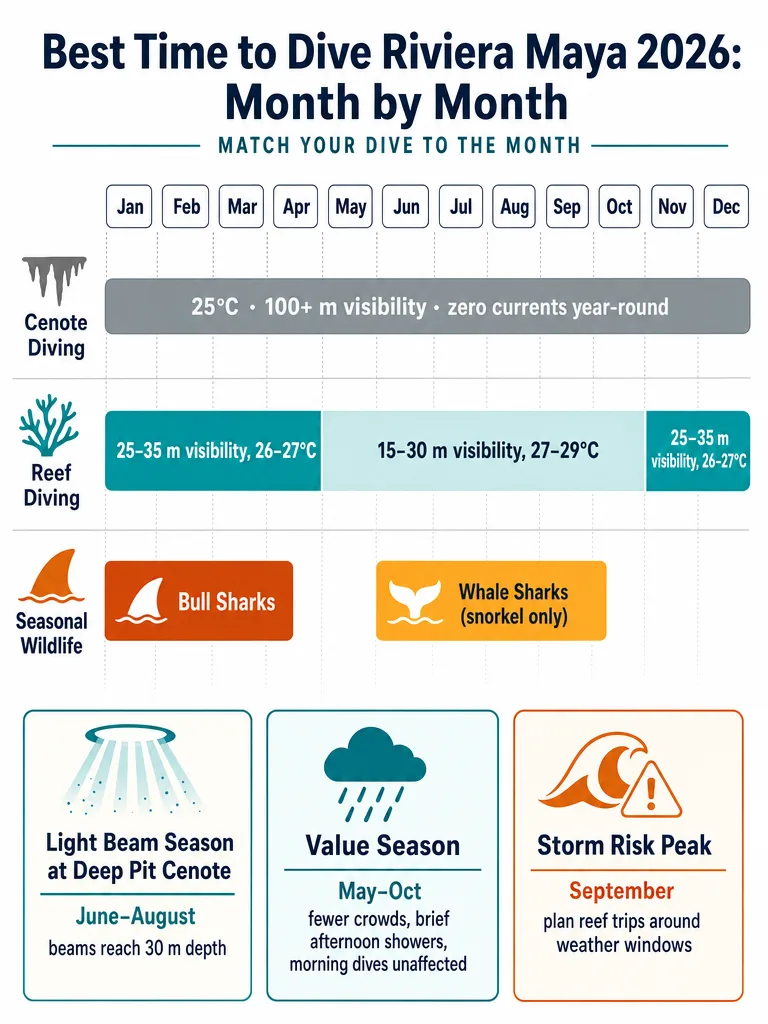
The best time to dive the Riviera Maya in 2026 depends entirely on what you want to see underwater, not on a single "high season." Cenote diving works every month, reefs are clearest in the dry-season windows, bull sharks run November through March, and whale sharks are a summer snorkel trip. Seth Dive Mexico's planning guide notes that water stays warm year-round at 25-29°C.
Here's the quick match:
- Cenotes: any month. Seth Dive Mexico's planning guide reports cenotes hold steady at 25°C, 100+ meters visibility, and zero currents all year.
- Reef diving: best in the clearer dry windows. Aqua Core Adventures lists January and February reef visibility at 25-35 m.
- Bull sharks off Playa del Carmen: November through March, a separate specialty trip.
- Whale sharks: summer, snorkel-only, roughly June through September.
- Best value: May, June, September, or October, when Seth Dive Mexico's guide points to fewer crowds and lower prices with the same great diving.
If your dates are locked and you're weighing what's realistic, start planning your dive by sending Seth your travel window, hotel, and certification level, and you'll get a match instead of a generic calendar.
What are the current dive conditions in Playa del Carmen and Cozumel?
Right now the water is warm and the sea is flat. Our latest reading for Playa del Carmen shows a sea surface temperature averaging 29.7°C (ranging 29.5-29.9°C), measured on August 11, 2026. That's rash-guard and shorty-wetsuit territory, no thick exposure protection needed for most divers.
Cozumel's ocean is calm as of the same date. Our marine forecast for August 11, 2026 reads a total wave height of 0.28 m, with swell at 0.22 m and wind waves at just 0.06 m. Those are gentle numbers for the channel, which usually means comfortable boat rides and clean drift dives.
Keep in mind this is a mid-August snapshot, deep in the warm rainy season. Conditions shift day to day, and August also sits inside the Atlantic hurricane watch window. Seth Dive Mexico's guide confirms water runs 25-29°C across the year, so warm-water gear works whenever you visit.
January to April: which divers get the best reef visibility and bull shark overlap?
January through April is the strongest reef-diving stretch of 2026 and the tail of bull shark season. Aqua Core Adventures reports January and February reef visibility at 25-35 m with 26°C water, and February as the driest month with the clearest water of the year. Bull sharks stay offshore Playa del Carmen through March, so certified divers can pair open-water reef dives with a shark trip in the same visit.
Month by month, from the Aqua Core Adventures reef table:
| Month | Reef visibility | Water temp | What's happening |
|---|---|---|---|
| January | 25-35 m | 26°C | Peak dry season, bull sharks, eagle rays. Book early. |
| February | 25-35 m | 26°C | Driest month, top visibility, sailfish offshore. |
| March | 25-35 m | 26-27°C | Final bull shark calls; spring-break crowds arrive late. |
| April | 20-30 m | 27°C | Last clean window before sargassum starts. |
February gives you the best combination of visibility and bull sharks in a single trip. If you want the shark encounter specifically, book before March ends, because that's when the season closes. For details on how those trips run, see our guide to bull shark diving in Playa del Carmen.
These months also suit beginners well: calm topside weather and clear reefs make for easy first ocean dives. Cenotes, of course, don't care what month it is.
May to August: which trips fit turtle season, whale sharks, sargassum, and The Pit sunbeams?
May through August is warm-water season with the widest range of wildlife, offset by sargassum and rising storm risk. Aqua Core Adventures puts reef visibility at 20-30 m across these months, with water climbing from 27-28°C in May to a steady 29°C by July and August. This is the window for turtles, whale sharks, and the famous light shows inside The Pit.
What each month brings:
- Turtle nesting season runs May through October and peaks in July and August, per Aqua Core Adventures, with reliable sightings around Akumal and Puerto Aventuras. Our guide to snorkeling with sea turtles in Akumal covers the rules.
- Whale sharks open in June as a snorkel-only summer trip (more on that below).
- The Pit sunbeams run June through August. Seth Dive Mexico's planning guide says the shafts of light penetrate 30 meters into the water, one of the best-looking dives in the region.
- Sargassum peaks June through September. Here's the key distinction competitors blur: it affects beaches and marina launches, not the cenotes or offshore reef sites themselves.
August also opens the hurricane watch. If you're chasing The Pit sunbeams or whale sharks, tell Seth your travel week and he'll build the day around cenotes and offshore reefs to sidestep the weed.
September to December: when do value trips, storm risk, and bull sharks change the plan?
September through December swings from the year's riskiest weather to its clearest reef water. Aqua Core Adventures marks September as the low point for visibility at 15-25 m, and it's also the peak Atlantic hurricane month. By November, visibility jumps to 25-40 m, the best-reading window on the whole calendar, and bull sharks return offshore Playa del Carmen.
The end-of-year reef picture, from Aqua Core Adventures:
| Month | Reef visibility | Water temp | Planning note |
|---|---|---|---|
| September | 15-25 m | 29°C | Peak hurricane month; flexible dates help. |
| October | 15-25 m | 28°C | Shoulder-season value; fewer crowds. |
| November | 25-40 m | 27°C | Best reef visibility of the year; bull sharks return. |
| December | 25-35 m | 26-27°C | Dry season, holiday crowds, book early. |
November is the single best reef-visibility window of the 2026 calendar, and it overlaps the return of bull shark season. October is the smart value play: Seth Dive Mexico's planning guide names it among the best months for fewer crowds and lower prices with the same diving quality.
If you're booking September or early October, keep your itinerary flexible and lean on cenotes as a weather-proof backup, since their conditions never change.
Is Riviera Maya diving good year round?
Riviera Maya diving is genuinely good year-round, but only cenote diving is truly consistent every month. Seth Dive Mexico's planning guide reports that cenotes hold 25°C water, 100+ meters of visibility, and zero currents in every season, with no wet-season or dry-season swing at all. Reef diving is also available all 12 months, but its quality moves with the calendar.
That's the distinction most guides gloss over. Reef diving depends on visibility, sea state, sargassum, predator presence, and crowd levels, which is why Aqua Core Adventures ranges reef visibility from a September low of 15-25 m to a November high of 25-40 m. Cenotes ignore all of that.
So the honest answer is yes, with a caveat: there is no bad month to dive here, only months better suited to certain trips.
What is the best month for cenote diving in Riviera Maya?
Any month is a good month for cenote diving, because conditions barely change. Seth Dive Mexico's planning guide reports cenotes stay at 25°C with 100+ meters of visibility and zero currents all year, so your comfort and clarity don't hinge on the calendar. The one seasonal highlight is The Pit's sunbeam window from June through August.
That means "best month" for cenotes is really about the specific site and light you want, not the weather:
- June through August: The Pit's shafts of light reach 30 meters down, per Seth Dive Mexico's planning guide, the standout seasonal cenote experience.
- Any month: Dos Ojos, Angelita, and the rest hold their conditions year-round.
The bigger decision is matching the cenote to your certification and comfort, not the date. Dos Ojos suits Open Water divers on daylight cavern routes, while The Pit and Angelita are deeper Advanced Open Water dives with a very different feel. Our guide on how to choose between Angelita, The Pit, and Dos Ojos walks through it, and beginners can start with snorkeling Dos Ojos.
When is bull shark season in Playa del Carmen?
Bull shark season in Playa del Carmen runs November through March. Seth Dive Mexico's planning guide lists that window, and it's a separate specialty trip for certified divers, not a standard reef dive. Aqua Core Adventures describes the dives on sandy bottom roughly 1 km offshore at depths of 23-28 m, outside the reef entirely.
The format matters for how the day feels. Aqua Core Adventures reports these trips run with 6-8 divers max, 2 guides, plus a dedicated safety diver, a tighter ratio built around a controlled encounter with large animals. That's a different experience from a drift along the reef, so plan it as its own outing rather than a bolt-on.
Bull shark diving is a November-through-March specialty for certified divers, run on open sand offshore, not a normal reef dive. If you want it, get your date on the books before March ends.
For the 2026 dates, costs, and what's included, see our detailed bull shark diving guide.
When is whale shark season in the Riviera Maya?
Whale shark season near the Riviera Maya is a summer snorkel trip, not a scuba dive. Seth Dive Mexico's planning guide puts the season from June through September. Aqua Core Adventures narrows the Cancún-area timing to mid-June through mid-September and states that scuba with whale sharks is prohibited by Mexican law, so every trip is snorkel-only.
A couple of planning notes so you don't overpromise yourself an exact date:
- Timing is a window, not a guarantee. Sources put the reliable stretch at roughly mid-June through mid-September; early-June sightings happen but aren't dependable.
- It's a surface experience. You'll snorkel alongside the sharks from a boat, which makes it perfect for non-divers, families, and mixed groups where not everyone is certified.
Because it's snorkel-based, whale shark trips work well as a group day even if half your party doesn't dive. If you're building a summer visit around these animals, tell Seth your travel week and group makeup so he can time it inside the reliable window.
Where should you stay in 2026 if timing matters: Playa del Carmen, Tulum, Cancun, or Puerto Morelos?
Playa del Carmen is the most flexible base for divers who want options. Seth Dive Mexico's planning guide presents it as the best home base because it sits centrally between Cancun and Tulum, with cenotes, reef diving, whale shark encounters, and MUSA all reachable within about a 90-minute radius. That central position matters most when your ideal month mixes several dive types.
Here's how the choice tracks with what you want, and the free hotel pickup runs the whole Cancun-to-Tulum corridor, so location won't lock you out of any trip:
- Playa del Carmen: best all-rounder for mixing cenotes, Cozumel, local reefs, and Cancun-area wildlife. See Cozumel vs Playa del Carmen diving.
- Tulum: easiest base if your trip is cenote-focused. Compare in Tulum vs Playa del Carmen and diving from Tulum or Playa.
- Cancun: convenient for arrivals and whale shark departures. Weigh it in Cancún vs Tulum.
- Puerto Morelos: quiet reef-and-turtle access between Cancun and Playa.
However you're staying, hotel pickup is free across the corridor.
Frequently asked questions
Is Riviera Maya diving good year-round, or are some months worth avoiding?
Cenote diving is genuinely consistent every month — 25°C water, 100+ meters of visibility, and zero currents regardless of season. Reef diving is available all 12 months but varies: visibility ranges from a September low of 15–25 m to a November high of 25–40 m. There's no month where you can't dive well here; the calendar just shifts which trip type delivers its best.
What month has the best reef visibility in Riviera Maya?
November delivers the highest reef visibility of the year at 25–40 m, with 27°C water and the return of bull sharks offshore Playa del Carmen. February is a close second at 25–35 m and is the driest month on the calendar. Both sit inside the dry-season window that runs roughly November through April, when sea conditions are most consistent and crowds are manageable outside of holiday weeks.
When is bull shark diving season in Playa del Carmen?
Bull sharks run offshore Playa del Carmen from November through March. These are specialty dives on a sandy bottom about 1 km offshore at 23–28 m depth — a separate trip from standard reef diving, run with 6–8 divers max, 2 guides, and a dedicated safety diver. February gives you both peak bull shark activity and top reef visibility in the same visit. Book before March ends, because that window closes hard.
When is whale shark season in Riviera Maya, and can you scuba dive with them?
Whale shark season runs roughly mid-June through mid-September near Cancún. Scuba diving with whale sharks is prohibited under Mexican law, so every trip is snorkel-only — which actually makes it ideal for mixed groups where not everyone is certified. The reliable window is mid-June to mid-September; early-June sightings happen but aren't dependable. Plan your travel week rather than a single date.
What is the best month for cenote diving in Riviera Maya?
Any month works for cenote diving — conditions don't shift seasonally. The one standout window is June through August, when shafts of sunlight penetrate 30 meters into The Pit, creating the cenote's most photographed light show. Outside that window, sites like Dos Ojos and Angelita hold the same 25°C water and 100+ meters of visibility year-round. Choosing the right cenote for your certification matters far more than picking the right month.
How bad is sargassum for diving in Riviera Maya, and which months are worst?
Sargassum peaks June through September and primarily affects beaches and marina launch points — not the cenotes or offshore reef sites themselves. Cenote diving is completely unaffected. Offshore reef dives usually stay clean even when beach entries are messy. If you're visiting in peak sargassum months, cenotes make a reliable weather-proof anchor while your guide routes ocean trips to clear launch sites.
Sources
- Best Time to Dive the Mesoamerican Reef from Riviera Mayaaquacoreadventures.com
- Best month to visit Grand Sirenis for snorkeling? - Facebookwww.facebook.com
- When and Where to Scuba Dive in 2026 - a Month-by-Month Guidewww.zubludiving.com
- Rivera Maya Scuba Diving - Ocean Breeze Akumaloceanbreezeakumal.com
- Diving in Riviera Maya in July | ScubaBoardscubaboard.com
- Best Time to Dive in Playa del Carmenplutodive.com