Can Beginners Do Discover Scuba in a Cenote?
Discover Scuba cenote beginners can join a guided dive in a shallow cenote with no certification, age 10+, and close instructor supervision.
Can beginners do Discover Scuba in a cenote?
Yes. A complete beginner with no certification can do a guided Discover Scuba Diving experience in a beginner-friendly cenote. Seth Dive Mexico confirms no certification and no previous experience are needed for the PADI Discover Scuba Diving program, which is built for people with zero scuba background. What matters is the type of activity you book.
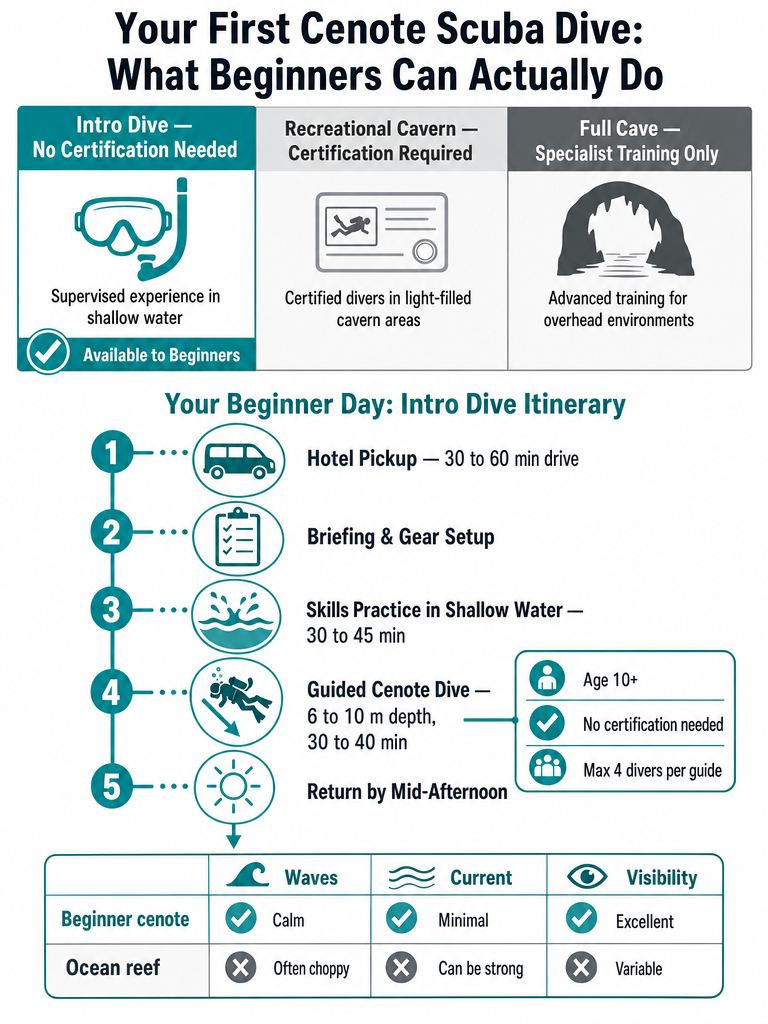
Here's where the confusion comes in. Discover Scuba in a shallow, open cenote is not the same as a certified recreational cavern dive, and neither is full cave diving. Xico Dive Center draws a sharp line: cenote scuba diving for certified divers is normally a guided cavern dive, not a Discover Scuba activity for non-certified guests. Both statements are true — they're describing different products.
So the honest answer depends on the exact experience:
- Discover Scuba in a beginner-friendly cenote: open to non-certified beginners, instructor-led, shallow.
- Recreational cavern dive: for certified divers, guided route, still within natural light.
- Full cave diving: specialized training and equipment only.
Tell Seth your experience level for a beginner-fit plan — Start Planning Your Dive
Do you need a certification to scuba dive in a cenote?
It depends on the activity. PADI Discover Scuba Diving requires no prior certification — beginners with zero experience can join a guided cenote dive (Source: Seth Dive Mexico). Certified recreational cavern dives generally require Open Water comfort and guide approval. Full cave diving requires specialized cave-diving training, equipment, and procedures.
Those three tiers matter more than any single cenote name. Cenotes like Dos Ojos, Chac Mool, and Chikin-Ha are often cited as beginner-friendly first-cenote routes for certified divers (Source: Xico Dive Center) — not as places a non-certified guest books a Discover Scuba try-dive. If you're already Open Water certified, those routes are the classic starting points once a guide checks your comfort with buoyancy, equalizing, mask clearing, and following a route.
If you've never dived, you're in the Discover Scuba lane instead, using a shallow, wide, well-lit cenote chosen for beginners.
| Activity | Certification needed | Who it's for |
|---|---|---|
| Discover Scuba (cenote) | None | First-timers, age 10+ |
| Recreational cavern dive | Open Water + guide approval | Certified divers |
| Full cave diving | Specialized cave training | Trained cave divers only |
The short version: a non-certified beginner does Discover Scuba, while a certified diver does a guided cavern route — two different products in the same cenotes.
To see whether Open Water is enough for the cavern routes, read whether you can dive cenotes with an Open Water card in Mexico.
What is PADI Discover Scuba Diving?
PADI Discover Scuba Diving is a beginner-level, instructor-led introduction to scuba for people with no experience — not a certification course. Yucatan Dive Crew describes it as a safe, guided introduction to the basic skills, breathing techniques, and sensations of diving, run under the close supervision of a PADI-certified instructor. There's no coursework, no online modules, and no homework beforehand.
It's designed for anyone curious about breathing underwater, whether you're testing the water before certifying or just want one unforgettable vacation dive. The program is available to anyone aged 10 and older who is in reasonable health and comfortable in water (Source: Seth Dive Mexico). Yucatan Dive Crew notes you may be asked to complete a brief medical questionnaire, and a "yes" answer can mean getting a doctor's clearance first.
You don't earn a card at the end, but many divers use Discover Scuba as the on-ramp to a full course. If that's you, see how to choose your first scuba diving experience.
Is cenote diving safe for first-timers?
A beginner-friendly cenote can be one of the calmest first-dive environments anywhere, but only when the site is chosen correctly. Beginner cenotes are selected for wide open spaces, shallow sections, calm water with zero currents, and natural light from the surface — the exact conditions that keep a first dive controlled (Source: Seth Dive Mexico). Casa Cenote, described by La Calypso DiveCenter as an open-air cenote in the middle of the mangrove with crystal-clear water, is a good example of that kind of open setting.
Not every cenote fits. Experienced divers on ScubaBoard have long cautioned that cenote dives can involve overhead and that they're not appropriate for most beginners without good buoyancy control — a warning that applies to deeper or more enclosed cavern routes, not a shallow, open, instructor-led try-dive.
That's the difference site selection makes. For a first Discover Scuba dive, beginners stay confined to the cavern zone, where natural light is always visible and a permanent guideline helps divers stay oriented.
Nervous about the whole idea? These tips to feel confident before your first dive help.
What happens during a Discover Scuba Diving day?
A Discover Scuba day is short, guided, and paced so you never move faster than you're comfortable. A typical Riviera Maya day runs from hotel pickup to a mid-afternoon return, with the actual underwater portion built on top of a shallow-water skills session. Yucatan Dive Crew says the overall experience usually runs around 2–3 hours of active program time.
Here's the sequence:
- Hotel pickup. Your instructor collects you anywhere from Cancun to Tulum. Seth Dive Mexico offers free hotel pickup across that zone.
- Drive to the cenote. The ride takes 30 to 60 minutes depending on your hotel location, and your instructor uses it to cover equipment, breathing, and hand signals.
- Briefing and gear setup. Equipment is fitted to your size — fins, mask, BCD, wetsuit. La Calypso DiveCenter runs a briefing before any water time.
- Shallow-water skills. In waist-to-chest depth, you practice breathing through a regulator, clearing your mask, equalizing, and buoyancy. This usually takes 30 to 45 minutes, and a good instructor won't move on until you're comfortable.
- Your guided dive. You descend into the cenote with your instructor beside you the entire time.
- Return. You're back at your hotel by mid-afternoon.
For the logistics of who does what, compare private vs group dive tours in the Riviera Maya.
How deep do beginners go on a cenote Discover Scuba dive?
Beginners typically explore around 6 to 10 meters on a cenote Discover Scuba dive, and the program caps depth at 12 meters (40 feet). Seth Dive Mexico gives the 6–10 meter working range and the 12-meter maximum; Yucatan Dive Crew independently confirms the roughly 12-meter (40-foot) limit for guided Discover Scuba dives.
The first real dive usually lasts about 30 to 40 minutes, and La Calypso DiveCenter lists a comparable 40-minute cenote dive that starts as shallow as 2 meters so you can settle in before going deeper.
Depth stays manageable partly because supervision is close. Guided beginner programs keep groups to no more than four divers per guide (Source: Seth Dive Mexico; La Calypso DiveCenter), and your instructor stays with you the entire time — often right beside you or holding your hand if needed.
Do I need to be a strong swimmer for Discover Scuba in the Riviera Maya?
No — you don't need to be a strong swimmer for Discover Scuba, but you should be comfortable in water. The program is open to anyone aged 10 and older who is in reasonable health and comfortable in water, and your gear keeps you neutrally buoyant so the water does most of the work (Source: Seth Dive Mexico). La Calypso DiveCenter phrases the requirement simply: you just need to know how to swim.
Basic health matters too. Yucatan Dive Crew notes participants may complete a brief medical questionnaire before diving, and answering "yes" to a health question can mean getting a doctor's clearance first. That's a standard screening step, not a long list of disqualifications.
If the idea of breathing underwater still makes you tense, that's normal for first-timers. The shallow-water skills session exists precisely so you build comfort before descending — and a good guide won't push you past your pace. Read 7 tips to feel confident before your first dive.
Is a cenote actually easier for first-timers than the ocean?
For many beginners, yes — a well-chosen cenote removes the variables that rattle new ocean divers. Beginner cenotes avoid waves, currents, and the limited visibility that can challenge first-timers in the sea, with visibility near Tulum reaching up to 40 meters and calm, still water throughout (Source: Seth Dive Mexico).
But easier doesn't mean identical. Xico Dive Center describes cenotes as a freshwater cavern environment with rock formations, light beams, and a quiet, almost meditative atmosphere — genuinely different from a reef. You may pass under rock overheads and swim through lower-light areas, which some people find magical and others find unfamiliar.
That's the real decision. If calm, glassy freshwater and dramatic rock formations sound appealing, a cenote is likely the easier and more striking first dive. If you'd rather have coral, fish, and open water overhead, a gentle reef dive may suit your nerves better.
| Factor | Beginner cenote | Ocean reef dive |
|---|---|---|
| Current | None (Seth Dive Mexico) | Possible |
| Visibility | Up to 40 m (Seth Dive Mexico) | Variable |
| Overhead | Some rock, cavern zone | Open water |
| Scenery | Formations, light beams | Coral, marine life |
For a fuller side-by-side, see cenote diving vs ocean diving key differences.
Can I go scuba diving in Tulum if I've never done it before?
Yes — you can scuba dive near Tulum with no prior experience through a guided Discover Scuba program. Beginners can explore cenotes near Tulum without certification, using shallow guided depths of 6–10 meters, visibility up to 40 meters, and water that stays around 24°C–26°C year-round (Source: Seth Dive Mexico). Beginner dives stay confined to the cavern zone, where natural light is always visible and a permanent guideline helps you stay oriented.
Those numbers make Tulum's cenotes a forgiving classroom: warm, clear, and current-free. The maximum depth for the Discover Scuba program is 12 meters, and groups stay at no more than four divers per guide.
If you're not staying in Tulum, the same beginner logic still applies. Travelers based in Playa del Carmen or Cancun can do the identical experience once transport is planned — Seth Dive Mexico offers free hotel pickup across that whole stretch. The cenote and pickup timing get matched to where you're staying.
To picture the dive itself, read what it's actually like to dive a cenote near Tulum for the first time.
How should mixed groups choose between Discover Scuba, snorkeling, and certified cavern dives?
Mixed groups work best when the itinerary matches each person's certification and comfort — nobody has to sit out. Non-certified guests can do Discover Scuba or cenote snorkeling, while certified divers in the same group follow a guided cavern route. A single cenote day can hold all three when it's planned that way.
Here's how the roles usually sort out:
- Complete beginners who want to dive: Discover Scuba, guided, capped at 12 meters.
- Non-divers who want in without scuba: cenote snorkeling near Playa del Carmen in open-air cenotes.
- Open Water divers: guided cavern routes — see the best cenotes for Open Water divers near Tulum.
- Advanced divers: deeper sites like The Pit or Angelita.
The key is a guide who plans one day around several skill levels rather than forcing everyone into the same dive. For how a family or couple can mix scuba with non-diving, read whether non-divers can join a cenote day with certified divers.
And before booking, it helps to understand the difference between cavern and cave diving so the certified divers in your group pick a route inside recreational limits.
What should you tell a guide before booking from Cancun to Tulum?
Give your guide the details that shape a safe, well-matched day, and you'll avoid the rushed, generic feel of a big group tour. The more specific your message, the better the cenote and pacing can be chosen for your group.
Include these when you reach out:
- Where you're staying — hotel, Airbnb, or villa location from Cancun to Tulum, so free hotel pickup and drive time can be planned (the ride runs 30–60 minutes depending on location).
- Your dates and how many days you want to dive.
- Ages in your group — Discover Scuba starts at age 10.
- Certification level, and for certified divers, your last dive date (a refresher may help if you're rusty).
- Any health or water-comfort concerns — this connects to the standard medical questionnaire.
- Whether you want private or semi-private pacing rather than a shared group.
Public detail on Seth Dive Mexico's exact Discover Scuba cenote price and full inclusion list is limited as of this writing, so ask directly for a quote tailored to your group. For how pricing is built from inclusions, see private cenote diving cost and what's included.
Send Seth your hotel, dates, and experience level for a custom recommendation — Start Planning Your Dive
Frequently asked questions
Can beginners do Discover Scuba in a cenote without any certification?
Yes — no certification and no prior experience are required for PADI Discover Scuba Diving in a cenote. The program is open to anyone aged 10 and older who is in reasonable health and comfortable in water. An instructor stays beside you the entire time, and depth is capped at 12 meters. It's a completely different product from the guided cavern dives designed for certified Open Water divers.
How deep do beginners go on a cenote Discover Scuba dive?
Most beginners explore 6–10 meters, and the program caps depth at 12 meters (about 40 feet). The first real dive runs roughly 30–40 minutes, and some sites start as shallow as 2 meters so you ease in gradually. Groups stay at no more than four divers per guide, with the instructor right beside you — or holding your hand — throughout the descent.
Is a cenote easier for first-time divers than the ocean?
For most beginners, yes. Well-chosen beginner cenotes have zero current, no waves, and visibility that can reach up to 40 meters — conditions that keep a first dive calm and controlled. The trade-off is that you'll swim near rock formations and may pass through lower-light areas, which some find magical and others find unfamiliar. If open water and coral sound more reassuring, a gentle reef dive may suit you better.
Do you need to be a strong swimmer for Discover Scuba Diving in the Riviera Maya?
Strong swimming isn't required, but you should be comfortable in water. Your buoyancy equipment keeps you neutrally suspended, so the water does most of the work. You may be asked to complete a brief medical questionnaire before the dive, and a 'yes' answer to any health question can mean getting a doctor's clearance first — a standard screening step, not a long list of disqualifications.
What happens during a Discover Scuba Diving day in the Riviera Maya?
Your instructor picks you up at your hotel — free pickup runs from Cancun to Tulum — and the drive to the cenote takes 30–60 minutes, used to cover gear and hand signals. You then spend 30–45 minutes practicing breathing, mask clearing, and buoyancy in shallow water before your guided cenote dive. The full active program runs around 2–3 hours, with a mid-afternoon return to your hotel.
Can a mixed group do Discover Scuba, snorkeling, and certified cavern dives on the same day?
Yes, when the day is planned around each person's level. Non-certified guests do Discover Scuba (capped at 12 meters, instructor-led), non-divers join cenote snorkeling in open-air sections, and certified Open Water divers follow a guided cavern route. The key is a guide who builds one itinerary around multiple skill levels rather than fitting everyone into the same dive. Sharing your group's certifications and ages when you book makes this straightforward to arrange.
Sources
- Book Discover Scuba Diving in a cenote | LaCalypso DiveCenterwww.lacalypsodivecenter.com
- Beginner divers, is cenotes too much? : r/scuba - Redditxicodivecenter.com
- Cenote appropriate for beginner? - ScubaBoardyucatandivecrew.com
- What is Discover Scuba Diving? - Yucatan Dive Crewwww.mexidivers.com