Can Non-Divers Join a Cenote Day With Certified Divers?
Non-divers can join a cenote trip as snorkelers, swimmers, surface guests, or Discover Scuba participants while certified divers do the cavern route.
Can non-divers join a cenote trip with certified divers?
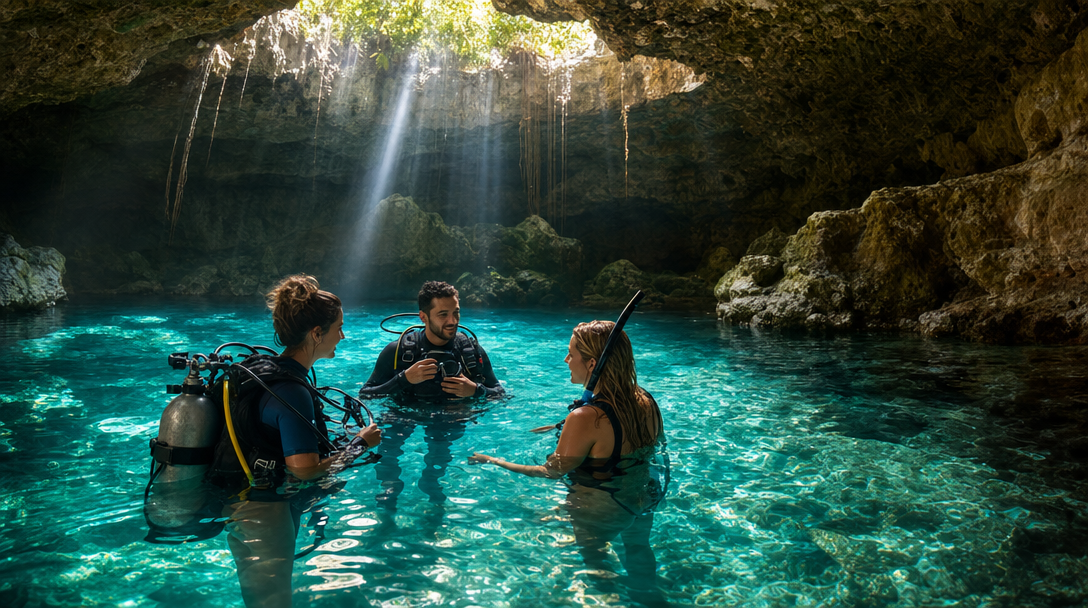
Non-divers can join the same cenote day as certified divers, just in a different role: snorkeler, swimmer, surface guest, or Discover Scuba participant rather than cavern diver. Aqua Core Adventures notes that many cenotes have an open-sky pool where snorkelers stay at the surface while divers drop into the cavern below, so a mixed group can share one site. Entrance fees run $150–$650 MXN per cenote depending on the spot (Source: Aqua Core Adventures).
The catch most operators gloss over: "joining" doesn't mean doing the same thing. A certified Open Water diver may run a guided cavern route. A non-certified companion stays in the open water, snorkels the surface, or tries a supervised shallow scuba experience where the site allows it. They share the cenote, the drive, and the lunch break — not the dive plan.
That distinction is what makes mixed-group days work or fall apart. A well-built itinerary keeps the diver inside cavern limits while the non-diver gets a full, unhurried experience in the same clear water.
Message Seth with your dates, hotel, and who's diving versus snorkeling for a plan that fits both.
What can non-divers do while certified divers are in the cenote?
While certified divers descend into a cavern route, non-divers have four solid options: snorkel the open-sky pool, swim in the calm shallows, relax at the surface in a life jacket, or try a supervised Discover Scuba session at a cenote that permits it. The Cenote Guy notes non-divers do not need any certification to explore cenotes — snorkeling, swimming, or enjoying the site from above all count.
Snorkeling is the strongest pick for most companions. The Cenote Guy calls it one of the best ways to see cenotes up close, because the clear, calm water makes rock formations and fish easy to spot without going deep. Cenote water also stays around 22–25 °C year-round, so it's comfortable for long surface time (Source: Aqua Core Adventures).
For someone who wants to actually breathe underwater, Discover Scuba is the answer — but only in shallow open cenotes. Cenote Dive Tour confirms a Discover Scuba session is available without certification, restricted to shallow open sites rather than cavern passages.
Many of these visitors aren't comfortable swimmers, and that's fine. The Cenote Guy notes life jackets are often available for added safety, which lets nervous companions float and watch without strain. If you're traveling with someone uneasy about water, our notes on feeling confident before your first dive may help calm the day before it starts.
Snorkeling vs Discover Scuba vs certified cavern diving in cenotes
Each person in a mixed cenote group fits one of three lanes, and they overlap only at the surface. Snorkelers and swimmers stay topside in open water. Discover Scuba participants go underwater in shallow open cenotes under direct instructor supervision. Certified Open Water divers run guided cavern routes inside the natural light zone. PADI splits cenote diving into open-water basins, guided cavern tours, and full cave dives, and your training decides which lane you're in.
Here's how the three experiences compare for a group booking together:
| Experience | Certification needed | Where it happens | Best for |
|---|---|---|---|
| Snorkeling / swimming | None | Open-sky pool, shallow surface | Non-divers, nervous swimmers, kids, families |
| Discover Scuba | None (instructor-led) | Shallow open cenotes only | First-timers who want to breathe underwater |
| Guided cavern dive | Open Water minimum | Natural light zone, within 130–200 ft of surface | Certified recreational divers |
Ko'ox Adventures lists a non-diver Discover Scuba experience at Casa Cenote with a maximum depth of 40 ft / 12 m, a class size of just 2, and no certification required (Source: Ko'ox Adventures). That's the ceiling for an introductory session — a guided cavern dive goes deeper and into overhead terrain a beginner isn't trained for.
The lanes share water at the surface but never share the dive plan. That's the rule that keeps a mixed day safe and unrushed for everyone. If you're sorting out which lane each traveler belongs in, our breakdown of how to choose your first scuba experience lays out the options side by side.
Do I need certification to dive in cenotes?
You need certification to scuba dive a cenote, but not to experience one. Non-divers can snorkel and swim with no card at all. To actually dive a guided cavern route, you need at least a PADI Open Water certification — and that's where non-diver access and scuba eligibility split apart.
For certified travelers, the good news is your Open Water card is usually enough. Seth Dive states that Open Water divers can dive many cenotes in Mexico on guided cavern tours, citing PADI that these tours stay within the natural light zone and within 130–200 ft (39–60 m) of the surface (Source: Seth Dive). A ScubaBoard contributor with over 1,000 dives put it plainly: "No. OW is all that is required" for a guided cavern dive.
What no recreational card covers is a non-certified person joining a cavern dive. That route stays off-limits until they train. The clean fix for a traveling pair: one dives the cavern, the other snorkels the same cenote, or the non-diver does a Discover Scuba session first.
If you hold an Open Water card and want the full eligibility rundown, our guide on diving cenotes with an Open Water certification covers which routes your training actually allows.
What is the difference between cavern diving and cave diving in cenotes?
Cavern diving stays in the natural light zone near the surface; cave diving goes past it into dark, overhead passages that demand specialized training. The line matters because a mixed group's certified diver belongs in the first category, never the second. Seth Dive states that recreational cavern tours stay within 130–200 ft (39–60 m) of the surface, while going beyond 200 ft (60 m), beyond the light zone, or through narrow passages crosses into cave-diving territory requiring full Cave Diver certification (Source: Seth Dive).
PADI is blunt about why this boundary exists: divers who enter overhead environments without the required training and equipment have diving's highest accident fatality rate (Source: PADI). The cenote's name doesn't decide whether you belong there — the route does.
For scale, Aqua Core Adventures notes the Quintana Roo Speleological Survey has mapped over 1,600 km of flooded passages in the region. A guided cavern tour touches only the lit, open edge of that system; the rest is reserved for cave-trained divers with redundant gear and dedicated certification.
A trustworthy operator matches your card to a cenote your training covers, then keeps you inside it. Our plain-language cavern vs cave diving guide for tourists walks through where one ends and the other begins.
How to experience cenotes for non-divers without feeling left out
Non-divers get a full cenote day through snorkeling clear, calm water, swimming relaxed shallows, floating with a life jacket, and choosing open-sky cenotes where divers drop into the cavern from the same pool. The Cenote Guy notes snorkeling is one of the best ways to see cenotes up close because the water is clear enough to show rock formations and fish without going deep.
The setup that prevents the "left behind" feeling is the open-sky pool. Aqua Core Adventures says many of the best snorkel cenotes have an open-sky pool where snorkelers stay at the surface while divers enter the cavern below — so the group is together, in the same water, doing parallel versions of the same experience.
Comfort helps too. Cenote water sits around 22–25 °C year-round (Source: Aqua Core Adventures), and the absence of waves or current makes it gentler than the open ocean for beginners or nervous swimmers. Life jackets are often available for anyone who wants extra buoyancy.
For families and first-timers, this is often the better day anyway — no certification pressure, no deep descent, just clear water and good light. Our best cenotes to snorkel near Playa del Carmen lists open-air sites that work well for surface visitors.
How do you choose a cenote that works for certified divers and non-divers?
Choose a mixed-group cenote by layout and comfort, not fame: you want an open-sky pool where snorkelers stay safely at the surface while divers enter the cavern, plus shallow beginner-friendly areas. Aqua Core Adventures confirms many top non-diver cenotes have exactly this structure — an open-sky pool above, cavern access below.
Three criteria do most of the work:
- Open-sky access. A site with a wide surface pool keeps non-divers in clear, lit water while the group's diver descends the cavern line.
- Shallow, calm sections. Look for gentle entry and shallow zones so nervous swimmers and Discover Scuba beginners stay comfortable. The calm, current-free water cenotes offer makes this easier than the ocean.
- A cavern route within recreational limits. For the certified diver, the route should stay inside the natural light zone and within 130–200 ft of the surface (Source: Seth Dive), so an Open Water card is enough.
Skip choosing by reputation alone. A famous deep cenote may suit an advanced diver but leave a non-diver with nothing safe to do nearby. The better question is whether one site serves both lanes at once.
Our local guide to the best cenotes near Tulum for diving and snorkeling helps you match sites to skill levels.
Which cenote examples fit mixed groups near Playa del Carmen and Tulum?
The cenotes that handle mixed groups best combine open-sky pools for snorkelers with cavern routes for certified divers. Ko'ox Adventures pairs Casa Cenote and Dos Ojos directly as a beginner-friendly day — try scuba at Casa Cenote, then snorkel Dos Ojos, no certification required (Source: Ko'ox Adventures). That combination is a clean template for a traveling pair.
Here's how common Riviera Maya sites map to skill levels:
| Cenote | Best for non-divers | Best for divers |
|---|---|---|
| Casa Cenote | Discover Scuba, mangrove snorkel | Easy open-water cavern entry |
| Dos Ojos | Surface snorkeling | Open Water cavern routes |
| Cenote Azul / Cristalino | Open-air snorkel pools | Shallow open-water dives |
| Gran Cenote | Calm snorkeling | Open Water cavern |
| The Pit | Limited (deep) | Advanced Open Water |
| Angelita | Limited (deep) | Advanced Open Water |
Dos Ojos suits Open Water divers, while The Pit and Angelita are deeper Advanced Open Water dives with very different moods — useful to know before pairing them with a non-diver who needs surface options nearby. Our guide on choosing between Angelita, The Pit, and Dos Ojos breaks down which fits which certification.
The pattern is simple: shallow open-sky cenotes work for everyone, while deep dramatic sites are diver-only and a poor base for a mixed day. For surface-focused companions, our best cenotes to snorkel near Playa del Carmen flags the open-air pools worth the drive.
Is a private cenote plan better for divers traveling with non-divers?
A private or semi-private cenote plan is usually the better fit for mixed groups, because a standard group tour locks everyone into one pace and one activity. When one person dives a cavern and another snorkels, a shared itinerary built around a single schedule tends to leave someone waiting, rushed, or doing an activity that doesn't match their comfort.
Private planning aligns the parts that mass tours treat as fixed: which cenote serves both lanes, how long the diver's window runs, when the snorkeler swims, and how pickup and transport work for everyone together. It also lets the guide brief the certified diver on the cavern route while keeping the non-diver comfortable at the surface — without the clock of a full boat.
This is the scenario competitor pages skip. They explain snorkeling or cavern rules in isolation, but rarely how to structure a day so a diver and a non-diver both leave happy.
Seth Dive Mexico builds private and semi-private cenote days with free hotel pickup from Cancun to Tulum, which removes the transport mismatch that breaks group bookings. Our comparison of private vs group dive tours in the Riviera Maya lays out the tradeoffs in pace, attention, and cost.
How much does a mixed cenote day cost when one person dives and one snorkels?
A mixed cenote day blends two cost layers: entrance fees per person plus the activity price for each lane. Aqua Core Adventures puts snorkel-friendly cenote entrance fees at $150–$650 MXN per site depending on the cenote (Source: Aqua Core Adventures). That fee applies to divers and snorkelers alike.
On top of entrance, the activity drives the rest. Ko'ox Adventures lists a non-diver Discover Scuba cenote-and-snorkel experience starting at $204 US$/person, run as a half-day trip with a maximum depth of 40 ft / 12 m and a class size of 2 (Source: Ko'ox Adventures). A pure snorkel companion typically costs less than a Discover Scuba session, since it skips the instructor-led scuba portion.
| Cost layer | What it covers | Source figure |
|---|---|---|
| Cenote entrance | Per-person site access | $150–$650 MXN |
| Non-diver Discover Scuba | Half-day, intro scuba + snorkel | From $204 US$/person |
| Certified cavern dive | Guided Open Water route | Varies by operator |
Exact mixed-day pricing depends on inclusions: gear, transport, guide ratio, and how many cenotes you visit. Public detail on a combined certified-diver-plus-snorkeler package price is limited, so confirm what's included before booking. Our breakdown of private cenote diving cost and what's included explains why inclusions matter more than the headline rate.
What should beginners and certified divers expect on the same day?
Both travelers should expect calm water, close supervision, and a shared rhythm that splits only at dive time. Cenote water stays around 22–25 °C year-round (Source: Aqua Core Adventures), so neither the snorkeler nor the diver faces ocean chop or cold. The day generally moves together — drive, briefing, water time — with the certified diver running a cavern route while the non-diver snorkels the same pool.
For the certified diver, expect a guided cavern tour inside the natural light zone, within 130–200 ft of the surface (Source: Seth Dive), led by a guide who briefs navigation, air management, and signals beforehand. For the non-diver, expect surface snorkeling, optional life jackets, and a Discover Scuba session only at shallow open cenotes that permit it.
Two safety points apply to everyone:
- Flight timing. Ko'ox Adventures instructs participants to wait 18 hours before flying after diving — plan your departure day around it.
- Minimum age. Ko'ox Adventures lists a minimum age of 10 years old for its non-diver cenote experience, useful for families weighing whether younger kids can join.
Don't expect every cenote to offer shore-watching for a non-diving spouse, or a guaranteed pairing of specific sites — that depends on the operator and the day. Public detail on exact pickup times and cenote pairings for any single mixed booking is limited, so confirm before you commit.
If anyone in your group is anxious about going under, our notes on what a first cenote dive near Tulum actually feels like set honest expectations before arrival.
Frequently asked questions
Can non-divers join a cenote trip with certified divers?
Yes — non-divers join the same cenote day in a different role: snorkeler, swimmer, or Discover Scuba participant rather than cavern diver. Many cenotes have an open-sky pool where snorkelers stay at the surface while certified divers descend the cavern route below. The group shares the water, the drive, and the day — just not the dive plan. Tell your guide each person's certification level before booking so the right site gets chosen.
What can non-divers do while certified divers are in the cenote?
Four solid options: snorkel the open-sky pool, swim calm shallows, float with a life jacket, or try a supervised Discover Scuba session at a shallow open cenote that permits it. Cenote water stays around 22–25 °C year-round with no current, making surface time comfortable for nervous swimmers. Discover Scuba goes no deeper than 40 ft / 12 m at qualifying sites and requires no certification — just an instructor-led session.
Do I need certification to dive in cenotes in Mexico?
No certification is needed to snorkel or swim a cenote. To scuba dive a guided cavern route, a PADI Open Water certification is the minimum required. That card covers tours that stay within the natural light zone and within 130–200 ft (39–60 m) of the surface. Cave diving — past the light zone or through narrow passages — requires full Cave Diver certification and is a separate category entirely.
What is the difference between cavern diving and cave diving in cenotes?
Cavern diving stays inside the natural light zone, within 130–200 ft (39–60 m) of the surface — the zone Open Water divers can access on a guided tour. Cave diving goes beyond the light zone, past 200 ft, or through narrow overhead passages, and demands full Cave Diver certification. PADI notes that divers who enter overhead environments without required training face diving's highest accident fatality rate. The route decides your category, not the cenote's name.
Which cenotes near Playa del Carmen and Tulum work best for mixed groups of divers and non-divers?
Open-sky cenotes with surface pools handle mixed groups best. Casa Cenote suits Discover Scuba beginners and offers easy open-water cavern entry for certified divers. Dos Ojos pairs surface snorkeling for non-divers with Open Water cavern routes below. Gran Cenote and Cenote Azul also offer calm snorkel areas alongside diveable passages. Deep sites like The Pit and Angelita are Advanced Open Water dives with limited surface options — a poor fit for a companion who isn't diving.
How much does a cenote day cost when one person dives and one snorkels?
Cenote entrance fees run $150–$650 MXN per person per site, applying to divers and snorkelers alike. A non-diver Discover Scuba intro at Casa Cenote and Dos Ojos starts at $204 US$/person for a half-day session with a maximum depth of 40 ft / 12 m and a class size of 2. A snorkel-only companion typically costs less than a Discover Scuba session since it skips the instructor-led scuba portion. Confirm exactly what gear, transport, and guide time are included before booking.
Sources
- Cenotes for a non cave diver : r/scuba - Redditwww.facebook.com
- Can You Dive Cenotes With Open Water in Mexico?www.instagram.com
- Do you need cave cert. to dive the Cenotes ? | ScubaBoardkooxadventures.com
- The Ultimate Cenote Experience for Non-Divers - Ko'ox Adventuresaquacoreadventures.com