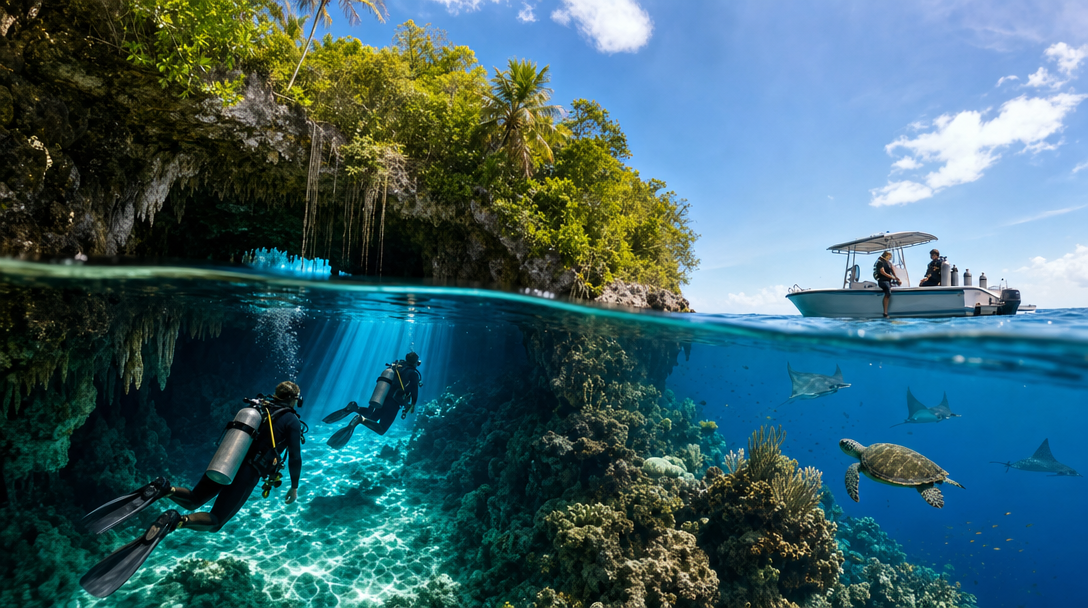
Cavern vs Cave Diving in Mexico: What Tourists Need
Learn cavern vs cave diving Mexico rules, certification needs, and safe cenote choices for your Riviera Maya trip with expert local guidance.
What Is the Difference Between Cavern and Cave Diving?
Cavern diving in a Mexican cenote is recreational overhead-environment diving that stays within the natural-light zone, where you can always see daylight from your position. Cave diving continues beyond that daylight zone into true technical territory that requires specialized training, redundant equipment, and dedicated cave certification.
The distinction matters because the two can share the same cenote entrance. At Dos Ojos, for example, a guided cavern route stays in the sunlit section, while a roped-off passage marked with skull-and-crossbones signs leads into the Yucatan Peninsula's deeper cave system — a place no vacation diver should enter without Full Cave Diver training. Beyond Diving Scuba puts it plainly: a cavern is still an overhead environment, but natural light remains the primary light source, and there is no decompression diving involved (Source: Beyond Diving Scuba).
For tourists diving cenotes in the Riviera Maya — Tulum, Playa del Carmen, Puerto Aventuras, Cancun, or day trips from Cozumel — "cenote diving" almost always means cavern diving, not cave diving. Reputable operators run cavern routes that stay within sight of daylight and follow permanent guidelines. If a guide or website implies you'll be doing real cave penetration on a standard tourist dive, that is either loose language or a serious red flag.
Can I Dive a Cenote in Mexico Without Cave-Diving Certification?
Yes — most tourists diving cenotes in Mexico do so without any cave certification, because the guided tours are cavern dives, not cave dives. What you need depends on whether you're certified at all, and at what level.
Here is the practical decision tree for Riviera Maya visitors:
| Your status | What you can do in cenotes |
|---|---|
| Non-certified traveler | Cenote snorkeling or a Discover Scuba program in a shallow, controlled cenote — no open-water cavern dive |
| PADI Open Water Diver | Most guided cavern dives at shallower cenotes (e.g., Dos Ojos, Chac Mool), with a qualified local guide |
| PADI Advanced Open Water Diver | All of the above plus deeper cenotes like The Pit (40 meters) and Angelita (30+ meters) |
| Cavern Diver certified | Guided cavern routes at a wider range of sites, still within daylight limits |
| Full Cave Diver certified | True cave penetration beyond the cavern zone, with appropriate gear and planning |
According to DivePoint Mexico, recreational divers without a cavern-diving certification can dive many cenotes in Mexico, as long as the dives stay within cavern limits under the supervision of a trained guide (Source: DivePoint Mexico). A Reddit scuba community thread echoes this cleanly: you do not have to be cave certified to dive cenotes — the difference is cavern vs cave (Source: r/scuba).
Is Open Water Certification Enough, or Do I Need Advanced Open Water?
For most tourist-friendly cenotes, Open Water certification is enough when you're diving with a qualified local guide. For deeper cenotes, you'll need Advanced Open Water. Some operators also set their own stricter rules on top of the agency minimums.
Here's why the advice online looks contradictory — it's measuring three different things:
- Agency minimums. PADI Open Water qualifies you to dive to 18 meters. That's enough for the shallower, daylight-zone cavern sections of many cenotes.
- Site depth. The Pit bottoms out around 40 meters and Angelita sits at 30+ meters, both well past Open Water limits — Advanced Open Water is required (Source: Seth Dive Mexico).
- Operator policy. Some shops apply stricter rules. Mexico Divers, for example, requires Advanced Open Water or previous cavern-diving experience for its Riviera Maya cavern and cave trips (Source: Mexico Divers).
If you hold only an Open Water card, you can still dive beautiful cenotes — you just won't be going to the deep-blue sites that make social-media highlight reels. Dos Ojos, Chac Mool, and Casa Cenote all work well for Open Water divers with a guide. The Pit and Angelita are Advanced-only, and that rule is not negotiable on a responsible dive.
What Do the Daylight Zone and Cavern Distance Limits Mean in Mexico?
The daylight zone is the section of an overhead environment where sunlight from the entrance is still visible to the diver. Cavern diving stays inside that zone; cave diving doesn't. The exact distance limit, however, is cited differently by different sources — which is why tourists get confused.
The three numbers you'll see published:
- 130 linear feet — The Cenote Guy cites OSHA as defining cavern diving as staying within the light zone, typically within 130 linear feet of the surface (Source: The Cenote Guy).
- 40 meters from the closest exit — DivePoint Mexico's working definition of the cavern zone (Source: DivePoint Mexico).
- 60 meters / 200 feet from open water — Cave Diving Adventures' and Scuba Total's definition (Source: Cave Diving Adventures).
These aren't really in conflict — they're conservative guidelines from different agencies and operators, all trying to keep recreational divers within sight of daylight and within a quick exit.
The only limit that matters on your dive is the route your guide has planned, briefed, and marked — you do not self-interpret distance underwater. Stay with the guide, stay on the approved cavern route, and stay where you can see natural light. Beyond Diving Scuba makes one more critical point: there is no cavern diving at night, because without daylight every cavern is effectively a cave (Source: Beyond Diving Scuba). Reputable operators in the Riviera Maya don't run night cavern dives for that reason.
When Does a Guided Cenote Dive Become Cave Diving Rather Than Cavern Diving?
A guided cenote dive crosses into cave diving the moment it leaves the daylight zone, exceeds recreational cavern limits, enters navigation-dependent passages, requires staged gas planning, involves restrictions, or adds decompression obligations.
In practice, you'll see visual markers well before that line. Mexican cave systems have permanent guidelines and warning signs — usually a skull-and-crossbones tag — placed at the boundary between cavern and cave zones. If your guide is doing the job correctly, you will never see the back of one of those signs on a tourist dive.
If an operator pitches a "cave adventure" to an Open Water or Advanced Open Water diver without requiring Full Cave certification, that's your signal to walk away. The Cenote Guy notes that cave diving requires advanced technical cave-diver certification and a minimum of 50 logged dives before training even begins (Source: The Cenote Guy).
Is Cenote Diving Safe for Vacation Divers?
Cenote cavern diving is a safe, well-established recreational activity when you stay within cavern limits, dive with a qualified guide, and respect a small number of specific risks unique to the overhead freshwater environment.
According to Diving in Mexico, five scenarios account for most cenote-diving incidents: silt-out from poor finning technique, divers getting lost past the daylight zone without cave training, running out of air, halocline disorientation at sites like Angelita and The Pit, and ear barotrauma from rapid depth changes in freshwater (Source: Diving in Mexico). Each has a practical behavior fix:
- Silt-out — use a frog kick or modified flutter, keep fins above the sediment, and never stand or kneel on the bottom.
- Getting lost — stay on the guide's line, keep the guide in sight, and never swim past permanent warning markers.
- Low air — check your gauge every few minutes; Diving in Mexico notes most cavern dives last 45 to 60 minutes, so you should plan a full turnaround on gas well before then.
- Halocline disorientation — the blurry layer where freshwater meets saltwater at Angelita or The Pit can wipe out visibility for a moment. Stay close to your guide, keep hands ready on your gauges, and hold position until the water clears.
- Ear barotrauma — equalize early and often, especially on the descent into deeper cenotes.
Beyond Diving Scuba also reminds divers that cenote formations took thousands of years to grow, and any damage is permanent (Source: Beyond Diving Scuba). Good buoyancy isn't just a safety skill — it's how you protect the place.
What Gear and Training Separate Recreational Cavern Diving From Technical Cave Diving?
Recreational cavern divers use standard scuba gear plus a light; technical cave divers use redundant systems, dedicated training, and line-handling protocols that take months to learn.
| Category | Recreational cavern diving | Technical cave diving |
|---|---|---|
| Certification | PADI Open Water or Advanced Open Water + local guide | Full Cave Diver (TDI, NACD, IANTD); Intro to Cave as a step |
| Tanks | Single tank | Double tanks or sidemount |
| Lights | One primary light, guide carries backup | Primary + two backup lights per diver |
| Exposure suit | 3–5mm wetsuit | 3–5mm wetsuit, often with hood |
| Navigation | Guide-led on permanent line | Diver-deployed reels, continuous guideline, line protocols |
| Gas planning | Standard recreational limits | Rule of thirds or stricter, staged decompression possible |
| Prerequisite dives | Varies by operator | Minimum 50 logged dives before training (per The Cenote Guy) |
Costa Rica Divers summarizes the equipment gap plainly: cave diving requires redundancy — double tanks or sidemount, redundant lights, stress management, and line protocols — that simply aren't part of a recreational cavern dive (Source: Costa Rica Divers). Technical agencies like TDI and NAUI run dedicated cave-training tracks that sit outside the PADI recreational pathway.
The short version: if a dive requires its own reel, a continuous guideline, or redundant gas, it isn't a cavern dive anymore — and it isn't part of a tourist itinerary.
Which Cenotes Are Best for First-Time Cavern Divers vs Advanced Divers?
Not every cenote is a diveable cavern — some are simply swimming holes, and others connect to cave systems that are off-limits to tourists. Choosing the right cenote starts with your certification.
Beginner-friendly cavern dives (Open Water):
- Dos Ojos — two connected cenotes near Tulum with bright light beams, shallow profile, and a well-trafficked cavern route. The gold standard for first-time cavern divers.
- Chac Mool — shallow, dramatic light effects, good buoyancy practice.
- Casa Cenote — open, almost estuary-like; excellent for nervous divers and very forgiving.
Advanced Open Water cenotes:
- The Pit — 40 meters deep with a hydrogen sulfide cloud around 30 meters that looks like an underwater mist (Source: Seth Dive Mexico).
- Angelita — 30+ meters with its famous underwater "river" created by the halocline (Source: Seth Dive Mexico).
For already cave-trained divers, the Yucatan offers some of the most complex cave diving in the world — Mayan Blue Cenote, Cenote Naharon, Cenote Jailhouse, Cenote Escondido, Cenote Sun, Mukhal Siphone, and the Battleship Room are all referenced in cave-survey literature, not tourist brochures. CINDAQ, the research organization behind much of that mapping, lists 6,674 survey stations for the area around Mayan Blue alone (Source: Cave Ha). That's context for how vast these systems are — not a tourist credential. If you're not Full Cave certified with logged Mexico experience, these sites aren't on your trip.
For a broader breakdown by site, our 10 Best Cenotes for Diving in Riviera Maya and Best Cenotes for Open Water Divers Near Tulum guides go deeper on each option.
Cenote Diving vs Ocean Diving — Which to Choose?
Cenotes and ocean reefs offer different experiences, and the better pick depends on your certification, comfort level, and what's happening with weather and sargassum during your vacation week.
| Factor | Cenote diving | Ocean diving (Riviera Maya / Cozumel) |
|---|---|---|
| Visibility | 100+ meters | 15–40 meters |
| Water temperature | 25°C year-round | 25–29°C seasonally |
| Currents | Minimal | Mild to strong (Cozumel drift) |
| Scenery | Stalactites, light beams, haloclines | Reefs, turtles, rays, tropical fish |
| Certification fit | Open Water and up (with site-appropriate matching) | Open Water to technical |
| Sargassum risk | None | Seasonal on some beaches |
Source for conditions: Seth Dive Mexico.
Cenotes win when ocean conditions are poor, when you want the most dramatic visibility of your life, or when strong currents would stress a newer diver. Ocean diving wins when you want marine life, drift diving, or the classic Caribbean-reef experience. Most vacation divers in the Riviera Maya do both during a trip — the logistics stack nicely, especially with hotel pickup covering Cancun down to Tulum. Our full Cenote Diving vs Ocean Diving: Key Differences guide compares them in more depth.
How Do You Choose and Book a Safe Cenote Guide in the Riviera Maya?
The cenote itself matters less than the guide running the dive. A good local guide plans the right site for your group, runs small ratios, briefs clearly, and never stretches the cavern boundary.
Questions to ask before you book:
- What is the guide's qualification? Cavern or Full Cave certified, with logged Mexico cenote experience — not just Open Water Instructor.
- Cavern or cave route? It should be cavern, within daylight, on permanent line.
- What is the group size and guide-to-diver ratio? Four divers to one guide is a reasonable cap for cenotes; smaller is better.
- What's included? Tanks, weights, lights, wetsuit, park fees, transport, water, snacks.
- What cenote are we diving, and why that one for my group? A good guide matches sites to certification, logged dives, and comfort level.
- How is transport handled? Free hotel pickup from Cancun to Tulum saves both money and vacation time.
- What happens if someone in the group is nervous or non-certified? The answer should include shallow-site options or cenote snorkeling alternatives.
Seth Dive Mexico runs private and semi-private cenote trips across the Riviera Maya with multilingual guidance, small group ratios, transparent inclusions, and free hotel pickup from Cancun through Tulum. If you're weighing private versus group pricing, our Private vs Group Diving Tours comparison lays it out honestly.
Ready to plan? Send Seth your travel dates, hotel or Airbnb location, each diver's certification level and logged dives, and whether anyone in the group is non-certified — you'll get a site recommendation that fits your group. Start Planning Your Dive.
Frequently asked questions
Do I need cave certification to dive cenotes in Mexico?
No — the guided cenote dives offered to tourists in the Riviera Maya are cavern dives, not cave dives, meaning they stay within the natural-light zone and don't require cave certification. A PADI Open Water certification is enough for many sites, while deeper cenotes like The Pit and Angelita require Advanced Open Water. A qualified local guide handles the route planning and keeps your group within the appropriate limits.
What is the minimum certification for diving The Pit or Angelita cenote?
Both The Pit (40 meters) and Angelita (30+ meters) require PADI Advanced Open Water certification at minimum, because their depths exceed the 18-meter Open Water limit. Operators apply this rule strictly — it's not negotiable on a responsible dive — so if you only hold an Open Water card, plan to dive shallower sites like Dos Ojos or Chac Mool instead.
How do I know if a cenote tour is safe for beginners?
Ask the operator three things before booking: whether the route stays within the daylight zone, what the guide-to-diver ratio is, and whether cenote snorkeling or Discover Scuba is available if anyone in your group isn't certified. A trustworthy operator will match the site to your group's actual certification level rather than put uncertified divers on a cavern dive.
Can non-certified travelers experience cenotes in Mexico?
Yes — cenote snorkeling and Discover Scuba programs in shallow, controlled cenotes are both open to non-certified travelers and make excellent first underwater experiences. These options don't require any prior training and are a legitimate way to see the cenotes without committing to a full certification course during your vacation.
Is hotel pickup included with cenote dive trips in the Riviera Maya?
It depends on the operator, but Seth Dive Mexico includes free hotel pickup across the full corridor from Cancun to Tulum, which removes one of the biggest logistical headaches for travelers staying at hotels, Airbnbs, or villas spread across the Riviera Maya. When you message to book, share your hotel or property location and it gets factored into your pickup time.
What should I tell a dive operator when booking a cenote trip?
Share your exact certification level (Open Water, Advanced Open Water, or higher), your total number of logged dives, the date of your most recent dive, your hotel or accommodation location, and whether anyone in your group is non-certified. That information lets a good guide choose the right cenote and briefing level for your group rather than defaulting to a generic itinerary.
Sources
- What is the difference between cavern and cave divingwww.beyonddivingscuba.com
- Cavern & Cave Diving Riviera Maya Mexico - Mexico Diversmexicodivers.com
- What is the difference between cavern vs cave diving in the cenotes?www.scubadavemexico.com
- Cavern vs. Cave Diving in Mexico: What’s the Difference?divepointmexico.com
- Cenote Diving Safety 2026 | Rules and Risksdivinginmexico.com