Cenote Angelita: Who Should Dive It and Who Shouldn't
Cenote Angelita suits calm Advanced Open Water divers with recent experience and good buoyancy; newer or rusty divers should choose an easier cenote.
Who Should Dive Cenote Angelita, and Who Should Choose a Different Cenote?
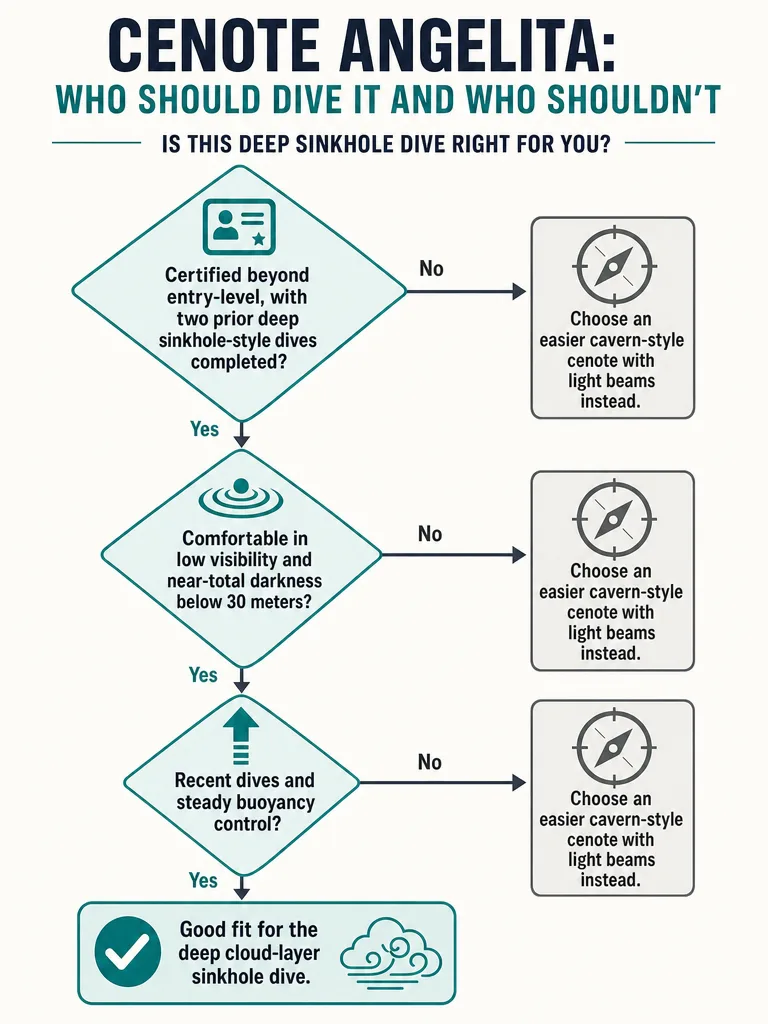
Cenote Angelita suits calm, buoyant Advanced Open Water divers with recent time underwater who are comfortable with darkness and shifting visibility. Newly certified divers, anyone who hasn't been in the water in a while, or divers who get uneasy when visibility changes suddenly typically have a better day at an easier, better-lit cenote.
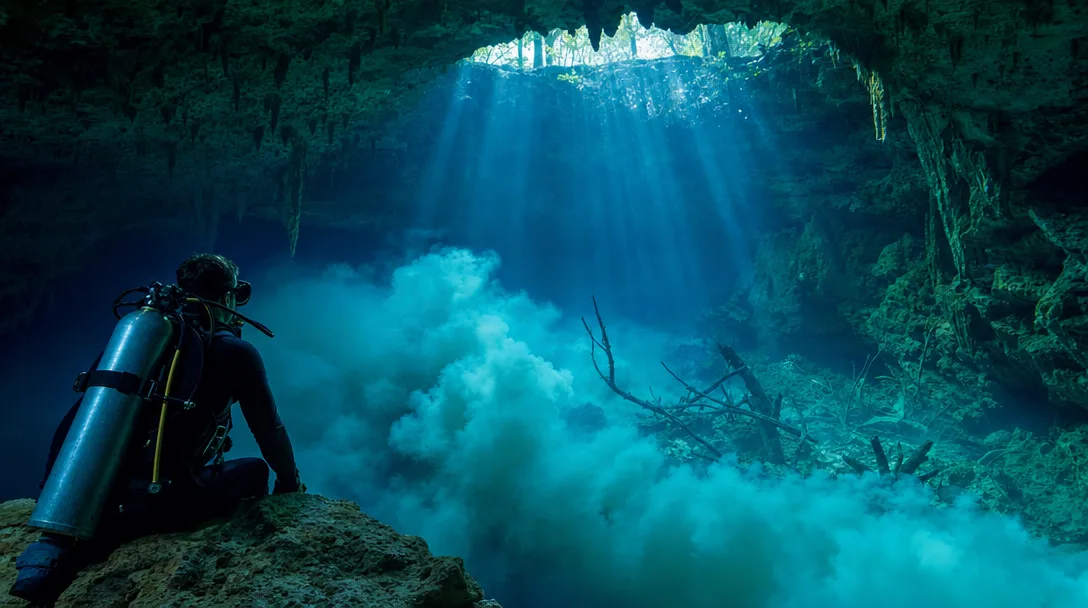
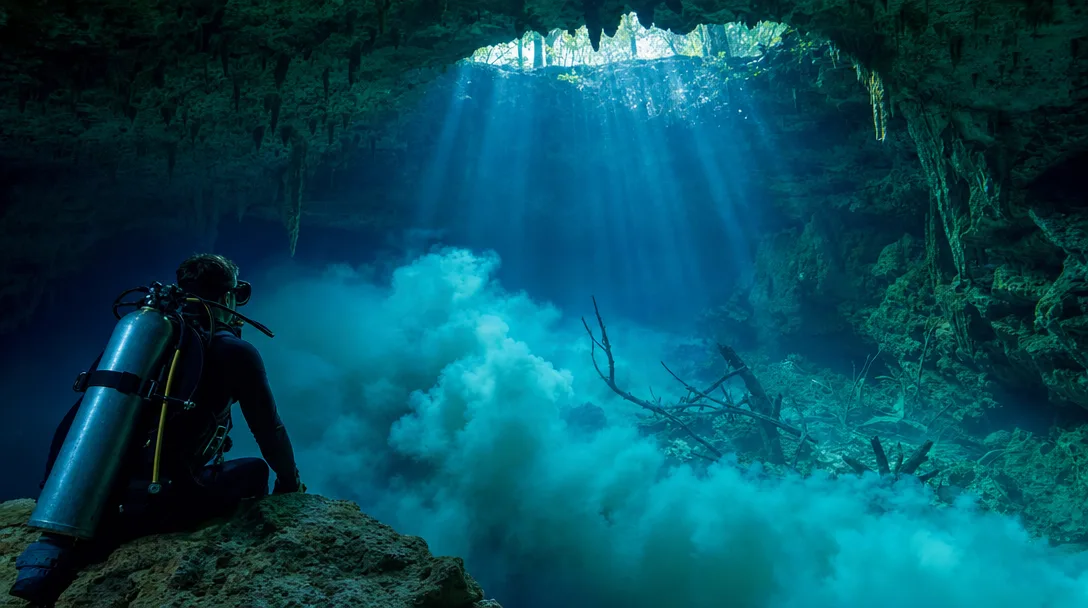
Cenote Angelita is a deep sinkhole south of Tulum built around a hydrogen sulfide cloud that Blue Life, a Riviera Maya cenote operator, places between 27 and 30 meters, splitting the water into a clear freshwater layer above and a dark saltwater layer below. The dive centers on a descent to that cloud and the debris island beneath it, a mound of fallen trees rising out of the haze, rather than on stalactite corridors or light beams.
Divers who love Angelita tend to share solid buoyancy control and genuine comfort at depth. A Facebook discussion among PADI-certified divers planning a Tulum trip groups Angelita with The Pit as "the deep ones," setting them apart from decorated, formation-heavy cenotes like Dreamgate and Nohoch, which one commenter said require buoyancy that's "really really good" before an operator will take divers in. If bright, photogenic formations are what you're picturing, a decorated cenote will likely give you a better vacation dive than Angelita will.
What Certification Do You Need to Dive Cenote Angelita?
Diving Cenote Angelita requires PADI Advanced Open Water certification. Blue Life and Ko'ox Diving, two Riviera Maya cenote operators, both list Advanced Open Water as the minimum credential for the site, tying the requirement to how deep the guided dive runs rather than to any optional add-on.
Blue Life goes a step further, saying local regulations classify Cenote Angelita as a level 3 dive, which means divers are expected to have already completed a level 1 and a level 2 cenote dive before attempting Angelita. That classification comes from Blue Life's own description of the site; the underlying regulation text itself isn't part of the research reviewed here, so treat the level 3 label as Blue Life's characterization of local rules rather than an independently confirmed regulation.
In practice, this means Angelita rarely works as a diver's first-ever cenote dive, even with an Advanced Open Water card already in hand. If you're still deciding whether Advanced Open Water is worth adding to your trip at all, is Advanced Open Water worth it for cenote diving breaks down which cenotes actually need it and which don't.
How Deep Is Cenote Angelita, and How Deep Do Guided Dives Actually Go?
Cenote Angelita's total depth depends on which operator measures it. Blue Life lists an absolute depth of 56 meters; Ko'ox Diving lists 60 meters. Neither figure is wrong so much as differently surveyed in an irregular sinkhole. What matters more for planning is the guided dive limit, which both operators cap well short of the bottom, and that number also differs by operator.
Blue Life keeps recreational Angelita dives at 30 meters, where the hydrogen sulfide cloud sits and natural light disappears. Ko'ox Diving takes divers slightly deeper, to 35 meters, and places the cloud itself at 25 meters with a halocline at 28 meters.
| Measurement | Blue Life | Ko'ox Diving |
|---|---|---|
| Total cenote depth | 56 m | 60 m |
| Guided dive limit | 30 m | 35 m |
| Cloud / halocline depth | 27-30 m (cloud) | 25 m cloud (3+ m thick), 28 m halocline |
| Average dive time | 35-45 minutes | 40 minutes |
No two operators quote Angelita's depth the same way, so treat any single number you read online as one operator's dive plan, not a universal fact about the cenote. Ask your guide which limit they use before you book. It changes how much of the dark layer below the cloud you'll actually see.
Beyond Certification: The Comfort Signals That Predict a Good Angelita Dive
Advanced Open Water certification tells you what a diver is legally allowed to do at Cenote Angelita. It doesn't tell you whether they'll enjoy it. The real difficulty lives in three things no certification card measures: how recently someone has dived, buoyancy control, and how their body reacts to a sudden drop in visibility.
Brenda Nelson, writing on PADI's blog about her own Angelita dive, described the moment her guide offered her a choice at the cloud layer: descend a few extra meters into the dark saltwater below, or hold above it and circle back. That kind of go-or-no-go moment is normal at Angelita.
"We would dive to 90ft to get to the gas layer, and then if I was comfortable with it we would dip below the clouds into the dark saltwater layer for a few moments."
No operator in the research publishes a formal readiness checklist for Angelita, so treat this as informed judgment rather than an official standard. If you haven't been diving recently, or you've felt panicky when visibility dropped to zero without warning, an easier cenote will give you a calmer, still memorable day.
What Does the Actual Dive to Cenote Angelita Look Like?
A guided dive at Cenote Angelita follows a fixed profile built around the hydrogen sulfide cloud, not a winding cavern route through stalactites. Divers descend through clear freshwater, reach the cloud and the debris island beneath it, then either hold at the cloud or continue into the dark saltwater layer below, depending on the operator and sometimes on the diver's own comfort in the moment.
- Enter by ladder at the surface platform, no jump required, and descend through the first several meters of freshwater, which can look slightly hazy near the top before clearing.
- Continue through glass-clear freshwater; Ko'ox Diving says visibility opens up dramatically a few meters below the surface.
- Reach the hydrogen sulfide cloud, which Ko'ox describes as more than 3 meters thick at 25 meters depth, and which Blue Life places between 27 and 30 meters.
- Pass the debris island, a mound of fallen tree branches that appears to rise out of the cloud like a small landmass.
- Decide, with your guide, whether to go below the cloud. Blue Life caps its Angelita dives at 30 meters, at the cloud itself, and says the water below is pitch-black with no natural light. Ko'ox Diving dives deeper, to 35 meters, crossing a halocline it places at 28 meters.
- Circle the sinkhole wall, check out small swim-throughs, then ascend and hold a safety stop before surfacing.
Total time underwater runs 35-45 minutes according to Blue Life, or about 40 minutes per Ko'ox Diving. That variability, some operators stop at the cloud, others take you through it, is part of what separates Angelita from a formation-based cenote, where the draw is stalactites and light beams rather than a decision about how far into the dark layer to go.
Cenote Angelita vs The Pit vs Dos Ojos: Which Fits Your Comfort Level?
Cenote Angelita and The Pit are grouped together by Tulum-area divers as the region's deep, advanced-only sites, distinct from decorated, formation-heavy cenotes and from classic cavern routes like Dos Ojos. A Facebook discussion among PADI-certified divers planning a Tulum trip lists Angelita and The Pit as the dives you "shouldn't miss" for depth, while steering divers who want swim-throughs and stalactites toward other cenotes instead. Detailed side-by-side specs for The Pit and Dos Ojos sit outside what this research confirms, so use this as a starting point for narrowing your choice, not a full comparison.
Diver Brenda Nelson's account of her own trip mentions booking dives at Angelita, Dreamgate, The Pit, and Dos Ojos across the same visit, which suggests operators in the area commonly pair a deep dive like Angelita with cavern-style sites for divers who want variety rather than one repeated profile.
For a deeper side-by-side on fit between these three sites, how to choose between Angelita, The Pit, and Dos Ojos walks through the decision by personality and comfort level, and what certifications let you dive The Pit covers that site's specific requirements in more detail.
What to Know Before You Book: Logistics and Extra Fees
Getting to Cenote Angelita means a short jungle walk after you park, not a beachside dock. Ko'ox Diving describes a roughly 150-foot path through the jungle from the parking area to the sinkhole, ending at a staircase and platform that lead straight into the water. Entry is by ladder, and no jumps are involved, which makes gearing up simpler than at some other cenotes.
Facilities onsite are basic: parking, restrooms, and tables for assembling equipment, but no food stalls, according to Ko'ox Diving. Pack a snack and water for after the dive.
Group size matters more here than at brighter cenotes. Blue Life caps its cenote groups, including Angelita, at 4 divers per guide, which keeps everyone within sight during the low-visibility stretch below the cloud.
Certification is only the entry ticket; how a specific trip gets planned around it is a separate question. Seth Dive Mexico, a Riviera Maya operator built around private and semi-private cenote trips with free hotel pickup from Cancun to Tulum, plans itineraries around each traveler's certification and recent dive experience rather than defaulting every booking to the same site. If you're wondering whether you need your own gear for cenote diving in Mexico, that's worth checking before you pack.
Frequently asked questions
Is the hydrogen sulfide gas at Cenote Angelita dangerous to breathe?
Divers are not at risk of acute hydrogen sulfide exposure at Cenote Angelita because scuba gear supplies compressed air rather than the ambient gas layer, according to diver discussion of the site. The cloud sits between roughly 25 and 30 meters depending on the operator, and its main effect on the dive is near-zero visibility, not toxicity, as long as you stay on your regulator and follow your guide's plan through that layer.
How far is Cenote Angelita from Tulum?
Cenote Angelita is about a 15 to 20 minute drive south of Tulum on the highway toward Chetumal, according to Ko'ox Diving and other operator accounts of the site. Most dive shops include transport in the booking, so you won't need to rent a car or find the jungle turnoff yourself. Seth Dive Mexico includes free hotel pickup from Cancun to Tulum on trips that include Angelita.
Can you snorkel at Cenote Angelita without scuba certification?
Yes, Cenote Angelita is listed as suitable for snorkeling as well as scuba diving by Ko'ox Diving. Snorkelers stay on the surface above the freshwater layer and won't reach the hydrogen sulfide cloud or debris island that certified divers descend to, so the experience is calmer but skips the site's signature feature. Advanced Open Water certification is required to see that layer firsthand.
What's the water temperature at Cenote Angelita?
Water at Cenote Angelita stays a fairly constant 24 to 25°C (75 to 77°F) year-round, according to Blue Life and Ko'ox Diving. That's noticeably cooler than the open ocean around Cancun and Cozumel, so most divers wear at least a 3mm wetsuit for comfort during the 35 to 45 minute dive. Bring exposure protection even if you're used to warmer reef diving elsewhere on the coast.
Are there crocodiles at Cenote Angelita?
Ko'ox Diving notes that a crocodile is occasionally seen near the entrance of Cenote Angelita, though it isn't a regular or guaranteed sighting. Guides check conditions and brief divers on entry procedure before every dive regardless of recent wildlife activity. If this concerns you, ask your guide about recent sightings before booking rather than assuming a crocodile encounter is common at the site.
Is Cenote Angelita usually booked as a single dive or paired with other cenotes?
Angelita is typically booked as one dive within a multi-cenote itinerary rather than a standalone trip. One published diver account describes booking Angelita alongside Dreamgate, The Pit, and Dos Ojos across a single Tulum visit, pairing the deep sulfide-cloud dive with cavern-style sites for variety. Seth Dive Mexico builds similar multi-cenote itineraries around a traveler's certification level and remaining vacation days.