Cenote Diving From Cancún 2026: Day Trip Costs and Times
Cenote diving from Cancún usually means a full day: 7:00 AM to 5:00 PM, about 1.5 to 2 hours each way, and $180 to $280 USD in 2026.
How long is a cenote diving day trip from Cancún?
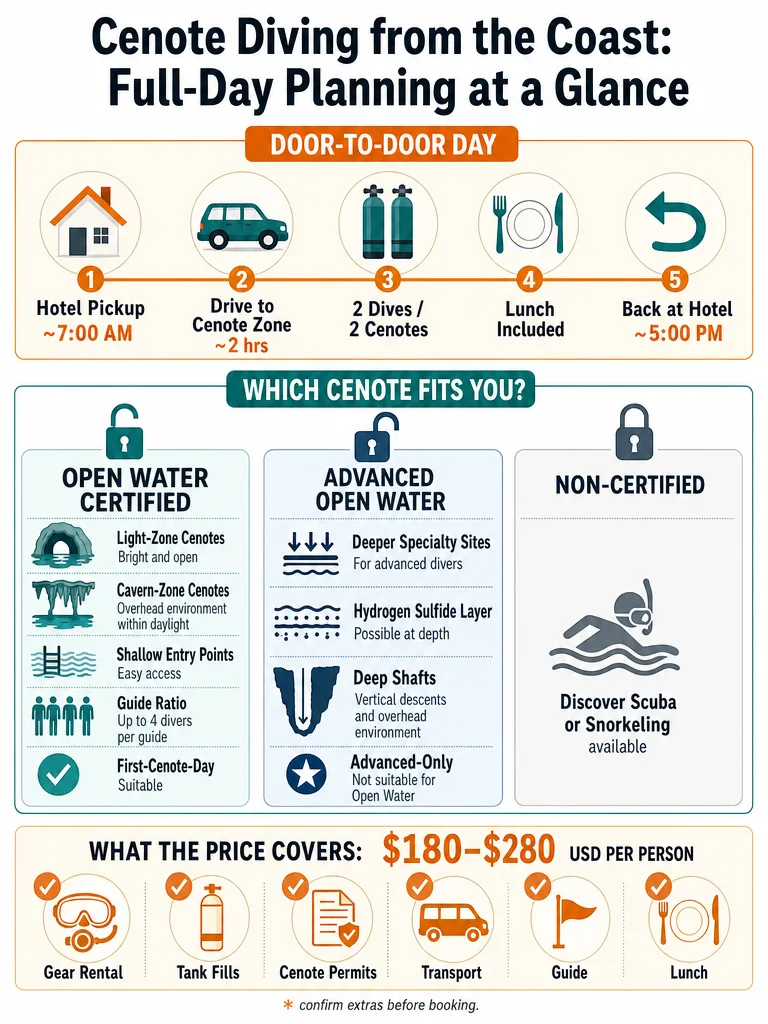
Plan on a full day, roughly 7:00 AM to 5:00 PM, when you dive cenotes from Cancún. The main cenote zone sits south of the city near Tulum, so the drive alone eats a big share of your daylight. Seth Dive's Cancún vs Tulum comparison puts the popular cenote zones about 1.5 to 2 hours away and roughly 135 km from Cancún, and Aquacore Adventures gives the same 2-hour drive with a typical 7 AM to 5 PM window for two dives at two cenotes plus lunch.
Some operators list shorter windows, which confuses first-time planners. Manta Divers Cancun runs its Cenote 2 Tank trip as a 6-hour day: check-in at the dive shop at 8:30 AM, back by around 3:00 PM. Vision Oceanos markets a shorter format at roughly 5 hours with a 7:00 AM Hotel Zone pickup, and lists each dive at 45 to 55 minutes.
Here's how to reconcile it. A "6-hour" clock usually starts at shop check-in, not at your hotel. Once you add hotel pickup, the drive south, two dives of 45 to 55 minutes each, a surface interval, and the return, the real door-to-door day lands close to full-day territory. That gap between advertised hours and actual time in your day is exactly what trips up people booking from a Cancún hotel.
Why do some Cancún cenote trips say half-day and others take all day?
The difference is almost always where the clock starts. A trip billed as "half-day" or "6 hours" usually counts from dive-shop check-in, while a "full-day" trip counts from your hotel door. With the cenote zone 1.5 to 2 hours south of Cancún per Aquacore Adventures, that starting point changes everything.
Four things stretch or shrink the day:
- Departure point. A shop check-in at 8:30 AM, like Manta Divers Cancun uses, skips the pickup leg. Hotel pickup, listed by Vision Oceanos at 7:00 AM, adds transfer time on both ends.
- Cenote location. Sites deeper into the Tulum corridor mean a longer drive than closer cenotes.
- Two-dive pacing. Two cavern dives of 45 to 55 minutes each need a surface interval between them.
- Lunch and return. Aquacore builds lunch and the transfer back into its 7 AM to 5 PM window.
A trip that advertises "6 hours" from a shop can still eat your whole day once you add pickup, drive, and the return leg to your hotel.
If you're staying in the Cancún Hotel Zone, how hotel pickup works for diving from Cancun to Tulum explains what changes when transport is handled door to door.
How much does cenote diving cost on average from Cancún in 2026?
Budget $180 to $280 USD per person for an all-inclusive two-cenote day from Cancún in 2026. Aquacore Adventures gives that range and describes it as covering gear, permits, sites, and lunch. Advertised operator rates cluster near the middle of that band.
Here's what the 2026 sources actually list:
| Operator / source | 2026 price | Format |
|---|---|---|
| Aquacore Adventures | $180–$280 USD | 2-cenote day, all-inclusive |
| Manta Divers Cancun | $220 USD | Cenote 2 Tank, 6 hr, gear included |
| Vision Oceanos | $240 USD | Two guided dives, all-inclusive |
Prices quoted in pesos read differently. Scuba Alux, based in Playa del Carmen, lists a double-tank Dos Ojos dive at $3,600 MXN, El Pit and Dos Ojos at $3,900 MXN, and Angelita plus Carwash at $4,300 MXN. Deeper, more technical pairings cost more.
For comparison, The Cenote Guy pegs shared group tours near Playa del Carmen at roughly $110 to $160 USD for two dives, with private trips costing more. Cancún-based rates run higher partly because the drive is longer.
Want a transparent quote with fees broken out and a realistic door-to-door timeline? Start Planning Your Dive by sending Seth your hotel and dates.
What should be included in a cenote diving price from Cancún?
A fair cenote price should fold in return transport, tanks and weights, a certified guide, cenote entrance fees, and lunch or snacks, so the headline rate matches your real vacation cost. The line item that most often lands as a surprise is the cenote entrance fee, paid in cash on site.
Manta Divers Cancun spells out a genuinely all-in package: return transport from the shop, cenote entrance fees, all scuba gear, wetsuit, bottled water, seasonal fruit, granola bars, and all taxes. Their note is blunt: you only need money for tips, photos, or souvenirs.
The Cenote Guy warns that quoted rates and final bills diverge exactly at these extras, and recommends asking for an itemized breakdown before paying a deposit.
Common extras to confirm before booking:
- Cenote entrance fees, often paid in cash on site
- Full gear rental beyond tanks and weights (wetsuit, mask, fins, BCD)
- Hotel pickup, which some operators surcharge and others include
- Nitrox, a small per-tank premium if you're certified
- Gratuity for your guide
If gear fit worries you, do you need your own gear for cenote diving in Mexico covers what's typically supplied and what's worth bringing.
Can I do cenote diving with only Open Water?
Yes, PADI Open Water is enough for many cenote dives from Cancún, as long as the dive stays in the light or cavern zone with a cavern-trained guide. Aquacore Adventures states the minimum for cavern cenotes is Open Water plus that guide, and defines the cavern zone as reaching up to 60 m from a permanent air and light opening, where you can always see the exit.
Manta Divers Cancun frames it the same way: their trips are cavern dives, not cave dives, so you stay inside the natural light zone with a clear, direct route to the surface. No cavern or cave qualification is required, but they add an important condition: you should be comfortable in the water and in control of your buoyancy, because the formations are fragile.
Open Water fit depends less on your card and more on your buoyancy comfort in an overhead environment.
Full cave penetration is a different world. That requires Intro-to-Cave or full Cave training through agencies like TDI, IANTD, or NACD, and it isn't a recreational activity. The line between the two matters for safety, and cavern vs cave diving in Mexico walks tourists through it. If you're weighing your card level, can you dive cenotes with Open Water in Mexico goes deeper on which routes stay within guided cavern limits.
Which cenotes from Cancún fit Open Water divers, Advanced divers, and first cenote days?
Dos Ojos and Casa Cenote suit Open Water divers and first cenote days, while Angelita and The Pit are Advanced Open Water sites because of depth. Aquacore Adventures organizes the common Cancún rotation by depth, which is the honest way to match a site to your certification.
| Cenote | Depth | Level | Good for a first cenote day? |
|---|---|---|---|
| Casa Cenote | 6–8 m | Open Water | Yes, easiest entry |
| Dos Ojos | 10 m | Open Water + cavern guide | Yes, classic light beams |
| Angelita | 30–40 m | Advanced Open Water | No, advanced only |
| The Pit | 40 m max | Advanced Open Water | No, advanced only |
Casa Cenote, also called Cenote Manatí, is an open-air mangrove channel with the easiest entry, which Aquacore calls great for your first cenote ever. Dos Ojos is two linked sinkholes at 10 m with the "laser beam" light effect when sun hits the halocline; a typical dive runs 40 to 45 minutes. National Geographic has featured its cave system.
Angelita is a circular sinkhole with a hydrogen sulphide cloud at 30 m that looks like an underwater river, listed at 30 to 40 m. The Pit reaches a 40 m maximum. Both need Advanced Open Water.
To pick between the headline sites, how to choose between Angelita, The Pit, and Dos Ojos sorts them by mood and level, and what cenote dive certifications let you dive The Pit covers the depth requirement in detail.
Can beginners do cenote diving from Cancún?
Beginners can experience cenotes from Cancún, but guided cavern diving is for certified divers, so non-certified travelers use different programs. The two beginner paths are Discover Scuba and snorkeling, which don't require a certification card.
Scuba Alux lists a Discover Scuba at Casa Cenote (one cenote dive) at $4,000 MXN, one supported example of a cenote-based try-dive for the uncertified. For a surface option, the same operator lists a Dos Ojos snorkel full tour at $1,800 MXN.
The distinction matters for mixed groups. Certified divers can follow a guided cavern route while beginners try Discover Scuba or snorkel the open pools nearby. If your group blends certified and non-certified people, can non-divers join a cenote day with certified divers shows how to structure the day so nobody sits it out.
If you're brand new and deciding what to book, two guides help: can beginners do Discover Scuba in a cenote explains the try-dive, and how to choose your first scuba diving experience compares Discover Scuba, snorkeling, and full certification for a vacation timeline.
Is cenote diving safe from Cancún?
Recreational cenote diving from Cancún is cavern diving, not cave diving, which is the core safety guardrail: divers stay in the light zone with a visible exit at all times. Manta Divers Cancun states its dives keep a clear, direct route to the surface throughout, and Aquacore Adventures defines the cavern zone as up to 60 m from a permanent light opening.
The guardrails that keep it recreational:
- Cavern, not cave. No penetration beyond line-of-sight of the exit. Full cave requires separate technical training through TDI, IANTD, or NACD.
- Light-zone limits. You can always see daylight and the way out.
- Cavern-trained guides. Aquacore requires Open Water plus a cavern-trained guide for cavern sites.
- Buoyancy control. Manta Divers stresses this because the formations are millions of years old and fragile.
- Small guide ratios. A Viator cenote listing caps its excursion at a maximum of 4 certified divers per guide, and Aquacore treats 4:1 as the operational ceiling.
Why the ratio matters in an overhead environment: a smaller group moves at a calmer pace, a guide can watch buoyancy more closely, and there's less silt kicked up to cloud the exit. That's harder to deliver on a packed cattle-boat tour.
Nervous before a first dive? Nervous about scuba diving? 7 tips to feel confident is built for that feeling.
Does cenote diving cost more than reef diving?
Cenote diving usually costs more per dive than local reef diving, mainly because of the longer transport, cenote entrance fees, and specialized cavern guides. The peso rates make the gap clear. Scuba Alux, based in Playa del Carmen, lists a double-tank Playa del Carmen reef dive at $2,600 MXN, while a double-tank Dos Ojos cenote dive runs $3,600 MXN, and El Pit with Dos Ojos hits $3,900 MXN.
Three things drive the difference:
- Transport. The cenote zone is 1.5 to 2 hours from Cancún, versus a short boat ride to reefs.
- Entrance fees. Cenotes charge on-site park fees that reefs don't.
- Guide specialization. Cavern-trained guides and tighter ratios cost more per person.
That said, USD-quoted Cancún cenote packages ($180 to $280 all-in) and reef days can overlap once you factor everything in. If you're deciding between the two experiences, cenote diving vs ocean diving: key differences breaks down conditions and value side by side.
How to choose the right Cancún cenote day before you book
Match the cenote day to your certification, your hotel location, and the sites you actually want, then confirm what's included before you pay. The single most useful move is sending an operator your dates, hotel, and experience level and asking for a door-to-door timeline plus an itemized price.
Run through this checklist:
- Certification. Open Water fits Dos Ojos and Casa Cenote; The Pit and Angelita need Advanced Open Water.
- Hotel location. From the Cancún Hotel Zone, expect a 1.5 to 2 hour drive each way, so plan a full day.
- Desired cenotes. Name the sites you want rather than accepting a set itinerary.
- Full-day timing. Confirm whether the quoted hours start at pickup or at shop check-in.
- Included fees. Verify cenote entrance fees, gear, tanks, weights, and lunch are in the price.
- Guide ratio. Look for a maximum of 4 divers per guide in an overhead environment.
- Water temperature. Cenotes run 24 to 25 °C, colder and fresher than the reef, so a 5 mm suit beats a shorty.
One note on exposure protection: your hotel-zone ocean will feel far warmer than the cenote. Our latest Playa del Carmen reading puts sea surface temperature at 30.2 °C as of August 29, 2026, roughly 5 to 6 degrees warmer than cenote water. Dress for the cenote, not the beach.
Still torn on where to base your trip? Best cenotes for Open Water divers near Tulum and the complete guide to cenote diving in Mexico help you narrow the list.
Frequently asked questions
How long does a cenote diving day trip from Cancún actually take?
Plan on a full door-to-door day, roughly 7:00 AM to 5:00 PM. The main cenote zone sits about 135 km and 1.5 to 2 hours south of Cancún near Tulum. Two cavern dives of 45 to 55 minutes each, a surface interval, lunch, and the return drive fill the day quickly. Operators who advertise '6 hours' typically start that clock at shop check-in, not your hotel — so add pickup time on both ends.
How much does cenote diving cost from Cancún in 2026?
Budget $180 to $280 USD per person for an all-inclusive two-cenote day from Cancún. Manta Divers Cancun lists their two-tank trip at $220 USD with gear, transport, and entrance fees included. Group tours near Playa del Carmen run $110 to $160 USD, but Cancún-based rates run higher because the drive is longer. Always ask for an itemized breakdown — cenote entrance fees are often paid in cash on site and left out of quoted rates.
Can you do cenote diving with just a PADI Open Water certification?
Yes — Open Water is enough for cavern-zone cenotes like Dos Ojos and Casa Cenote, provided you dive with a cavern-trained guide. The cavern zone extends up to 60 m from a permanent light opening, and you can always see the exit. Buoyancy control matters more than your certification level, since the limestone formations are millions of years old and fragile. Deep sites like The Pit (40 m) and Angelita (30–40 m) require Advanced Open Water.
Which cenotes near Cancún are best for first-timers vs. advanced divers?
Casa Cenote (6–8 m, open-air mangrove channel) is the easiest entry point and ideal for a first cenote ever. Dos Ojos (10 m, 40–45 min dives) suits Open Water divers and delivers the classic light-beam effect where sunlight hits the halocline. Angelita and The Pit — both past 30–40 m — require Advanced Open Water and are not appropriate for a first cenote day. Match the site to your certification before accepting any set itinerary.
What's included in a cenote diving price from Cancún, and what gets added on?
A solid all-in package covers return transport, tanks and weights, a certified cavern guide, cenote entrance fees, full gear (wetsuit, BCD, mask, fins), and lunch or snacks. Manta Divers Cancun explicitly includes entrance fees, all scuba gear, wetsuit, water, and seasonal fruit — leaving only tips and souvenirs to the diver. Common surprise add-ons elsewhere: entrance fees paid in cash on site, full gear rental, hotel pickup surcharges, and Nitrox premiums.
Can beginners or non-certified travelers do a cenote experience from Cancún?
Yes, through Discover Scuba or snorkeling — both skip the certification requirement. Scuba Alux lists a Discover Scuba at Casa Cenote at $4,000 MXN and a Dos Ojos full snorkel tour at $1,800 MXN. Mixed groups work well: certified divers follow a guided cavern route while non-certified guests try a try-dive or snorkel the open pools nearby. Guided cavern diving itself is reserved for certified Open Water divers and above.
Sources
- Cenote-Diving.com - All You SHOULD Know Before Going 2026 (with ...aquacoreadventures.com
- Scuba Diving in Cenotes - Playa del Carmen - Viatorwww.viator.com
- Cenote 2 Tank Cancun | Manta Dive & Snorkel Cancunwww.mantadivers.com
- Cenote Diving Cost in Playa del Carmen (2026 Guide)thecenoteguy.com
- Cenote Diving Cancún — 2 Dives | Vision Oceanoswww.tripadvisor.com