Cenote Snorkeling Tour: What’s Included and Who It’s For
Cenote snorkeling tour details: no certification, gear, lunch, water, snacks, towels, and hotel pickup from Cancun to Tulum for $90-150 pp.
What's Included in a Cenote Snorkeling Tour?
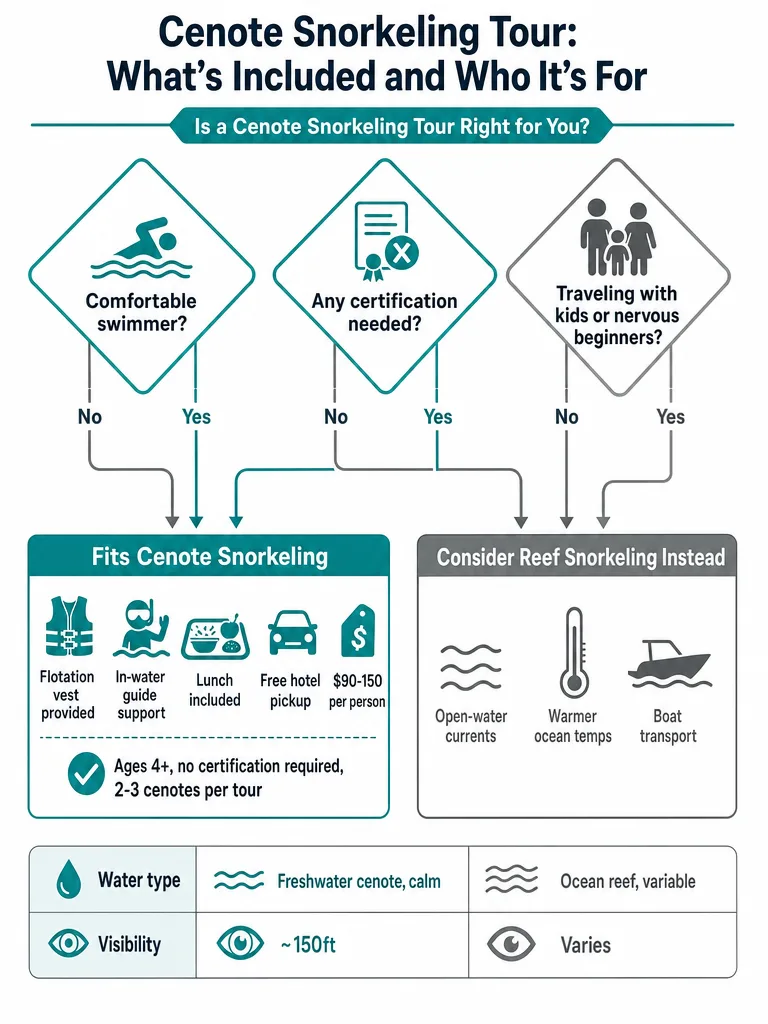
A cenote snorkeling tour needs no scuba certification, no diving experience, and no strong swimming skills, according to Seth Dive Mexico's tour page, which markets the trip as beginner-friendly for all ages. The core package bundles mask, snorkel, buoyancy vest, a private in-water guide, lunch, water, snacks, towels, and hotel pickup into one price of $90-150 per person.
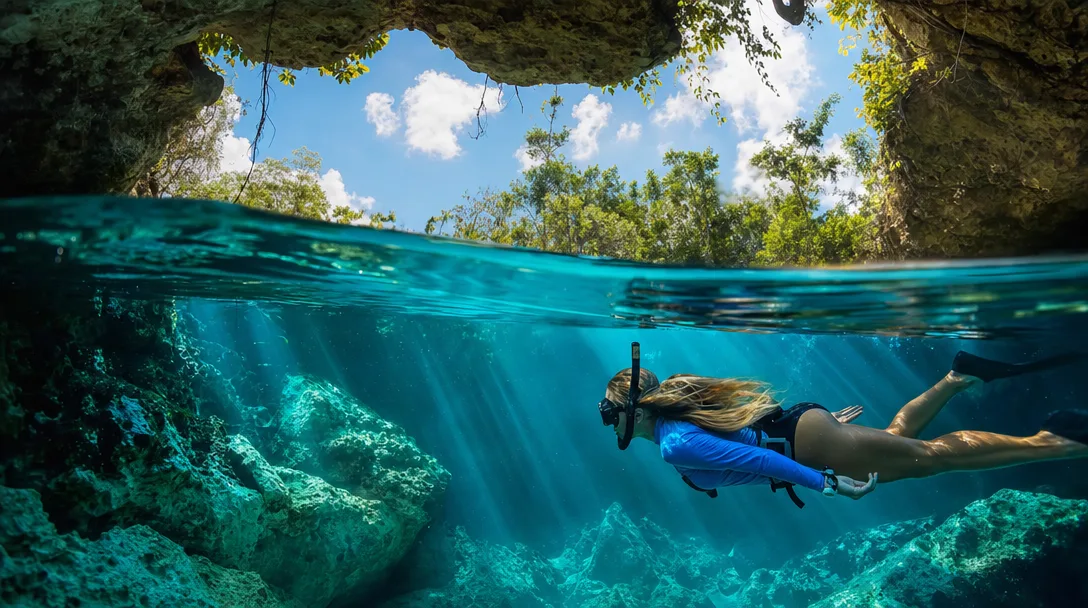
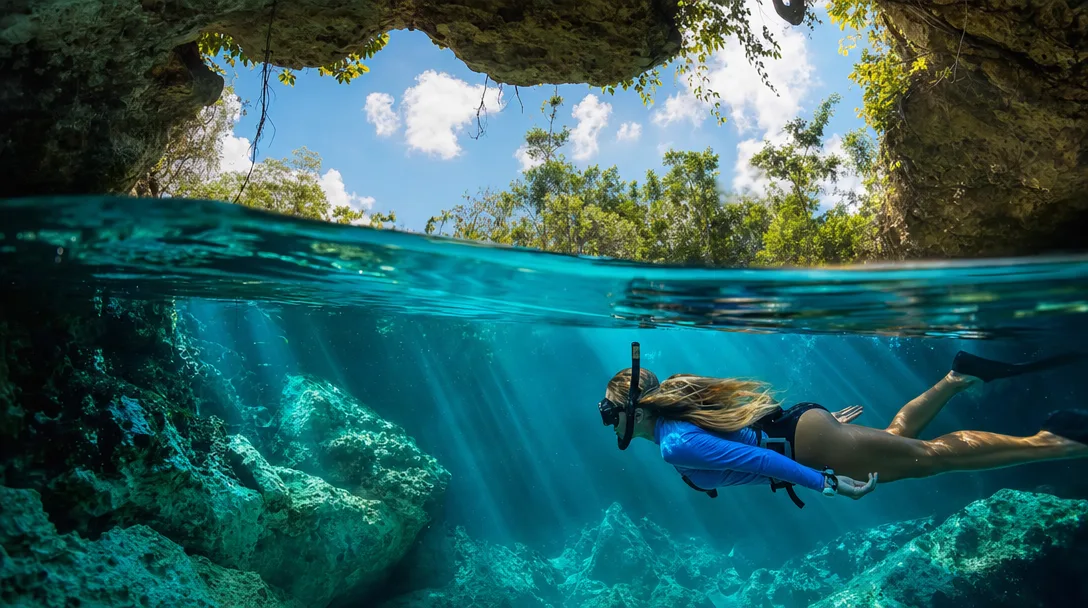
A cenote snorkeling tour is a guided snorkeling outing inside a freshwater sinkhole in the Yucatán jungle, not a trip in the open ocean. Seth Dive Mexico supplies mask, snorkel, fins, and a buoyancy vest for every guest, plus a private guide who stays in the water with you instead of watching from a boat. Water, snacks, and towels are included between stops, a traditional Mexican lunch fills the midday break, and free round-trip pickup covers hotels anywhere from Cancun to Tulum.
Seth Dive Mexico visits two to three cenotes on a single tour rather than one stop, mixing open jungle pools with partially enclosed caverns on the same day so guests see different lighting and rock formations without booking a second trip. The guide manages pacing between sites and helps anyone unsteady in the water, which is why the same tour works for grandparents floating next to grandchildren.
Do You Need to Know How to Swim to Snorkel in Cenotes?
Swimming ability isn't a requirement for cenote snorkeling, because a buoyancy vest keeps every guest floating at the surface while a guide stays in the water the entire time. The vest and the guide's positioning matter more here than they might at an ocean beach, since fresh water is less buoyant than salt water and most cenote operators require flotation for exactly that reason.
That gap between fresh water and salt water is a real physical difference, not a formality: without added flotation, freshwater sinkholes feel harder to stay level in than the water most travelers are used to at the coast. A vest closes that gap for non-swimmers, and a guide who stays alongside guests can adjust pace or offer a hand the moment someone feels unsteady. That combination is why complete non-swimmers, nervous first-timers, and young children can join the same trip as a confident swimmer without anyone feeling out of place.
Who Can Join: Age Limits and Certification Requirements
Age minimums vary by operator even though none of the major Riviera Maya cenote snorkeling programs require scuba certification. Private, small-group tours commonly set no formal minimum age, while the cenote-and-reef trip listed through PADI Adventures, run by Infinity2 Diving in Tulum, sets a minimum age of 10. Neither asks for prior certification or logged dives.
| Tour type | Minimum age | Swim requirement | Certification required |
|---|---|---|---|
| Private, small-group cenote tours | Children as young as 4 on many private trips | None stated; buoyancy vest and in-water guide typically provided | None |
| PADI Adventures cenote & reef trip (Infinity2 Diving, Tulum) | 10+ | Life jacket included; no swim test stated | None |
The gap in minimum age tracks with format. A private tour lets a guide adjust pace and attention around one family's youngest member, which is how young kids can join safely. The shared PADI Adventures itinerary mixes reef conditions into the same day and caps age at 10, likely because open-water reef snorkeling adds current and swell exposure that a freshwater-only cenote day doesn't carry.
Cenote Snorkeling vs. Reef Snorkeling: Which Fits Your Group First?
Cenote snorkeling sits in calm, current-free fresh water, while reef snorkeling depends on the day's wind, swell, and tide. That difference is the biggest factor when a group includes nervous swimmers or young kids. Cenotes are enclosed and shielded from wind and surf, so conditions stay consistent from morning to afternoon; ocean conditions along the Riviera Maya coast can shift from calm to choppy depending on the day's weather.
| Condition | Cenote snorkeling | Ocean/reef snorkeling |
|---|---|---|
| Currents | None; enclosed freshwater pools | Present; strength changes with wind, swell, and tide |
| Visibility | Generally clear and steady year-round | Varies day to day with weather and sediment |
| Overall predictability | Consistent regardless of season | Can shift from calm to rough on short notice |
For nervous swimmers, young children, or a first-time group, cenotes remove the one variable that makes ocean snorkeling unpredictable: the water itself. Reef snorkeling still wins on marine life variety on a good day, but it asks more of first-timers when conditions turn choppy.
Which Cenotes Will You Actually Visit?
Most private cenote snorkeling tours, including the itinerary outlined above, cover two to three cenotes in a single outing, pairing an open jungle pool with a partially enclosed cavern-style site so the light and scenery change between stops. The exact stops depend on the day's plan, but the same five names show up repeatedly across Riviera Maya tour itineraries: Dos Ojos, Cenote Eden, Casa Cenote, Siete Bocas, and Sac Actun.
Dos Ojos sits above one of the region's well-known cave systems, with water clear enough to reveal stalactites and stalagmites from the surface. Cenote Eden is shallower and calmer, a jungle pool surrounded by tropical gardens that tends to suit families with young kids. Casa Cenote is different again: an open-air mangrove system where sea turtles, tropical fish, and tarpon show up in the same swim. Siete Bocas takes its name from seven jungle openings that pour light into the water, creating the dramatic light beams photographers chase. Sac Actun is part of one of the longer known underwater cave networks in the region, and guests snorkel above its formations without entering the cave itself.
A three-cenote day mixing open pools with cavern-style sites gives a group more variety than any single cenote can offer on its own. The Riviera Maya has dozens more cenotes beyond these five, including Casa Tortuga, Cenote Azul, Cenote Cristal, Gran Cenote, Cenote Manati, and Xel-Há, each with its own character and crowd level.
What Should You Pack for a Cenote Snorkeling Tour?
Packing for cenote snorkeling splits into two short lists: gear the operator provides and a handful of personal items worth bringing yourself. Mask, snorkel, fins, buoyancy vest, and towels are typically supplied for every guest, so there's little need to pack snorkel gear or beach towels before the trip.
- Wear your swimsuit under your clothes so you're ready to snorkel at the first stop.
- Skip packing a towel if your operator provides one; a dry change of clothes is still worth bringing for the ride back, since cenote water runs noticeably cooler than the ocean.
- Pack a waterproof phone case or case-mounted camera if you want photos; cenote water and cave entrances are hard on unprotected phones.
- Rinse off lotions and sunscreen before entering where a site asks for it. Cenotes are closed freshwater systems and more sensitive to runoff than the open ocean.
For a longer packing rundown, including what to leave at the hotel, see the complete packing list for cenote snorkeling tours.
Private vs. Group Cenote Snorkeling Tours: What's the Real Difference?
The real difference between private and group cenote snorkeling tours is attention per guest, not just price. The PADI Adventures cenote-and-reef trip, run through Infinity2 Diving in Tulum, caps groups at a maximum of 6 divers per guide, while a separate private half-day cenote tour reviewed by The Cancun Guide lists group sizes running as large as 10 people sharing one guide.
| Tour type | Typical group size | Guide attention | Pacing |
|---|---|---|---|
| Private/small-group tours | Your party only | One guide focused on your group | Set by your comfort and interests |
| PADI Adventures shared trip (Infinity2 Diving, Tulum) | Up to 6 per guide | Shared among up to 6 travelers | Fixed schedule, sites set on the day |
| Larger shared group tours | Reported as high as 10 per group, per The Cancun Guide | Split across more guests | Fixed schedule, limited individual adjustment |
A private structure changes more than pacing. It's also what makes hotel pickup work smoothly across the Cancun-to-Tulum corridor, since a private guide can build the pickup and drop-off around one hotel instead of a shared shuttle stopping at multiple properties first. Families with a mix of ages, or a group that includes a non-diver, a non-swimmer, and a confident swimmer in the same party, tend to notice the difference most, since a shared group schedule can't slow down for one nervous swimmer without affecting everyone else's day.
Frequently asked questions
Is it better to book a cenote snorkeling tour directly with an operator or through my hotel?
Booking directly with a private operator usually gives clearer, all-in pricing than a hotel tour desk, which often marks up excursions or bundles them into vacation vouchers with restrictions. Seth Dive Mexico lists private cenote snorkeling tours at $90-150 per person, covering guide, gear, food, and hotel pickup in one price, so travelers can compare that figure directly against any hotel-desk quote before committing to either option.
Do I need to bring my own snorkel gear, or is it included in the tour price?
Mask, snorkel, fins, and a buoyancy vest are included in most cenote snorkeling packages, so packing your own gear isn't necessary. Some lower-cost tours hand out basic rental snorkels without a purge valve to clear water, which is why divers who already own a well-fitting snorkel sometimes bring it along for comfort. Full equipment is provided either way, and bringing your own remains optional rather than required.
How long does a cenote snorkeling tour usually take, start to finish?
A cenote snorkeling tour runs roughly five hours door to door, based on Tulum's PADI Adventures cenote itinerary, with about one hour of snorkeling per site. Multi-cenote private tours follow a similar rhythm, visiting two to three cenotes with time built in for lunch and hotel transport on each end. Plan to give up most of a morning or afternoon rather than expecting a quick one-stop outing.
Will I see sea turtles or other wildlife while snorkeling in a cenote?
Casa Cenote, an open-air mangrove system included on many multi-stop tours, is the site most likely to have sea turtles, along with tropical fish and tarpon moving through its jungle waterway. Most other cenotes are enclosed freshwater sinkholes without ocean species, so fish life there is sparser than on a reef. The main draw at those sites is water clarity, light beams, and cave formations rather than marine biodiversity.
Do I need a wetsuit for cenote snorkeling, and how cold is the water?
A wetsuit isn't necessary for cenote snorkeling, since the activity stays at the surface for roughly an hour at each site. Cenote water runs noticeably cooler than the ocean because it comes from underground freshwater rivers rather than sun-warmed seawater, so a rash guard and a dry change of clothes for afterward are worth packing even though full exposure protection isn't required.
Is a cenote snorkeling tour worth it if I'm staying in Cancun's Hotel Zone instead of Tulum?
Yes, a cenote snorkeling tour is worth booking from Cancun's Hotel Zone, since operators offering free round-trip pickup cover hotels anywhere between Cancun and Tulum rather than limiting service to properties near the cenotes. A private guide handles the drive, gear, lunch, and site selection as part of one flat price, so staying farther from the cenotes doesn't add separate logistics or cost for Cancun-based travelers.