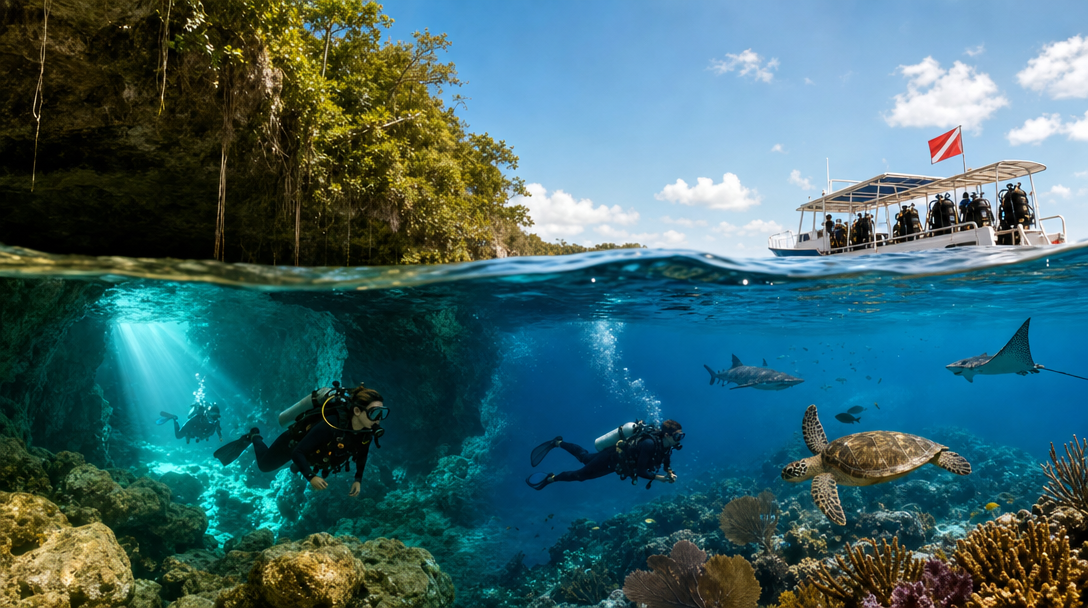
Cozumel vs Playa del Carmen Diving: Which Is Better?
Cozumel vs Playa del Carmen Diving: Which Is Better?. A practical guide to cozumel vs playa del carmen diving for Certified recreational divers vacationing
Cozumel vs Playa del Carmen diving: which is better for your trip?
Cozumel wins for classic ocean reef diving; Playa del Carmen wins for variety and convenience. Choose Cozumel if you want drift dives, walls, swim-throughs, and clearer water, where visibility often reaches more than 30 meters (Source: Xico Dive Center). Choose Playa del Carmen if you want a mainland base with reefs, cenotes, and seasonal bull sharks on the same trip.
That split matters because the two destinations answer different vacation questions. Cozumel is an island reef destination. Playa del Carmen is a coastal town that doubles as a launchpad for ocean dives, freshwater cenotes, and a famous shark season. One comparison source puts it cleanly: Cozumel is best known for its drift dives, walls, and unbeatable visibility, while Playa del Carmen offers bull sharks, wrecks, reefs, cenotes, and night dives all in one place (Source: Xico Dive Center).
If your trip is built around reef beauty alone, Cozumel is the stronger pick; if you want underwater variety from one home base, Playa del Carmen does more.
Most divers don't have to pick. Many stay in Playa del Carmen for easy reef and cenote access, then take a day trip to Cozumel for the drift diving (Source: Xico Dive Center). The rest of this guide breaks down each choice by skill level, dive goals, and trip length.
What's the difference between diving Playa del Carmen and Cozumel?
Cozumel is an island; Playa del Carmen is mainland. Cozumel sits in the Caribbean Sea off the eastern coast of Mexico's Yucatán Peninsula, opposite Playa del Carmen in the state of Quintana Roo (Source: Wikipedia). That geographic separation, not just reef quality, is what makes the two diving experiences feel so different.
A cenote is a freshwater sinkhole often connected to a cavern or cave system on the Yucatán Peninsula (Source: The Very Hungry Mermaid). Cozumel diving centers on saltwater reefs. Playa del Carmen diving centers on both saltwater and freshwater, because the cenotes sit a short drive inland from town.
The island itself is substantial. Cozumel is about 48 km long and 16 km wide, with a 2020 population of 88,626 (Source: Wikipedia). It's a self-contained dive destination, not an extension of the mainland coast. Its reefs are part of the Mesoamerican Barrier Reef System, the world's second largest coral reef system, protected inside Arrecifes de Cozumel National Park (Source: Wikipedia).
Playa del Carmen works differently. Its diving is commonly divided into reefs, cenotes, and bull shark dives, which gives you a mix of underwater experiences from one mainland base (Source: The Very Hungry Mermaid).
| Factor | Cozumel | Playa del Carmen |
|---|---|---|
| Type | Island, saltwater reefs | Mainland, reefs + freshwater cenotes |
| Signature dive | Drift dives, walls | Cenotes, bull sharks (seasonal) |
| Visibility | Often 30m+ | Varies by site |
How does Playa del Carmen compare to Cozumel for reef diving?
Cozumel is more widely praised for reef diving, but Playa del Carmen reefs still earn their place. Forum and travel sources lean toward Cozumel for ocean reef drama, while describing Playa's local reefs as solid for divers already in town. One ScubaBoard contributor put it plainly: reef diving is much more interesting and diverse in Cozumel, so for ocean diving people usually prefer the island (Source: ScubaBoard).
The opinions do conflict, and honesty matters here. One Facebook group comment claimed there's "nothing in Playa," while another argued the divide isn't that great, noting you'll see more fish and critters in Playa while Cozumel has nicer coral and swim-throughs (Source: Facebook scuba diving group). A travel guide split the difference: Playa's reef and wreck diving isn't as exciting as Cozumel's, but the sites aren't too crowded, the reefs are in good shape, and it's a great place to get certified or get your feet wet again after time out of the water (Source: The Very Hungry Mermaid).
Named Playa del Carmen reef sites in the corpus include Tortuga Reef, known for resident sea turtles, plus Sabalos Reef, Shangri-La, Tortugas, Jardines Reef, and Barracuda Reef off the coast of Xcaret (Source: Tofu Traveler; The Very Hungry Mermaid).
For pure reef quality the sources favor Cozumel; for convenient, uncrowded training-friendly reefs, Playa holds up. If you're unsure which suits your level, our Cozumel vs Playa del Carmen reef comparison goes deeper.
Should I stay in Playa del Carmen and day trip to Cozumel for diving?
Base in Playa del Carmen if you want cenotes plus a Cozumel reef day; base on Cozumel if reefs are your whole trip. Many divers choose the first route, staying in Playa del Carmen for easy access to local reefs and cenotes, then taking a day trip to Cozumel for its world-class drift diving (Source: Xico Dive Center).
The logic is about access. Cenotes are reachable by short drive when you're staying in Playa del Carmen (Source: Tofu Traveler), and Cozumel sits directly opposite the town across the Cozumel Channel (Source: Wikipedia). From a Playa base, you can mix freshwater and saltwater days without relocating.
Exact ferry schedules and current crossing prices change often, so confirm those close to your dates rather than trusting an old guide. Public detail on same-day timing varies by operator and isn't reliable to quote here.
If you're weighing where to sleep, our guide on whether a Cozumel day trip is worth leaving the Playa hotel zone and the Tulum vs Playa del Carmen town comparison both help. Send your hotel location and trip length, and we'll tell you which base saves you the most water time.
Is Playa del Carmen or Cozumel better for beginner divers?
Playa del Carmen is usually the calmer starting point for newer, rusty, or cautious certified divers. One travel source specifically calls Playa a great location to get certified, or to get your feet wet again after a while out of the water (Source: The Very Hungry Mermaid). Its local reefs run gentler and less current-driven than Cozumel's signature drift dives.
Cozumel can absolutely suit beginners too, but site choice matters more there. Palancar Reef, for example, is suitable for both newer and experienced divers and offers a variety of experiences across skill levels (Source: Tofu Traveler). The deciding factor is your comfort with drift diving and walls, since those are Cozumel's defining conditions.
Cenotes are a separate question driven by certification, not destination. Some cenotes are accessible to an Open Water Diver with a qualified guide, while others require Advanced Open Water or formal cave training, depending on the site (Source: The Very Hungry Mermaid). The dive must stay within guided cavern limits that match your training.
If nerves are the real issue, our notes on feeling confident before a dive and the best beginner dive spots in the Riviera Maya are good next reads. Not certified yet? Look at getting PADI Open Water on vacation.
When is Playa del Carmen the better choice for cenotes, bull sharks, wrecks, and night dives?
Playa del Carmen wins whenever you want more than reef diving on a single trip. Its non-reef draws are exactly what Cozumel can't offer: freshwater cenotes, a seasonal shark gathering, a dive wreck, and varied night dives, all from one mainland base (Source: Xico Dive Center).
Cenotes are the headline. Beloved Playa-area cenotes include Dos Ojos, Casa Cenote, and Chikin-Ha, with most dive centers also reaching sites farther out (Source: The Very Hungry Mermaid). The Pit pushes into technical territory, reaching depths of up to 394 feet (Source: Tofu Traveler), so it sits well beyond cavern limits for most recreational divers.
Bull sharks are the second big reason divers pick Playa over Cozumel. The seasonal bull shark dive runs from mid-November to mid-March, when pregnant bull sharks gather around Playa del Carmen (Source: The Very Hungry Mermaid). Barracuda Reef is one of the sites where divers meet them in season (Source: Tofu Traveler).
Beyond that, Playa offers the wreck of Mama Viña, an artificial reef full of marine life, plus night dives where octopus, bioluminescence, and hunting predators come out (Source: The Very Hungry Mermaid). Water stays divable year-round, between 25 ºC and 28 ºC (Source: The Very Hungry Mermaid).
If your wish list includes cenotes or in-season bull sharks, Playa del Carmen is the clear base. For deeper planning, see the 10 best cenotes for diving in the Riviera Maya, how to choose between Angelita, The Pit, and Dos Ojos, and our bull shark season guide.
What are the best dive sites in Cozumel to compare with Playa del Carmen?
Cozumel's standout sites are Palancar, Santa Rosa Wall, Punta Sur, and the C-53 wreck. These are the reefs that built Cozumel's reputation, all part of the Mesoamerican Barrier Reef System inside a protected marine park (Source: Wikipedia; Tofu Traveler).
The protection context is real and citable. Arrecifes de Cozumel National Park sits off the southern coast of Cozumel Island in Quintana Roo, covers 120 square kilometers, and was established on 07/19/1996 under President Ernesto Zedillo (Source: Wikipedia). The reef's fame goes back further: Jacques Cousteau named Cozumel one of the world's top diving destinations in 1961 after diving its coral reefs (Source: Cozumel Living).
| Cozumel site | What it's known for |
|---|---|
| Palancar Reef | Coral formations, swim-throughs; suits new and experienced divers |
| Santa Rosa Wall | Dramatic drop-off, sponges, splendid toadfish |
| Punta Sur | Reefs near the park's southern boundary |
| C-53 Felipe Xicotencatl | Scuttled Navy minesweeper wreck at ~82 feet |
The C-53 is an artificial reef created by a sunken former Mexican Navy minesweeper, sitting at a depth of 82 feet and home to grouper, barracuda, and schooling fish (Source: Tofu Traveler). Santa Rosa Wall is the classic drift wall, with turtles, nurse sharks, and eagle rays passing along the drop-off (Source: Tofu Traveler).
For a fuller breakdown of conditions and getting there, see our Cozumel reef diving guide.
Are there any unique marine species to see in Cozumel?
Cozumel's signature sightings are turtles, eagle rays, nurse sharks, tropical fish, and the endemic Cozumel splendid toadfish. Divers gliding along famous sites like Palancar, Santa Rosa Wall, and Punta Sur regularly encounter turtles, eagle rays, nurse sharks, and countless tropical fish (Source: Xico Dive Center).
The toadfish is the standout. Santa Rosa Wall features splendid toadfish, large sponges, and colorful corals (Source: Tofu Traveler), and the Cozumel splendid toadfish is endemic, listed as vulnerable by the IUCN (Source: Wikipedia). The protected reef ecosystem hosts more than 1,000 marine species, including loggerhead and hawksbill sea turtles and green turtles (Source: Wikipedia).
Playa del Carmen's marine life skews different. Its reefs deliver moray eels, turtles, lobsters, and colorful schools of fish, plus the seasonal bull sharks Cozumel doesn't get (Source: Xico Dive Center). One diver summed up the contrast well: you'll see more fish and critters in Playa, while Cozumel has the nicer coral and swim-throughs (Source: Facebook scuba diving group).
For endemic reef species and big drift-along encounters, Cozumel; for shark season and reef critters from a mainland base, Playa del Carmen.
Which itinerary works best if you want both Cozumel reefs and Riviera Maya cenotes?
Pair a Cozumel reef day with Playa del Carmen or Riviera Maya cenote days, and base on the mainland. This is the route many divers already take: stay in Playa del Carmen for local reefs and cenotes, then day-trip to Cozumel for the drift diving (Source: Xico Dive Center). It captures both signatures without choosing one over the other.
A simple split for a multi-day trip:
- Cenote day first. Ease in with a guided cavern dive like Dos Ojos that matches your certification (Source: The Very Hungry Mermaid).
- Cozumel reef day. Cross to the island for Palancar, Santa Rosa Wall, or Punta Sur (Source: Tofu Traveler).
- Specialty day, if in season. Add a bull shark dive between mid-November and mid-March, or a night dive on the Mama Viña wreck (Source: The Very Hungry Mermaid).
For deeper site decisions, lean on our Cozumel reef diving guide and the complete cenote diving guide for Mexico. Mixed group with non-divers? See whether non-divers can join a cenote day.
Logistics get simpler when the plan is built around your real starting point. Seth Dive Mexico handles free hotel pickup from Cancún to Tulum, so the itinerary works around your hotel, dates, and experience level rather than a fixed departure schedule.
Sources
- Scuba diving in Mexico: Playa del Carmen vs. Cozumel? - Redditwww.facebook.com
- Playa Del Carmen vs Cozumel | ScubaBoardxicodivecenter.com
- What is the Difference Between Diving in Playa del Carmen and ...theveryhungrymermaid.com
- The Ultimate Guide to Diving in Playa del Carmen, Mexico.www.tofutraveler.com
- Cozumel vs Playa del Carmen Diving in 2026: Which Has Better Reefs?divepointmexico.com
- Is Diving Better in Cozumel or Playa Del Carmen?www.reddit.com