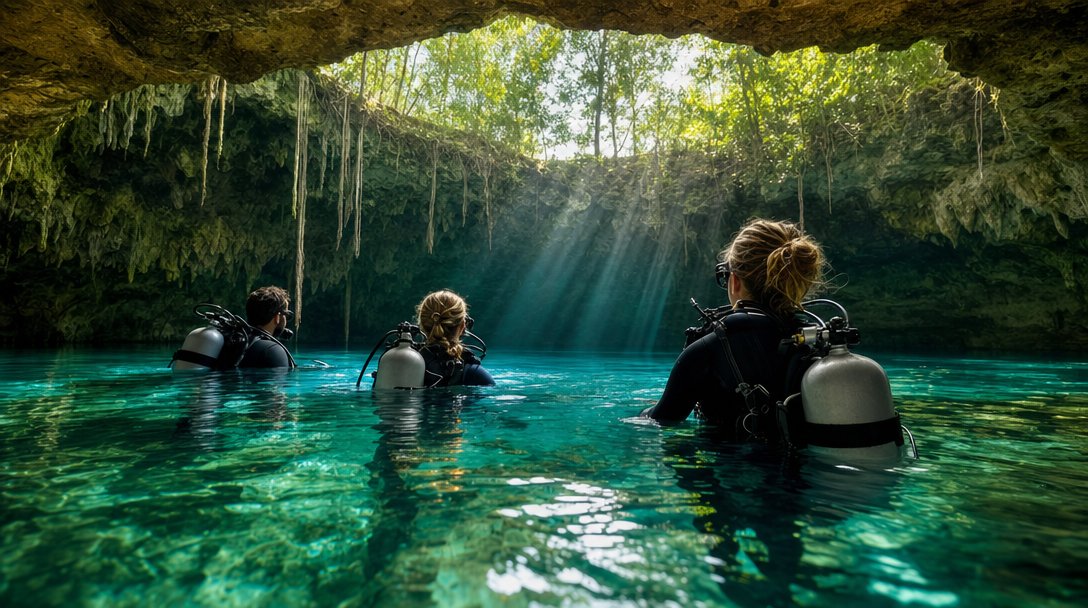
How Many Cenote Dives Can You Do in One Day?
Two cenote dives is the normal Riviera Maya day; a third is possible when certification, site pairing, guide pace, and transfer time all line up.
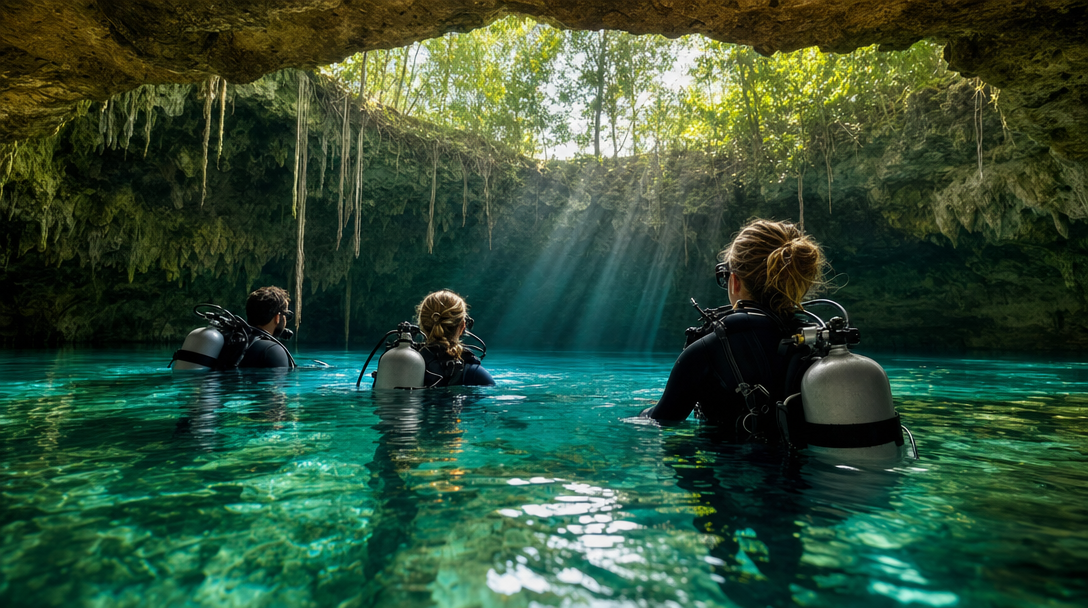
How many cenote dives can you do in one day in the Riviera Maya?
Two cenote dives is the normal full-value day in the Riviera Maya, and a third is only realistic when certification, site pairing, guide pace, and transfer time all line up. Aquacore describes a standard cenote day as a full-day trip with 2 dives at 2 different cenotes, lunch, and transfer, running roughly 7 am to 5 pm. Tank-Ha lists two or three cavern dives per trip depending on the category, with a typical 5–6 hours door-to-door.
Most vacation divers plan for two and come home happy. That pacing gives you real bottom time at each site, an unhurried surface interval, and enough energy to actually enjoy the second dive instead of grinding through it.
Only morning dives are possible at many cenotes because of entry time restrictions (Source: Tank-Ha), so the day starts early no matter what. The question isn't really "what's the maximum," it's "what fits your certification, your legs, and your drive time without feeling rushed."
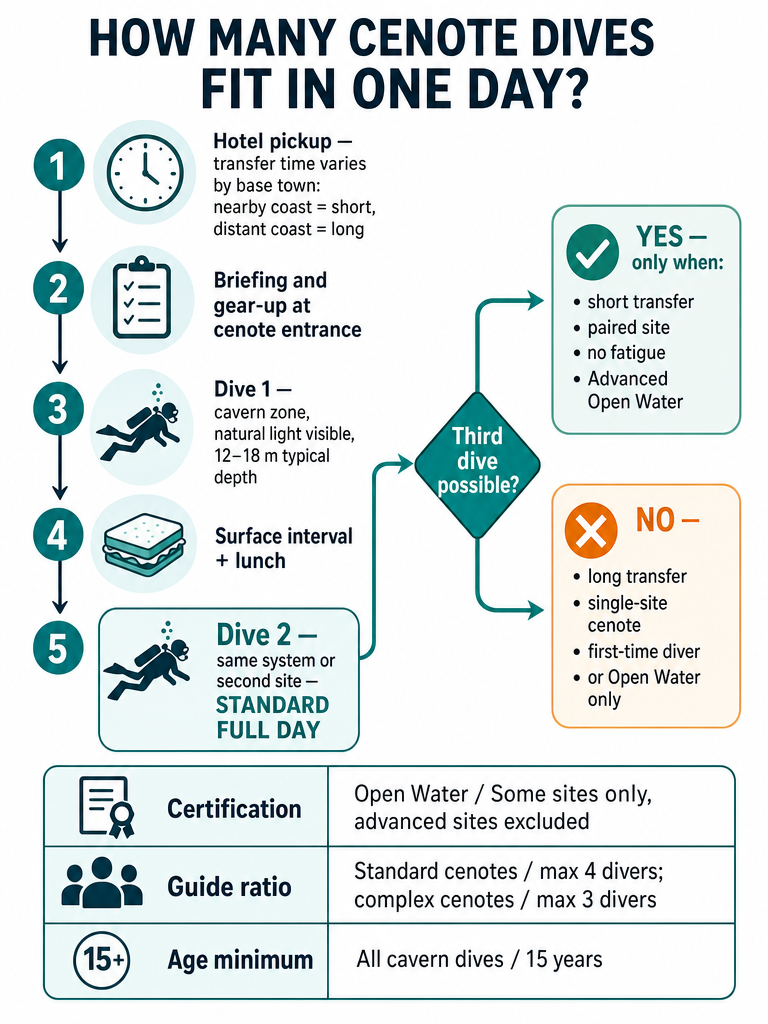
Can you do 3 cenote dives in one day?
Yes, three cenote dives in one day is doable, but it's not the default, and experienced divers openly warn about the third one. Tank-Ha says some cavern trips include two or three dives depending on the trip category. On ScubaBoard, one diver with 200 to 499 logged dives wrote that after three cave dives, "I was feeling wiped on the 3rd dive my skills weren't as sharp, i wouldn't do it again."
That matters more in a cenote than on a reef. Cavern diving asks for steady buoyancy, guideline discipline, and constant awareness of your exit. A tired diver on dive three has less margin for those things.
A third dive works best when a few things stack up: you're a strong, current diver, the sites are shallow and close together, your guide keeps the pace calm, and you're not burning half the day in transit. If any of those slip, two dives is the smarter call.
The third dive is where enjoyment and safety margin both drop, so treat it as optional, not standard.
For most certified vacationers, the honest answer is: book two, feel great, and leave the third for a future trip.
Is 3 cenotes in a day too much?
Three cenotes and three dives are not the same thing, which is where most planning goes sideways. On ScubaBoard, a scuba instructor pointed out that Dos Ojos and Chac Mool are usually done as two dives each, while Tajma Ha is a single-dive cenote. Try to hit all three named cenotes in one day and you're not planning three dives, you're planning a five-dive day.
That's why "three cenotes in one day" is often unrealistic even when three dives is fine.
| Cenote | Common dive count | Notes |
|---|---|---|
| Dos Ojos | Two dives | Usually run as its own two-dive site |
| Chac Mool | Two dives | Also typically a full two-dive stop |
| Tajma Ha | One dive | Commonly a single-dive cenote |
So a comfortable "three-dive day" usually means two dives at one system plus one at another, not three separate cenote destinations. Chasing three famous names adds drive time, entry fees, and gear-up cycles that turn a good day into an exhausting one.
If your heart is set on specific cenotes, tell your guide the names first. The right pairing beats the longest list.
What does a first cenote day actually look like?
A first cenote day is a morning-start, full-day outing built around two dives, transport, briefings, and a surface interval. Aquacore describes it as roughly 7 am to 5 pm with 2 dives at 2 different cenotes, lunch, and transfer. Tank-Ha puts the door-to-door duration at 5–6 hours for a two- or three-dive trip.
Here's the usual shape of the day:
- Pickup and drive. You head into the jungle toward the cenote zone; morning departures are standard because of entry time restrictions (Source: Tank-Ha).
- Briefing and gear-up. Your guide walks through the line route, hand signals, and cavern rules, then you kit up at the cenote.
- Dive one. Cenote cavern dives typically run 40–60 minutes (Source: Tank-Ha).
- Surface interval. Rest, water, and often a snack between dives.
- Dive two. A second cenote or a second route, with the same calm cavern pacing.
- Lunch and return. Aquacore's example includes lunch before the ride back.
Water sits around 24°C/77°F year-round in most cenote freshwater sections (Source: Blue Life), so a 5mm wetsuit keeps you comfortable across both dives. Group size is capped at a maximum of 4 divers per instructor (Source: Tank-Ha), so the day stays personal rather than crowded.
How does staying in Cancún, Playa del Carmen, or Tulum change the plan?
Where you sleep decides how much of your dive day is spent in a van. The Riviera Maya cenote corridor runs from Tulum up toward Puerto Morelos, with Playa del Carmen in the middle (Source: World Adventure Divers). Aquacore notes the drive from Cancún to the Tulum area cenotes is about 2 hours each way, which is a big chunk of a 7 am to 5 pm day.
That transfer time is the real variable behind "two dives or three."
| Base | Cenote access | Best fit |
|---|---|---|
| Tulum | Closest to the main cenote cluster | Cenote-only days, easy third-dive potential |
| Playa del Carmen | Central, short drives both directions | Mixed cenote and reef plans |
| Cancún | ~2 hr each way to Tulum area cenotes | Two dives; a third gets tight |
From Cancún, two dives fill the day comfortably and a third pushes things long. From Tulum or Playa del Carmen, you keep more hours underwater instead of on the highway. If you're weighing towns, our guide on diving from Tulum or Playa del Carmen and which is easier breaks down the drive-time tradeoffs, and how hotel pickup works from Cancún to Tulum covers the logistics if your stay is farther north.
Can I do cenote diving with only Open Water?
Open Water certified divers can do plenty of cenote dives, because recreational cenote diving happens in the cavern zone where natural light stays visible and the exit stays close. Blue Life confirms that when you book a cenote dive with a Riviera Maya operator, you're doing a recreational cavern dive, not a cave dive. The gate isn't cave training, it's depth and site complexity.
Shallower, well-lit cenotes suit Open Water divers well. Dos Ojos and Casa Cenote are commonly diveable at recreational depths, and Blue Life notes Casa Cenote as an exception that offers a non-cavern option. Deeper sites are a different story.
The Pit and Angelita go well beyond Open Water depth limits and call for Advanced Open Water plus experience.
Cavern dives are typically 12 to 18 meters (Source: Diving in Mexico), which sits inside Open Water range. But the moment a site pushes toward 30 meters or adds a demanding halocline, certification and comfort matter more.
If your dream list includes the deep, dramatic sites, read is Advanced Open Water worth it for cenote diving and how to choose between Angelita, The Pit, and Dos Ojos before you book. For daylight cavern routes, Open Water is often enough.
What certification do I need for cenote diving?
For standard cenote diving in the Riviera Maya, you need to be a certified recreational diver, not a cave diver, because these are cavern dives. Blue Life is clear: recreational cenote dives take place in the cavern zone, close to an exit, so a cave diving certification is not required. Cave diving is a separate form of technical diving that demands dedicated training.
The practical breakdown:
- Open Water Diver: enough for many daylight cavern-zone cenotes at recreational depths.
- PADI Advanced Open Water: opens up deeper sites like The Pit and Angelita where supported.
- Cave certification (NACD, TDI, IANTD): required only for true cave diving beyond the cavern zone, which is not what most vacation trips involve.
The line between cavern and cave is the whole safety story, and it's worth understanding before you book. Our explainer on cavern vs cave diving in Mexico and what tourists need lays out exactly where recreational diving ends.
If you're not certified yet, you're not out of luck: beginners can try Discover Scuba in a cenote, or earn PADI Open Water in Mexico with home study plus 2 dive days during your trip.
How deep can I dive in cenotes?
Recreational cavern dives in cenotes are typically shallow, around 12 to 18 meters (Source: Diving in Mexico), which keeps you well inside standard recreational limits. Tank-Ha lists a broader depth range of 7–30 meters / 20–100 feet depending on the specific cenote trip and your certification level. Depth, not distance, is what most often decides whether a site fits you.
Diving in Mexico is firm on the ceiling: you should not go deeper than 30 meters without Cave certification and proper gas planning. That limit exists because deeper cenote environments combine overhead conditions, haloclines, and reduced margin for error.
| Depth zone | Typical sites | Certification fit |
|---|---|---|
| 12–18 m | Most daylight cavern dives | Open Water Diver |
| Toward 30 m | The Pit, Angelita | Advanced Open Water |
| Beyond 30 m | True cave routes | Cave certification only |
Cavern diving also stays within 60 meters of a permanent air or light opening (Source: Diving in Mexico), so the surface stays reachable at all times. Depth is a big part of why site pairing matters: a deep site early in the day affects how a second or third dive should be planned.
Which safety limits matter most before adding a third dive?
Before you add a third cenote dive, the deciding factors are guide ratio, daylight-zone discipline, gas reserve, halocline conditions, and honest fatigue. These are the same rules that keep two dives safe, and they get harder to hold when you're tired.
Diving in Mexico's core cavern rules: never lose sight of natural sunlight, always stay with the guideline laid by the guide, and surface with at least 70 bar in reserve. Group size is capped at 4 divers per certified guide, dropping to 3 divers per guide at some more complex cenotes (Source: Blue Life). Smaller ratios mean closer supervision, which matters most late in the day.
Deep sites add their own wrinkle. At Angelita and The Pit, visibility can drop to zero for 5 to 10 seconds as you pass through the halocline (Source: Diving in Mexico). That's manageable when you're sharp and briefed, less so when you're on your third tank and your buoyancy is slipping.
If any single limit feels tight, gas reserve, ratio, daylight, or your own focus, that's your signal to stop at two. A calm two-dive day protects both your safety margin and your vacation.
Not sure where your comfort level lands? Tell Seth your certification, logged dives, and the cenotes you're eyeing, and he'll build a pace that keeps every dive enjoyable.
Frequently asked questions
How many cenote dives can you do in one day in the Riviera Maya?
Two cenote dives is the standard full-value day — one at each cenote, with a proper surface interval between them. Operators like Tank-Ha structure trips as two or three cavern dives running roughly 5–6 hours door-to-door. A third dive is possible but depends on your certification, the sites chosen, and honest fatigue. Most vacation divers book two, enjoy both, and leave feeling great rather than wrung out.
Can you do 3 cenote dives in one day?
Three cenote dives in one day is doable, but experienced divers openly caution against it. One diver with 200–499 logged dives wrote on ScubaBoard: 'I was feeling wiped on the 3rd dive, my skills weren't as sharp, I wouldn't do it again.' In cavern environments — where buoyancy, guideline discipline, and exit awareness matter constantly — fatigue on dive three carries real consequences. Treat a third dive as optional, not standard.
Is trying 3 cenotes in one day too much?
Three cenotes and three dives aren't the same thing. A scuba instructor on ScubaBoard noted that Dos Ojos and Chac Mool each typically require two dives, while Tajma Ha is a single-dive cenote — meaning three named cenotes could mean a five-dive day. Drive time, entry fees, and gear-up cycles add up fast. A smarter approach: pick two contrasting cenotes and do them well instead of chasing the longest list.
What does a typical cenote dive day actually look like from start to finish?
Expect a full-day outing running roughly 7 am to 5 pm. Morning departures are mandatory at most cenotes due to entry time restrictions. The day follows: pickup and jungle drive, guide briefing and gear-up at the cenote, dive one (typically 40–60 minutes), a surface interval with water and snacks, dive two at a second route or cenote, then lunch and the ride back. Water stays around 24°C/77°F year-round, and groups are capped at 4 divers per instructor.
Do I need cave diving certification for cenote diving in the Riviera Maya?
No cave certification is needed for recreational cenote diving. When you book a cenote dive with a Riviera Maya operator, you're doing a cavern dive — staying in natural light, near spacious exits, and within recreational depth limits. Cave diving is a separate technical discipline requiring dedicated training. Open Water certification covers most daylight cavern cenotes; Advanced Open Water opens up deeper sites like The Pit and Angelita.
How does where I'm staying — Cancún, Playa del Carmen, or Tulum — affect my cenote dive day?
Location determines how much of your day is spent in a van. The drive from Cancún to the Tulum-area cenote corridor is about 2 hours each way — a significant chunk of a 7 am to 5 pm day. From Tulum or Playa del Carmen, transit is much shorter, which makes a third dive more realistic and keeps more time underwater. If you're staying anywhere from Cancún to Tulum, free hotel pickup is available — just share your hotel name when you reach out.
Sources
- Beginner divers, is cenotes too much? : r/scubaworldadventuredivers.com
- 3 Cenotes in a day..www.facebook.com
- Stunning cavern dives in Cenotesaquacoreadventures.com
- Cenote Diving Cancún — What Your First Cenote Day Actually Looks Likedivinginmexico.com
- Cenote Diving Safety 2026 | Rules and Riskswww.reddit.com