Is Advanced Open Water Worth It for Cenote Diving?
Advanced Open Water for cenote diving is worth it if The Pit or Angelita is on your list; Open Water already covers many daylight cenote dives.
Is Advanced Open Water worth it for cenote diving?
Advanced Open Water is worth it for cenote diving when your goal is deeper Riviera Maya sites like The Pit or Cenote Angelita. Open Water already covers most daylight cavern-zone cenote dives, so AOW is not mandatory for every site. Seth Dive Mexico caps Open Water divers at 18 meters (60 feet) and Advanced divers at 30 meters (100 feet) (Source: Seth Dive Mexico).
That single depth difference decides most of the question. Many of the Riviera Maya's most photographed cenotes sit well within Open Water reach, where daylight stays visible and navigation is straightforward. You can have a genuinely great cenote day without ever touching the AOW course.
The math changes when a specific site is on your list. The Pit's famous sunbeams and hydrogen sulfide cloud sit between 30 and 40 meters. Angelita's eerie underwater river layer is deeper too. Those are the dives Open Water divers can't legally or safely reach.
So the honest answer depends on your list, not on prestige.
If you're unsure which cenotes match your training, message Seth with your dates, hotel, and experience level for a straight recommendation.
Can you dive cenotes with Open Water certification?
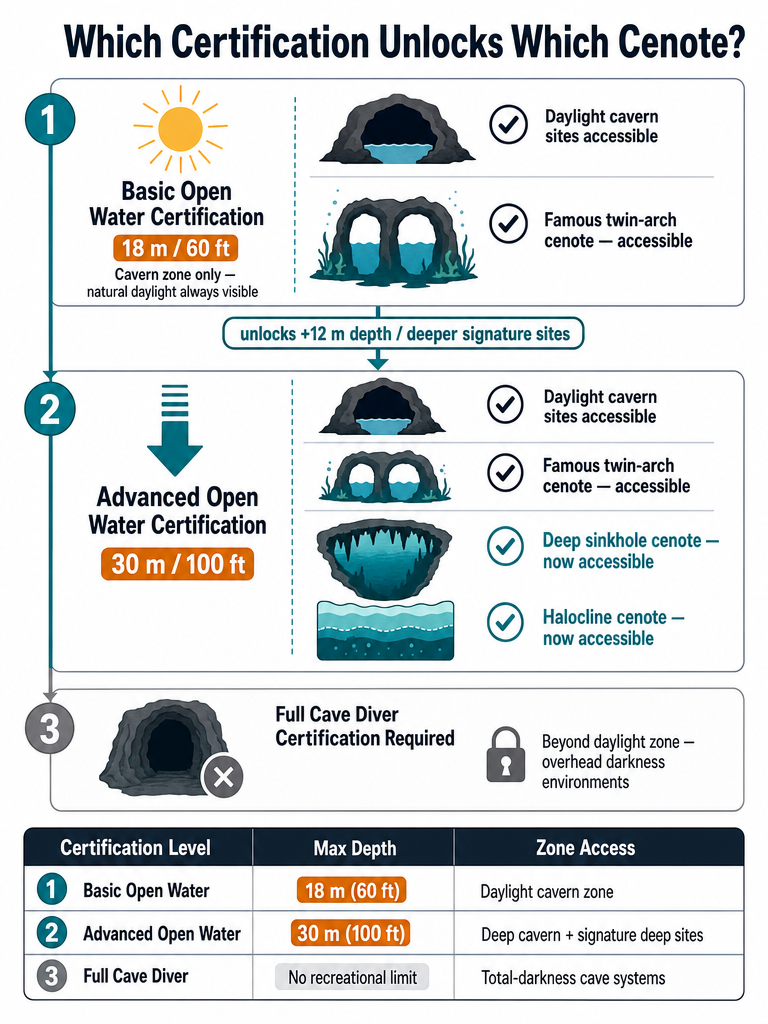
Open Water divers can dive many Riviera Maya cenotes, staying within the cavern zone where natural daylight is always visible, at depths up to 18 meters (60 feet) (Source: Seth Dive Mexico). Most cenotes in the region fall into this category, which makes them accessible with basic training and recent experience. You are not locked out of the classic cenote experience with an Open Water card.
The cavern zone is the recreational sweet spot. According to Dive Magazine, cited in Seth Dive Mexico's cenote guide, cavern diving means not going further than 60 meters into the overhead environment while remaining within visible light from the surface. That daylight rule is what keeps these dives inside recreational limits.
The Cenote Guy, another Riviera Maya operator, puts it plainly: an Open Water certification is sufficient for many cenotes, and their dives require at least that level. Open-water-friendly cenotes are typically open, well-lit, and easy to navigate, so you can focus on buoyancy and comfort in freshwater.
Don't overbuy training you don't need. If a shallow, sunlit cavern dive is your goal, your existing card likely covers it and Open Water is enough for a large share of the Riviera Maya's most beautiful cenote routes. For a fuller breakdown, see our guide on whether Open Water is enough for cenote diving.
Do you need Advanced Open Water for The Pit or Cenote Angelita?
You need Advanced Open Water for The Pit and Cenote Angelita because both sites sit below the Open Water depth limit. Seth Dive Mexico states that the AOW certification extends your depth limit from 18 to 30 meters, giving access to these dives. At The Pit, the famous sunbeams and hydrogen sulfide cloud sit between 30 and 40 meters (Source: Seth Dive Mexico).
These aren't marginal differences. The Pit and Angelita are defined by features that live in deep water. Angelita's surreal hydrogen sulfide "river" and The Pit's dramatic light shafts are the whole point of visiting, and they're out of reach on an Open Water card.
Seth Dive Mexico's cenote guide is direct about the requirement: cenotes featuring haloclines and hydrogen sulfide layers, like The Pit or Cenote Angelita, require an Advanced Open Water certification.
Here's what changes at depth:
| Feature | Open Water reach | AOW-only depth |
|---|---|---|
| Max depth | 18m (60ft) | 30m (100ft) |
| The Pit sunbeams / H₂S cloud | Out of reach | 30–40m |
| Angelita underwater river | Out of reach | Deeper layer |
| Deeper Cozumel reef walls | Out of reach | Within limit |
If The Pit or Angelita is on your bucket list, Advanced Open Water is the certification that gets you there. Beyond depth, AOW builds the deep-diving, navigation, and buoyancy refinement that make these more demanding sites comfortable rather than stressful.
How to choose between Angelita, The Pit, and Dos Ojos
Choose by certification and comfort, not fame. Dos Ojos is an Open Water-friendly cavern dive with stunning light beams. The Pit and Cenote Angelita are deeper Advanced Open Water dives with very different moods, requiring the 30-meter depth limit (Source: Seth Dive Mexico). Match the site to what your card allows and what you actually want to experience.
Dos Ojos is the accessible showstopper. Seth Dive Mexico's cenote guide highlights its dramatic light beams, and it sits in the daylight cavern zone Open Water divers can dive. It's a strong pick if you want a memorable dive without adding two training days.
The Pit and Angelita are deeper and moodier. The Pit delivers cathedral-like sunbeams and a hydrogen sulfide cloud between 30 and 40 meters. Angelita is famous for its eerie underwater river layer. Both need AOW.
| Cenote | Certification | Mood |
|---|---|---|
| Dos Ojos | Open Water | Bright, light beams |
| The Pit | Advanced Open Water | Deep, dramatic sunbeams |
| Cenote Angelita | Advanced Open Water | Eerie, surreal H₂S layer |
For a deeper site-by-site comparison, read how to choose between Angelita, The Pit, and Dos Ojos.
Tell Seth which mood appeals to you, and he'll match the cenote to your certification and comfort level.
What is the difference between cavern diving and cave diving?
Cavern diving stays within the daylight zone where surface light is always visible, while cave diving continues into total darkness beyond that light. Advanced Open Water supports recreational cavern-zone cenote diving; true cave diving requires Full Cave Diver certification (Source: Seth Dive Mexico). This distinction is a safety boundary, not a technicality.
Dive Magazine, cited in Seth Dive Mexico's cenote guide, defines cavern diving as not going further than 60 meters into the overhead environment while staying within visible light from the surface. That light is your exit reference and your safety margin.
Cave diving crosses that line. Once you pass beyond daylight into the maze of a full cave system, you're in an environment that demands specialized training, redundant equipment, and guideline navigation.
Seth Dive Mexico's guide lays out the ladder clearly: Open Water for basic caverns, Advanced Open Water for deeper daylight dives, and Full Cave Diver for exploring beyond the daylight zones. Cavern diving is recreational; cave diving is a separate technical discipline with its own certification path.
For a fuller explanation aimed at travelers, see our guide on cavern vs cave diving in Mexico.
Can Advanced Open Water divers do cave dives in Mexico?
Advanced Open Water divers cannot do true cave dives in Mexico. AOW extends your depth to 30 meters and improves your skills, but it does not qualify you for total-darkness cave routes in systems such as Sac Actun or Ox Bel Ha. Full Cave Diver certification is mandatory for diving beyond the daylight zone (Source: Seth Dive Mexico).
This is the most important line to get right. The Riviera Maya's vast underwater cave systems, including Sac Actun and Ox Bel Ha, are among the largest in the world, and they draw serious divers. But they are cave-diving territory, off-limits to recreational divers regardless of how many depth or navigation dives you've logged. An AOW card makes you a more capable cavern diver, not a cave diver.
Advanced Open Water is a recreational credential; cave systems require dedicated technical cave training, full stop.
A reputable operator won't take you past the daylight zone on an AOW card. If a guide offers to, that's a serious red flag about their safety standards. Choose your operator as carefully as your certification.
What does the PADI Advanced Open Water course include with Seth Dive Mexico?
The PADI Advanced Open Water course with Seth Dive Mexico is a 2-day program of five adventure dives, listed at $450 per person, with Deep Dive and Underwater Navigation as the two mandatory dives (Source: Seth Dive Mexico). The prerequisite is PADI Open Water Diver certification or equivalent. There are no exams or classroom sessions; the entire course is about gaining experience through guided dives.
You choose three electives from a range of specialties. Seth Dive Mexico particularly recommends:
- Peak Performance Buoyancy — transformative for control and comfort underwater, and the skill that matters most in delicate cenote environments.
- Night Dive — an unforgettable dive on a reef or in a cenote.
- Drift Dive — essential for Cozumel's current-swept reefs.
What sets the Riviera Maya apart is where those adventure dives happen. Your Deep Dive might take place at The Pit or Angelita. Your Navigation dive might be in a crystal-clear cenote where you practice compass skills, with cenote visibility reaching up to 40 meters in clear conditions (Source: Seth Dive Mexico).
Course details at a glance:
| Detail | Seth Dive Mexico |
|---|---|
| Price | $450 per person |
| Duration | 2 days |
| Dives | 5 adventure dives |
| Prerequisite | PADI Open Water or equivalent |
| Min age | 12 (15 for full certification) |
| Experience | 20 years |
For reference, Blue Life in Playa del Carmen and Tulum lists a comparable AOW course at $449.00. The certification is valid worldwide and never expires.
Is it smarter to book Open Water-friendly cenote dives now or take AOW first?
Book Open Water-friendly cenote dives now if you have limited vacation time and no specific deep sites on your list. Take AOW first only if The Pit, Angelita, or deeper Cozumel walls are the reason you're diving. Guided cenote dives run $85–$130 USD with gear and entrance fees included, while the AOW course is a 2-day, $450 commitment (Source: Seth Dive Mexico).
The tradeoff is time and money against access. Two days spent certifying is two days not spent diving. For many travelers, one or two guided cenote dives at Dos Ojos or a similar cavern site delivers the "wow" moment without the extra investment.
| Option | Cost | Time | Best for |
|---|---|---|---|
| Guided cenote dives | $85–$130 per dive | Half or full day | Dos Ojos, cavern-zone sites |
| AOW course | $450 | 2 days | The Pit, Angelita, deep Cozumel |
Independent operator Explorations Evo puts a full-day guided cenote diving tour at $150 to $210 USD as of 2025 prices, so shop by inclusions, not just the headline rate.
If your goal is one or two memorable cenote dives, booking guided cavern dives now is usually the smarter use of vacation time.
For a broader look at trip value, see what's included in private cenote diving cost. Not sure which side you fall on? Send Seth your goals and he'll tell you honestly whether AOW earns its place on your trip.
How deep can you dive with Advanced Open Water?
Advanced Open Water divers can dive to 30 meters (100 feet), compared to the 18 meters (60 feet) limit for Open Water divers (Source: Seth Dive Mexico). That extra 12 meters gives access to deeper cenotes and reef walls, and it's the single most practical benefit of the certification for Riviera Maya diving.
| Certification | Max depth |
|---|---|
| PADI Open Water Diver | 18m (60ft) |
| PADI Advanced Open Water Diver | 30m (100ft) |
Depth alone isn't the whole story in cenotes. These deeper sites are where you meet haloclines, where freshwater and saltwater mix into a blurry optical layer, and hydrogen sulfide clouds that hover like fog. Visibility can reach up to 40 meters in clear conditions, but those transition layers demand calm, planned diving (Source: Seth Dive Mexico).
That's why the AOW skills matter as much as the depth number. Deep-diving awareness, underwater navigation, and buoyancy control are exactly what keep a diver comfortable at The Pit or Angelita.
Every deeper cenote dive with Seth Dive Mexico is guide-led and planned around your certification and comfort.
What should you confirm before booking AOW for cenote diving?
Before booking Advanced Open Water for cenote diving, confirm you hold PADI Open Water certification or equivalent, meet the age minimum, and have your target cenotes in mind. Seth Dive Mexico lists the prerequisite as Open Water certification and a minimum age of 12 years (15 for full certification) (Source: Seth Dive Mexico). Sorting these details before you arrive protects your limited vacation days.
Run through this checklist:
- Certification prerequisite — you need PADI Open Water Diver or equivalent to enroll.
- Age — minimum 12, with 15 required for full certification.
- Recent experience — if it's been a while, mention it so your guide can plan a refresher.
- Target cenotes — decide whether The Pit, Angelita, or deeper Cozumel walls are your actual goal; that's what justifies the course.
- Gear — cenote water sits at 24°C to 26°C (75°F to 79°F) year-round, and a 5mm full wetsuit is recommended (Source: Seth Dive Mexico).
- Logistics — confirm free hotel pickup covers your stay anywhere from Cancun to Tulum.
Hotel pickup removes most of the booking friction. Free round-trip transport can turn the whole day into an easy hotel-to-site-to-hotel outing; see how hotel pickup works from Cancun to Tulum for what to confirm.
The fastest path to a good recommendation is one message with your dates, hotel, and experience level. Seth is a local guide with 20 years of experience and multilingual support, so you'll get a straight answer about whether AOW or guided cenote dives fit your trip.
Frequently asked questions
Do you need Advanced Open Water for The Pit and Cenote Angelita?
Yes — both sites sit below the Open Water depth ceiling. The Pit's sunbeams and hydrogen sulfide cloud hover between 30 and 40 meters, and Angelita's surreal underwater river layer is similarly deep. Advanced Open Water extends your limit from 18 to 30 meters (60 to 100 feet), which is the minimum needed to reach these features. Open Water divers simply can't access what makes either cenote worth visiting.
Can you dive cenotes with just an Open Water certification?
Open Water certification covers most Riviera Maya cenotes — including Dos Ojos — as long as you stay in the cavern zone where surface light is always visible, at depths up to 18 meters (60 feet). The majority of cenotes in the region fall into this category. You're not locked out of spectacular cenote diving; you're only locked out of the deeper, moodier sites like The Pit and Angelita.
What does the PADI Advanced Open Water course include in the Riviera Maya?
Seth Dive Mexico's PADI AOW course runs two days, costs $450 per person, and covers five adventure dives — Deep Dive and Underwater Navigation are mandatory, plus three electives you choose. There are no exams or classroom sessions. Your Deep Dive might happen at The Pit or Angelita; your Navigation dive in a cenote with visibility up to 40 meters. Prerequisite is PADI Open Water or equivalent, minimum age 12.
What's the difference between cavern diving and cave diving in Mexico?
Cavern diving stays within the daylight zone — never more than 60 meters into the overhead environment, with surface light always visible. Cave diving crosses into total darkness beyond that boundary and requires Full Cave Diver certification, redundant equipment, and guideline navigation. Advanced Open Water qualifies you for cavern-zone cenotes only. No recreational certification, including AOW, covers penetration cave diving in systems like Sac Actun or Ox Bel Ha.
Is it smarter to take AOW first or book guided cenote dives now?
Book guided cenote dives now if vacation time is limited and The Pit or Angelita aren't on your list. Guided cavern dives run $85–$130 USD with gear and entrance fees included — a half-day commitment. The AOW course is a $450, two-day investment. If Dos Ojos or a well-lit cavern cenote is your goal, your existing Open Water card already covers it. AOW earns its place only when specific deep sites justify two days out of your trip.
How deep can you dive with Advanced Open Water certification?
Advanced Open Water extends your maximum depth to 30 meters (100 feet), compared to 18 meters (60 feet) for Open Water divers. That extra 12 meters is what separates basic cavern cenotes from the deep sites that define the Riviera Maya's most dramatic dives. At those depths you'll encounter haloclines — where freshwater and saltwater blur into an optical haze — and hydrogen sulfide clouds, both of which reward calm, planned diving.
Sources
- Diving in a cenote with open water certificationwww.facebook.com
- Cenote Diving with Open Water vs. Advanced Certificationsthecenoteguy.com
- PADI Advanced Open Water Diver Coursebluelife.com
- Open Water Course in Cenote & Ocean + 1 Cenote Dive ...explorationsevo.com
- The Complete Guide to Cenote Diving in Mexicowww.reddit.com
- First-timer cenote diving guide safety tips cost and best sightswww.tripadvisor.com