PADI Open Water in Mexico: Home Study + 2 Dive Days
Book PADI Open Water Mexico with home study, 2 dive days, free pickup from Cancun to Tulum, and small-group instruction for beginners.
What does the PADI Open Water Diver course in Mexico include?
The PADI Open Water Diver course in Mexico is the entry-level scuba certification from PADI (the Professional Association of Diving Instructors), built around three phases: knowledge development, confined-water skills, and open-water training dives. At Seth Dive Mexico, the course is listed at $450 per person, structured as home study plus 2 days of diving, with a minimum age of 10, no prior scuba experience required, and a certification depth of 18 meters / 60 feet.
The PADI Open Water Diver certification is recognized worldwide, valid for life, and lets certified divers explore the underwater world with a buddy down to 18 meters / 60 feet anywhere in the world. That global recognition is part of why it's the most common entry-level course travelers complete on vacation in the Riviera Maya.
Here's what the standard course covers, regardless of operator:
- Knowledge development: scuba physics, gear, planning, hand signals, and safety procedures, completed through PADI eLearning.
- Confined water training: typically 5 skill sessions in a pool or pool-like environment to practice everything before going to depth.
- Open water training dives: 4 dives in the ocean or a controlled cenote to demonstrate skills and experience real diving conditions.
How does home study plus 2 dive days work with PADI eLearning?
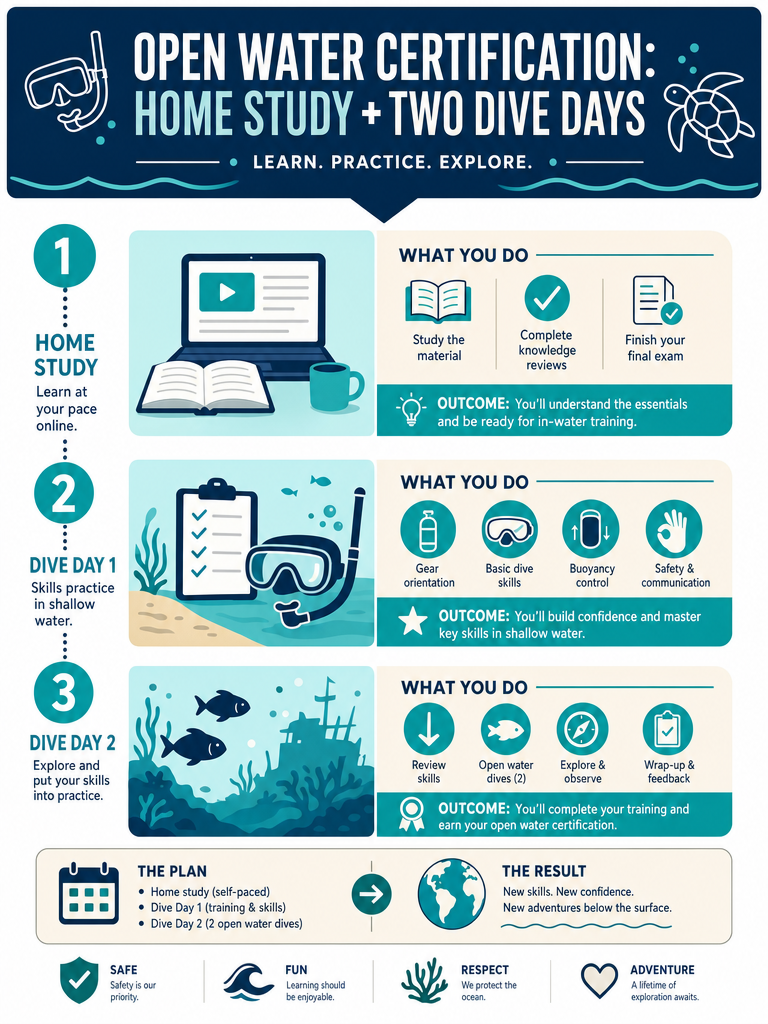
Home study plus 2 dive days works because PADI eLearning lets you handle all the theory before your flight, so your vacation is reserved for the water. According to Scuba Playa, students who complete eLearning before arrival only need the water sessions scheduled in destination, with the eLearning option scheduling confined and open water training over two complete days starting at 8:00 AM each day. Pocna Dive Center confirms the same approach: theory at home, practical training after arrival.
Here's how the workflow looks in practice for a Riviera Maya traveler:
- Before your trip: Buy PADI eLearning, work through 5 chapters of theory, watch the videos, complete the knowledge reviews and quizzes at your own pace. Most travelers spend 6–8 hours on this over a couple of weeks.
- Day 1 in Mexico: Meet your instructor, fit gear, and complete the 5 confined-water skill sessions — split across two pool sessions per Scuba Playa's structure. You'll cover mask clearing, regulator recovery, buoyancy, out-of-air response, and controlled ascents in shallow, controlled water.
- Day 1 (continued) and Day 2: Move into open water — ocean or a calm cenote depending on conditions — for 4 open-water training dives. Scuba Playa notes the first two dives stay shallow at 12 m / 40 ft and the last two go to the full 18 m / 60 ft.
- End of Day 2: Final skill demonstrations, debrief, and digital certification card issued through PADI.
If you'd like a course mapped around your specific travel dates and hotel, send Seth your trip details and you'll get a private 2-day plan back. Start Planning Your Dive.
Home study plus 2 dive days is the most vacation-efficient way to earn a full PADI Open Water certification without sacrificing a third or fourth day of your trip to a classroom. The structure is identical to a longer course — only the theory location changes.
How long does the PADI Open Water course take in Mexico?
The PADI Open Water course in Mexico takes anywhere from 2 days to 4 days in destination, and the difference comes down to one variable: when you do the theory. Operators that build their schedule around PADI eLearning, like Seth Dive Mexico and Scuba Playa, can compress the practical work into 2 dive days. Operators that include theory after you arrive — Mexico Blue Dream lists 3 days with eLearning, Jaguar Divers lists 6–8 hours of self-study plus 2.5 days of practical classes, and Acuaticaribe lists 3–4 days — naturally take longer.
| Format | Theory location | In-destination days | Source |
|---|---|---|---|
| Home study + 2 dive days | Before arrival (eLearning) | 2 | Seth Dive Mexico |
| eLearning + 2 full water days | Before arrival | 2 | Scuba Playa |
| eLearning + 3 days | Before/during arrival | 3 | Mexico Blue Dream |
| Self-study + 2.5 practical days | Before arrival | 2.5 | Jaguar Divers |
| Standard course | In destination | 3–4 | Acuaticaribe |
Things that stretch the course longer: not finishing eLearning before your flight, needing extra repetition on a specific skill, weather pushing a dive day, family scheduling around children ages 10–11 (who have additional restrictions), or simply choosing a slower private pace. None of these are problems — they just need to fit your vacation calendar.
How much does PADI Open Water cost in Mexico, and what should be included?
PADI Open Water in Mexico typically runs $450–$680 USD, but the headline price is meaningless without an inclusion checklist. Seth Dive Mexico lists its course at $450 per person. PADI Adventures lists an E-Learning Open Water Diver option at USD 680 for 3 days and 4 dives. Jaguar Divers lists its standard course at $509 USD but explicitly excludes food and transportation to the dive centre. Acuaticaribe and Seth Dive's beginner guide cite a broader range of $335–$488 USD depending on the operator.
The right way to compare PADI Open Water prices in Mexico is line by line — not by sticker price — because eLearning fees, certification fees, gear, transport, and marine park fees can add up to several hundred dollars on top of the base course.
Here's the checklist to run against any quote before you book:
| Inclusion | Why it matters |
|---|---|
| PADI eLearning | Often a separate purchase ($150–$200 range); confirm whether it's bundled |
| PADI certification fee | Required to issue your card; some operators charge separately |
| Full equipment rental | BCD, regulator, wetsuit, mask, snorkel, fins (Scuba Playa includes all six) |
| Transportation / hotel pickup | Jaguar Divers excludes it; Seth Dive Mexico offers free pickup from Cancun to Tulum |
| Marine park or cenote fees | Cozumel Marine National Park, cenote entry — easily $20–$40 per day |
| Lunch / drinks / food | Some operators include lunch; many do not |
| Group size | Scuba Playa caps at 4; private/semi-private options cost more but mean more attention |
| Extra days | Jaguar Divers charges $169 USD per extra day if you need more time |
What are the requirements to enroll in a PADI Open Water Diver course in Mexico?
To enroll in a PADI Open Water Diver course in Mexico, you must be at least 10 years old, have adequate swimming skills, be in good physical health, and need no prior scuba experience. That standard appears across PADI dive centers in the Riviera Maya, including Pocna Dive Center, Scuba Playa, and Seth Dive Mexico itself.
"No prerequisite" is not the same as "no requirements." Here's what each piece means in practice:
- Minimum age 10: Children ages 10–11 enroll in PADI Junior Open Water Diver, which Xico Dive Center says can be earned in three days with theory and pool training. Scuba Playa restricts this age range to a maximum depth of 12 m / 40 ft and allows no more than two children in this age range per group.
- Adequate swimming skills: PADI requires a basic swim test (typically a 200-meter swim, no time limit, plus a 10-minute float). You don't need to be fast — you need to be calm and unassisted in deep water.
- Good physical health: A standard PADI medical statement screens for conditions that affect diving — heart, lungs, ear, sinus, recent surgery, certain medications. If anything is flagged, a doctor's signature is needed before training. This is why "Prerequisite: none" on a course page never overrides the medical form.
- No prior scuba experience: Genuinely no — the course is designed for absolute first-timers.
If you're unsure about the swim test or have any condition that might require a doctor's sign-off, message your operator before booking. It's far easier to handle the medical form at home than to discover an issue on Day 1 in Mexico.
What skills will you practice before your open water dives?
You'll practice every core scuba skill in shallow, controlled water before going anywhere near 18 meters. According to Scuba Playa, the Open Water course includes 5 confined-water skill sessions spread across two pool sessions, and Pocna Dive Center confirms the same five-standards structure before the four open-water dives. Nothing happens in the ocean that you haven't already done in a pool with your instructor right next to you.
Dive Point Mexico lists the standard skill set, which lines up with PADI's global curriculum:
- Equipment setup and pre-dive checks — assembling the BCD, regulator, tank, and weights, then running buddy checks.
- Hand signals and underwater communication — how to signal "OK", "problem", "up", "down", "low on air", and direction.
- Mask skills — clearing water from a partially or fully flooded mask, and removing/replacing the mask underwater.
- Regulator skills — recovering a regulator that's fallen out of your mouth and clearing water from it.
- Buoyancy control — the fin pivot and hovering, so you stop sinking to the bottom or floating to the surface.
- Out-of-air response — switching to your buddy's alternate air source and ascending together.
- Controlled ascents and safety stops — going up slowly, breathing normally, and pausing at 5 m / 15 ft.
- Calm problem-solving — cramps, mild disorientation, mask issues, all practiced shallow before they ever happen deep.
If a skill doesn't click the first time, you repeat it. There is no clock. That's the entire point of confined water — it's where you build muscle memory before depth, current, or wildlife enter the picture. If you're feeling nervous, our 7 tips to feel confident before scuba diving walks through the same anxieties from a beginner's perspective.
Which PADI course in Mexico is right for you: Discover Scuba, Scuba Diver, Open Water, or Advanced?
The right PADI course depends on how much vacation time you can give it and whether you want a one-time experience or a real certification. Discover Scuba is for trying scuba once. PADI Scuba Diver is a partial certification for travelers short on time. PADI Open Water Diver is the full entry-level certification that lets you dive with a buddy worldwide. PADI Advanced Open Water Diver is the next step for already-certified divers.
| Course | Best for | Time | Depth limit | Certification |
|---|---|---|---|---|
| Discover Scuba Diving | First-timers trying scuba once | Half-day to full day | 12 m / 40 ft | No certification |
| PADI Scuba Diver | Travelers short on time who want a partial cert | 2 days, 2 dives | 12 m / 40 ft, supervised | Partial (Pro Dive International) |
| PADI Open Water Diver | Beginners ready to dive independently | 2–4 days, 4 dives | 18 m / 60 ft, with buddy | Full, lifelong, worldwide |
| PADI Advanced Open Water | Certified divers wanting deeper sites | 2 days, 5 dives | 30 m / 100 ft | Advanced certification |
A few practical tips for choosing:
- If you have one morning and just want to know what breathing underwater feels like, Discover Scuba is the right call.
- If you have 2 days but limited interest in further diving, PADI Scuba Diver gets you in the water without the full theory load.
- If you have 2–3 days and any plan to dive again on a future trip, go straight to Open Water — Scuba Diver can be upgraded later, but the full course is more economical the first time.
- If you're already certified, skip ahead to Advanced and unlock The Pit, deeper Cozumel walls, and night dives.
For a deeper comparison written for first-timers, our guide to choosing your first scuba diving experience breaks down each option by price, depth, and confidence level.
PADI vs. SSI: Which certification should you choose in Cancun, Playa del Carmen, Tulum, or Cozumel?
Both PADI and SSI (Scuba Schools International, with its MySSI digital platform) are recognized worldwide, and recreational divers can even mix agencies — Open Water with one, Advanced with the other. For most travelers earning their first certification on vacation in Mexico, PADI is the simpler choice because it has the largest global dive-center network, a standardized course sequence, and instant brand recognition at almost any future dive destination.
A few honest distinctions, drawn from the comparison work done by Cancun Diving Experiences and Solo Buceo:
- Course structure: PADI uses a strict sequence — theory, then confined water, then open water — which is predictable and easy to plan around vacation days. SSI allows more flexibility in ordering course components.
- Cost: PADI is sometimes more expensive due to material and certification fees. SSI's digital materials are free, which can lower the headline price. In practice, total trip cost depends more on inclusions (gear, transport, marine park fees) than on the agency.
- Recognition: Both are accepted at virtually every dive operator worldwide. If you imagine diving in Indonesia, Egypt, or the Caribbean later, neither will leave you stuck.
For a vacation certification in the Riviera Maya specifically, the agency matters less than the operator — your instructor, group size, and dive sites shape the experience far more than the logo on your card.
Where do the practical training dives happen in the Riviera Maya, and how do logistics work?
Practical training dives in the Riviera Maya happen wherever conditions, certification standards, and your comfort line up best on the day — most commonly the ocean off Playa del Carmen or Cozumel, with confined skills in a calm shore entry or a pool, and occasionally a shallow cenote section for buoyancy practice. The dive site is chosen for safety and skill standards, not marketing — which is why a good local guide matters more than a fixed itinerary.
A few examples from operators across the region:
- Mexico Blue Dream runs its 4 sea dives across 4 different sites in Playa del Carmen, giving students variety in depth, structure, and marine life.
- Cozumel Diving splits its open-water dives between 2 shore dives and 2 boat dives inside Cozumel Marine National Park, one of the clearest and most protected reef systems in the Caribbean.
- Scuba Playa progresses students through depth: first two dives at 12 m / 40 ft, last two at 18 m / 60 ft.
Logistics for travelers staying in Cancun, Playa del Carmen, Tulum, Cozumel, Isla Mujeres, resorts, Airbnbs, or villas:
- Confirm pickup: Seth Dive Mexico offers free hotel pickup from Cancun to Tulum, which removes the biggest friction point — finding the dive shop in an unfamiliar city before sunrise.
- Plan an early start: Most water training begins between 7:30 and 8:30 AM. Expect to be back at your hotel by mid-to-late afternoon.
- Pack light: Swimsuit, towel, sunscreen (reef-safe), water, and any prescription dive mask. Gear is included.
- Build a rest day after: You can't fly within 18–24 hours of your last dive, so schedule certification mid-trip rather than the day before departure.
If you're trying to decide which town to base in, Tulum vs Playa del Carmen and Cancún vs Tulum compare access, travel time, and what each base unlocks for your dive week.
How to choose and book a private or semi-private PADI Open Water course
The fastest way to avoid a crowded, rushed certification is to send the operator the right information before booking — not after. Group classes scale by stuffing more students into the same instructor's day. Private and semi-private courses scale by giving you and your buddy or family the entire instructor's attention, which translates to faster skill mastery, more questions answered, and more flexibility if you need an extra rep on a tricky skill. Scuba Playa caps Open Water groups at no more than 4 divers per instructor — a reasonable industry ceiling, but a 1:1 or 1:2 private course gives meaningfully more practice time per student.
Send this in your first message to any operator:
- Travel dates and which days you can give to training (ideally 2 consecutive days, mid-trip).
- Hotel, Airbnb, or villa location for pickup planning — Cancun Hotel Zone, Playa del Carmen, Tulum, Akumal, Puerto Aventuras, etc.
- Age of every participant, especially if children 10–11 are involved (Junior Open Water restrictions apply).
- Swimming comfort — honest assessment of how relaxed you are in deep water.
- Health considerations — anything that might trigger a medical form question.
- Prior experience — none, a Discover Scuba in the past, snorkeling background.
- Preferred language for instruction.
- What you want after certification — reef dives in Cozumel, cenote diving like Dos Ojos or Gran Cenote, or just the card to use on future trips.
Seth Dive Mexico is a small, multilingual, locally-run operator built specifically for this kind of vacation certification — private or semi-private, free hotel pickup from Cancun to Tulum, and an itinerary built around your schedule rather than a fixed group calendar.
Ready to lock in your dates? Send Seth your travel dates, hotel, age, and experience level and you'll get a real custom plan back, not a generic booking link. Start Planning Your Dive.
Frequently asked questions
Can I do the PADI Open Water course in Mexico if I'm not a strong swimmer?
You don't need to be a fast or athletic swimmer — PADI's swim requirement is a 200-meter swim at any pace, plus a 10-minute float or tread. What matters is that you're calm and unassisted in deep water; if you can do that, the course is open to you regardless of stroke technique.
How soon after finishing the course can I fly home?
PADI recommends waiting at least 18–24 hours after your final dive before flying to reduce the risk of decompression sickness, so it's worth scheduling your certification days mid-trip rather than right before your departure flight.
Is the PADI eLearning cost included in the $450 course price, or is it separate?
Always confirm this before booking, because eLearning is sometimes sold separately and can add $150–$200 to your total cost; contact Seth directly with your dates and he'll clarify exactly what's bundled so you aren't surprised on arrival.
Can my 10-year-old do the same Open Water course as an adult?
Children aged 10–11 complete the PADI Junior Open Water Diver version of the course, which has the same skill standards but caps their depth at 12 meters and requires a parent or certified adult to dive with them; the course typically takes three days for this age group.
What happens if I don't finish my eLearning before I arrive in Mexico?
Arriving without completed eLearning usually adds at least one extra day to your schedule, since theory cannot be skipped — some operators will accommodate this, but it eats into your vacation days and may shift your dive dates depending on the calendar.
Sources
- Dives courses in Mexico | Book online | PADI Adventurestravel.padi.com
- PADI Scuba Diver Certification in Mexico | Pro Dive Internationalwww.prodiveinternational.com
- Junior Open Water Course - Xico Dive Centerxicodivecenter.com
- PADI Open Water Diving Certification Course Activity - Tripadvisorwww.tripadvisor.com
- ※ open water diving playa del carmen » Scuba Playascubaplaya.com
- OPEN WATER DIVERwww.pocnadivecenter.com