Reef-Safe Habits for Cenote and Ocean Dive Days
Reef-safe sunscreen isn’t always enough for cenote diving; ask the site, shower first, and use a rash guard to avoid lotion issues.
Is Reef-Safe Sunscreen Actually Allowed in Cenotes?
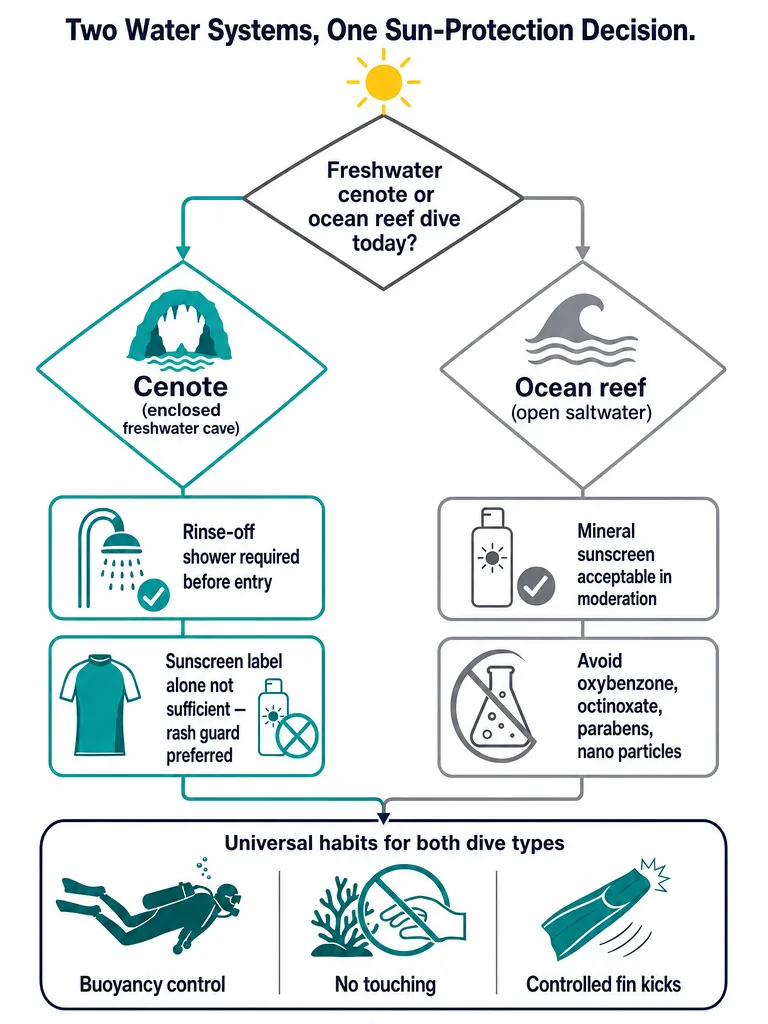
A "reef-safe" sunscreen label does not automatically clear you to swim in a cenote. Reef-safe sunscreen is sun protection formulated without ingredients linked to coral bleaching and marine toxicity, most commonly oxybenzone and octinoxate. Ocean reef operators built that standard around open, tidal water; cenotes are enclosed freshwater cave systems that hold onto contamination in a completely different way.
Rules vary by site, and the guidance divers run into is genuinely mixed. Xico Dive Center's Riviera Maya diving guide lists reef-safe sun protection as one of several accepted eco-friendly habits for divers around Playa del Carmen. A Cancún-area cenote safety discussion on Facebook takes the opposite position: one commenter argues no sunscreen at all, reef-safe or otherwise, because cenotes are freshwater systems and swimmers are, in their words, "the biggest foreign contaminate."
Both views circulate among divers booking trips right now. The practical takeaway: don't assume your bottle's label settles the question. Ask your operator or guide about that specific cenote's rule before you apply anything.
Why Cenotes Are More Sensitive Than Ocean Reefs to Sunscreen
Cenotes hold onto contamination far more than an ocean reef does, because they are collapsed limestone cave systems filled with groundwater rather than open water connected to a moving tide. The Cenote Guy's diving safety guide describes cenotes as a hidden terrain of cathedrals, tight corridors, and unpredictable rock formations: a closed system with far less water volume and circulation than the open sea.
An ocean reef sits in a massive, moving body of water that dilutes whatever runs off a diver's skin. A cenote has no such advantage. The same Facebook safety thread that debates sunscreen labels makes the point directly: these are freshwater systems, and every lotion, spray, or repellent a visitor brings in stays concentrated in a much smaller, mostly still pool.
That gap in water volume is why cenote operators tend to enforce stricter rules than ocean dive shops about what touches the water at all.
What Ingredients Should You Avoid in Reef-Safe Sunscreen?
Oxybenzone and octinoxate top the list of ingredients to avoid before any dive, cenote or reef, because they threaten already-stressed corals even in small amounts, according to the Woods Hole Oceanographic Institution. Woods Hole's own compiled list, drawn from the Haereticus Environmental Laboratory's Protect Land + Sea certification standard, also flags octocrylene, homosalate, PABA, parabens, triclosan, and nano-sized zinc or titanium particles as ingredients worth checking for on the label before you buy.
That last category matters more than most divers realize. "Mineral" sunscreen sounds automatically safer, but nano-milled zinc oxide or titanium dioxide can behave differently in water than the non-nano versions, which is part of why Woods Hole calls out particle size specifically rather than just the mineral-versus-chemical distinction.
If you're shopping before a Riviera Maya trip, read the actual ingredient list rather than trusting a "reef safe" claim printed on the front. A product can carry that phrase in the US without any binding standard behind it, so the label alone doesn't tell you whether oxybenzone, octinoxate, or nano particles are inside.
Is Biodegradable or Mineral Sunscreen Enough for Cenote Diving?
Mineral and biodegradable sunscreens are not a guaranteed pass into every cenote, even though they mark a real improvement over oxybenzone-based formulas. The guidance in circulation is split down the middle. Xico Dive Center's eco-friendly diving guide treats reef-safe sun protection as an accepted practice across Playa del Carmen and the wider Riviera Maya, while a commenter on the Cancún cenote safety thread rejects that framing outright, calling reef-safe sunscreen "not reef safe" and "a garbage marketing ploy" for freshwater systems.
That same guidance also notes that some cenotes and protected areas carry tighter sunscreen rules than others, and that the simplest move is to ask before you get in the water.
Do You Have to Shower Before Entering a Cenote?
Yes. Showering before entering a cenote is standard practice at reputable sites, whether or not you're wearing sunscreen. Commenters on the Cancún-area cenote safety thread confirm this directly: one notes flatly that "you have to shower before going in," and another adds the same requirement in near-identical wording. A separate swimming-safety guide reinforces that visitors are commonly expected to rinse off lotions, perfume, and insect repellent before getting in the water.
The logic tracks with everything else about cenote sensitivity. A quick rinse strips off the residue from sunscreen, deodorant, bug spray, or body lotion that would otherwise sit in a small, mostly still pool of freshwater. Treat the pre-dive shower as a fixed part of the routine at any cenote you visit. If a site skips this step entirely, that's worth noticing.
Rash Guards vs Sunscreen: The Safer Default for Dive Days
A rash guard and a hat sidestep the sunscreen debate altogether, and the more conservative sourced guidance points to physical coverage as the better default on both cenote and reef days. The Woods Hole Oceanographic Institution recommends wearing a rash guard and leggings specifically to limit sunscreen use in the first place, rather than counting on any lotion formula to be harmless.
That's a simple fix for a Riviera Maya trip. A long-sleeve rash guard, board shorts or leggings, a wide-brim hat for the surface, and time in shade between dives cover most of the exposure sunscreen would otherwise need to handle. You skip the ingredient question, the "is this cenote strict about it" question, and the pre-dive shower scramble, because there's nothing left on your skin to rinse off.
For any skin sunscreen genuinely can't avoid, such as the drive between sites, apply it well before you reach the water and let it fully absorb rather than putting it on at the water's edge.
Cenote Buoyancy vs Ocean Reef Buoyancy: What Changes Underwater
Buoyancy mistakes cause different damage in a cenote than they do on an ocean reef, and that difference matters more to conservation than which sunscreen a diver is wearing. In a cenote, hitting the ceiling can knock off rock formations that took thousands of years to form, while sinking too low stirs up silt that can cut visibility to zero in seconds, according to The Cenote Guy's cenote diving safety guide. On an ocean reef, the equivalent mistake is contact with living coral, whose protective mucus layer can be stripped by even a light touch, opening it to disease, as Ocean Gardener's reef-diving guide explains.
| Buoyancy mistake | Cenote consequence | Ocean reef consequence |
|---|---|---|
| Rising too fast | Contact with fragile ceiling formations | Rapid ascent risk, less structural damage |
| Sinking or hovering low | Silt cloud cuts visibility to near zero | Sand or coral contact, sediment stress on coral |
| Unstable trim near structure | Fins or tank clip rock formations | Fin contact shatters branching coral |
| Grabbing for stability | Damage to non-renewing rock surfaces | Strips coral's protective mucus layer |
The environment changes, but the fix doesn't: dial in buoyancy in open water before diving anywhere with fragile structure nearby. If you're not confident in your trim yet, Open Water certification is enough for the right cenote route as long as the dive stays within guided cavern limits and your guide can pace the day to your comfort level.
Securing Gear and Fin Control on Cenote and Reef Dives
Loose gear damages cenote formations and coral the same way: a dangling gauge or unclipped octopus swings and drags without the diver noticing until it's already caught on something. Xico Dive Center's diving guide calls this out directly, recommending a full gear check for anything that can swing, drag, or trail before diving near a reef or a nursery structure. Ocean Gardener's reef-diving guide adds that fin damage is usually invisible to the diver causing it, since it happens behind them, and recommends smaller, higher kicks whenever coral or fragile structure sits near the fin radius.
Woods Hole puts the stakes plainly: even the lightest touch, or a cloud of sediment kicked up by fins, can damage or kill live coral. In a cenote, the same wide kick that shatters a coral branch on a reef can instead cloud out visibility for the rest of your group in a silt-floored passage.
Before descending at either type of site, run a slow visual check of your own gear (gauges clipped, octopus secured, camera lanyard tight) and note what's behind and below your fins before you turn. It's a five-second habit that protects a reef colony and a cenote formation equally well.
Can Beginners Dive Cenotes in Mexico Without These Concerns?
Certification level, not sunscreen choice, is what mainly determines how much of this guide applies to you. Divers without any certification can typically still experience a cenote through a shallow, instructor-led introduction such as a Discover Scuba-style session; public detail on the exact depth limits for these programs is limited, but they generally stay in shallow water under close supervision.
For certified divers, an Open Water certification qualifies you for recreational cavern-zone cenote dives, areas where natural daylight stays visible, at depths up to 18 meters (60 feet), according to Seth Dive Mexico's cenote diving guide. Most Riviera Maya cenotes fall inside that zone. Deeper cenotes with haloclines or hydrogen sulfide layers, like The Pit or Cenote Angelita, require Advanced Open Water certification for dives up to 30 meters (100 feet). Cavern diving itself means staying within 60 meters of the overhead environment while remaining inside visible light from the surface, per the Dive Magazine definition cited in Seth Dive's guide.
For beginners, this naturally lowers the sunscreen and buoyancy stakes: shallower daylight zones, shorter exposure, and a guide managing pace and positioning. It doesn't remove the pre-dive shower requirement or the value of a rash guard over sunscreen, but it does mean the deep-cavern concerns in this guide mostly apply once you're diving Advanced-level sites.
Building a Reef-Safe Dive-Day Checklist for Cenotes and Ocean Dives
The safest dive-day routine puts physical coverage first and leaves sunscreen as a backup, applying the same core habits whether you're headed to a cenote or a reef. Pull these into one pre-dive routine:
- Cover up first. Rash guard, leggings or board shorts, and a hat handle most sun exposure without needing sunscreen at all.
- Check ingredients if you do use sunscreen. Avoid oxybenzone, octinoxate, octocrylene, homosalate, PABA, parabens, triclosan, and nano zinc or titanium, per Woods Hole's list.
- Ask your operator about that specific site's rule. Cenote policies vary, and some ban sunscreen entirely regardless of formula.
- Shower before entering any cenote. This is standard practice and rinses off lotion, repellent, and perfume residue before you touch the water.
- Dial in buoyancy before diving near fragile structure. Practice trim in open water if you're not confident hovering still.
- Secure loose gear. Clip gauges, tuck your octopus, and check for anything that can swing or drag before you descend.
- Watch your fins as much as your hands. Smaller, higher kicks near coral or cenote formations prevent damage you won't see happen behind you.
This same checklist works whether your day is a shallow Discover Scuba cenote session or a full cenote-versus-ocean dive comparison across two very different Riviera Maya environments. The label on your sunscreen bottle matters less than the habits you bring into the water with it.
Frequently asked questions
Is reef-safe sunscreen actually allowed in cenotes?
Rules vary by cenote, and guidance is genuinely split. Some Riviera Maya diving guides list reef-safe sun protection as an accepted eco-friendly habit, while divers in a Cancún-area safety discussion argue no sunscreen at all belongs in a cenote, calling reef-safe formulas "a garbage marketing ploy" for freshwater systems. Ask your operator about that specific site's rule before applying anything, since a label alone doesn't settle it.
Why are cenotes more sensitive to sunscreen than ocean reefs?
Cenotes are collapsed limestone cave systems filled with still groundwater, not open water flushed by tides. An ocean reef sits in a massive moving body of water that dilutes runoff from a diver's skin; a cenote has no such dilution. Every lotion, spray, or repellent a swimmer brings in stays concentrated in a much smaller, mostly still pool, which is why cenote operators enforce stricter rules than ocean dive shops.
What sunscreen ingredients should divers avoid before a dive?
Oxybenzone and octinoxate top the list, since they threaten already-stressed corals even in small amounts, according to the Woods Hole Oceanographic Institution. Woods Hole's compiled list, based on the Haereticus Environmental Laboratory's Protect Land + Sea standard, also flags octocrylene, homosalate, PABA, parabens, triclosan, and nano-sized zinc or titanium particles. Read the actual ingredient list before a Riviera Maya trip; a "reef safe" label alone carries no binding US standard.
Is mineral or biodegradable sunscreen enough for cenote diving?
Not automatically — guidance in circulation is split. One Riviera Maya diving guide accepts reef-safe sun protection as standard practice, while divers in a Cancún cenote safety thread reject that framing outright, calling reef-safe sunscreen "not reef safe" for freshwater systems. Some cenotes enforce a stricter no-sunscreen policy regardless of formula, so check with your specific site instead of assuming mineral or biodegradable automatically clears you.
Do you have to shower before entering a cenote?
Yes, showering before entering a cenote is standard practice at reputable sites, sunscreen or not. Divers in a Cancún-area cenote safety discussion confirm this directly, noting flatly that "you have to shower before going in." The rinse strips off sunscreen, deodorant, bug spray, or lotion residue that would otherwise sit concentrated in a small, still pool of freshwater — treat it as a fixed part of your routine.
What's a safer alternative to sunscreen for cenote and reef dives?
A rash guard and a hat sidestep the sunscreen debate entirely. The Woods Hole Oceanographic Institution recommends wearing a rash guard and leggings specifically to limit sunscreen use rather than relying on any lotion formula being harmless. Pair that with board shorts, a wide-brim hat for the surface, and shade between dives, and there's little left on your skin to rinse off before you get in the water.