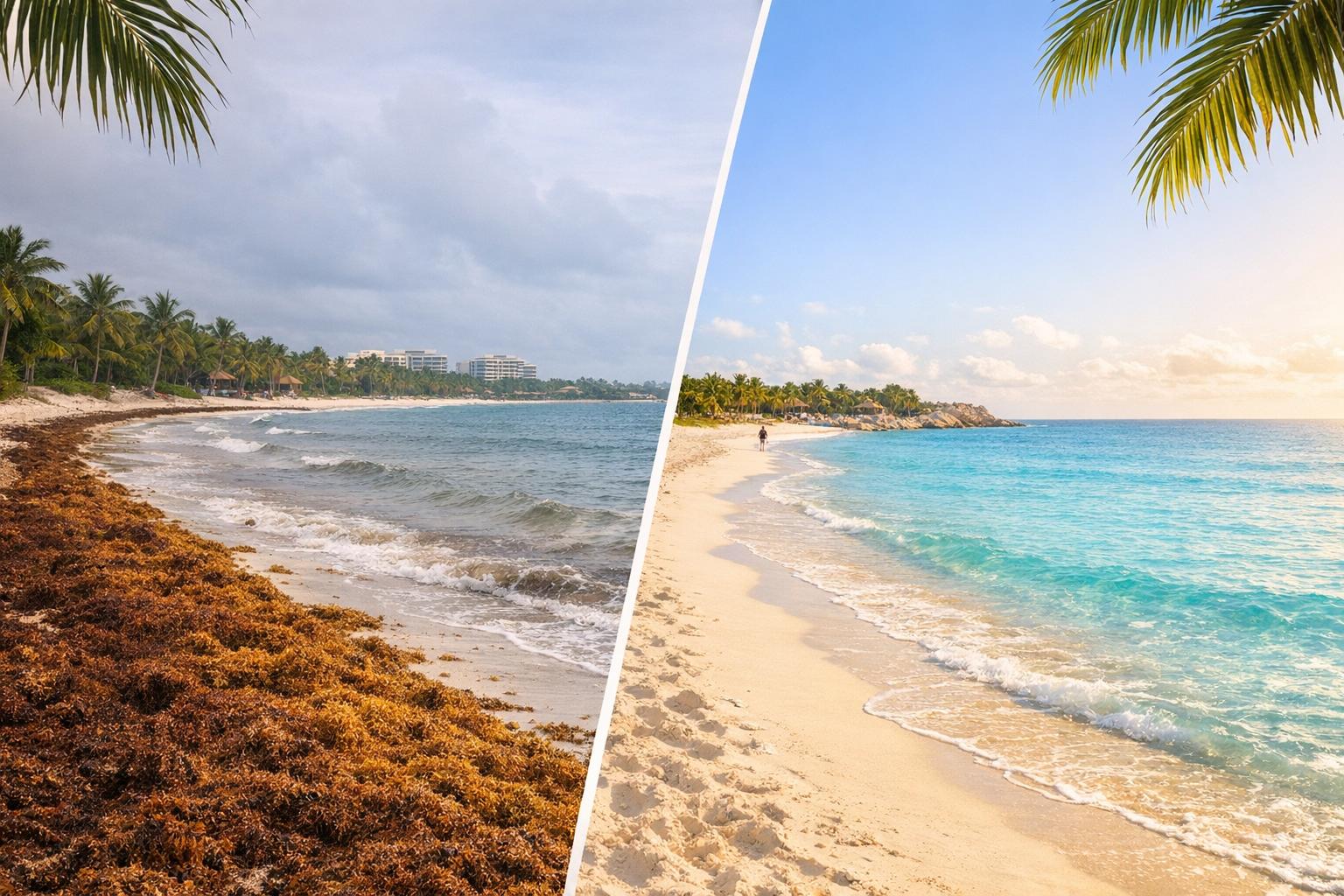
If you're planning a trip to Cancún or Tulum in 2026, sargassum seaweed could impact your beach experience. Here's what you need to know:
- Worst Months: June to August are the heaviest for sargassum, with murky waters and strong odors making beaches less enjoyable.
- Moderate Risk: April, September, and October are unpredictable, with some areas clear one day and covered the next.
- Best Months: November to March typically have the least seaweed, though early 2026 has seen higher-than-usual arrivals even during these months.
- Alternatives: Cenotes, Cozumel’s west coast, and protected bays like Akumal and Soliman Bay remain clear and offer great diving and snorkeling options.
Real-time tracking tools like Sargassum Monitoring® and Tulum Times Beach Pulse can help you plan. For a sargassum-free experience, consider cenote diving, snorkeling, or heading to Cozumel’s reefs.
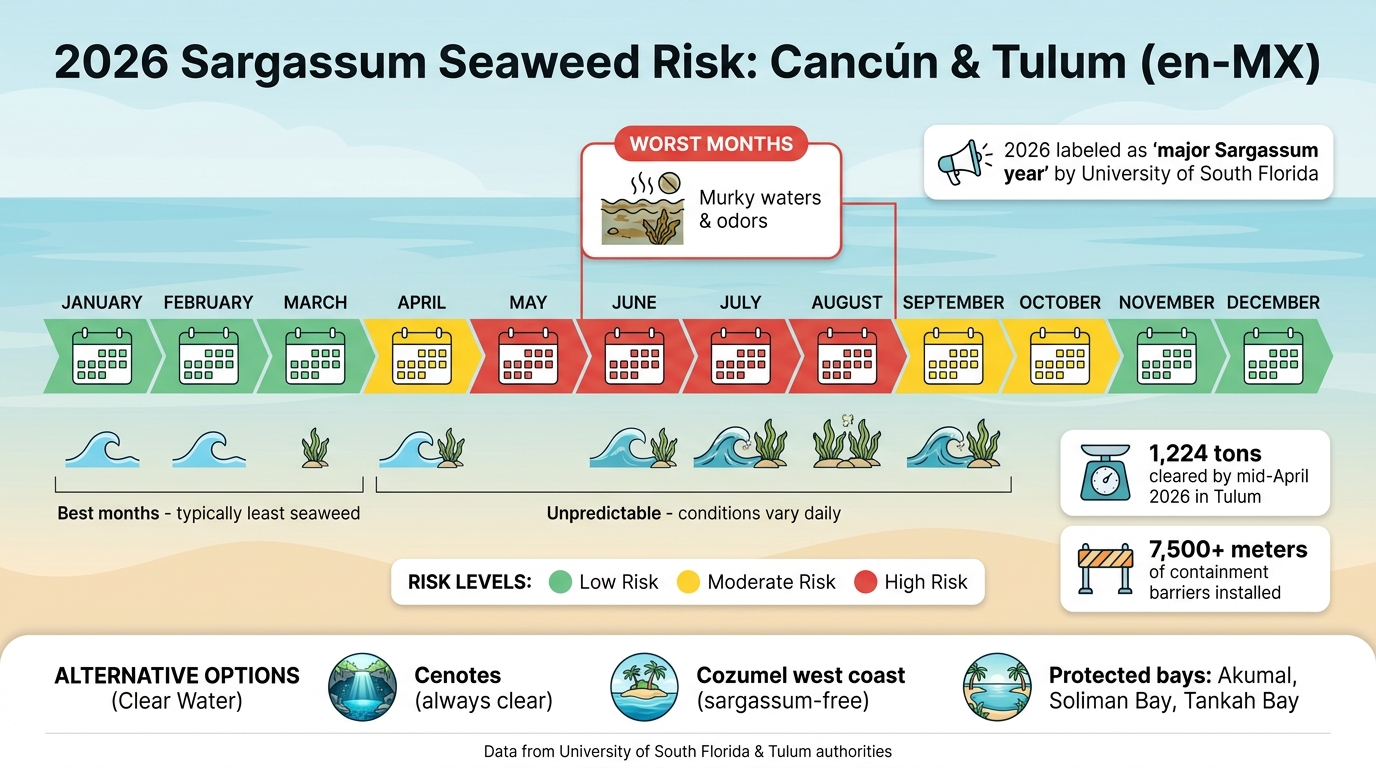
Sargassum Seaweed Risk Levels by Month in Cancún and Tulum 2026
2026 Sargassum Forecast for Cancún and Tulum
The University of South Florida (USF) has labeled 2026 as a "major Sargassum year" [5], with unusually high seaweed arrivals even in January and February, months that are typically clear. By mid-April 2026, Tulum authorities had already cleared 1,224 tons of sargassum from the coastline [3]. Below is a detailed look at the risk levels throughout the year to help you plan your visit.
Peak Months (May to October)
The main sargassum season traditionally spans May to October, driven by Caribbean currents that transport large seaweed mats to the Riviera Maya [5]. These months see heavy accumulations that overwhelm beaches, and the decomposing algae releases a noticeable sulfur-like odor [6]. To combat this, authorities have installed over 7,500 meters of containment barriers offshore to intercept the seaweed before it reaches land [5].
Worst Months (June to August)
June through August are the most problematic months for beachgoers [7]. During this time, massive sargassum deposits cloud the water and disrupt activities like swimming and snorkeling. If your plans center around enjoying the beaches or water sports, it's wise to avoid these months altogether.
Moderate Risk Months (April, September, October)
April, September, and October can be unpredictable due to shifting winds and currents. As The Tulum Times observes:
"While one beach may be covered in seaweed on a Monday morning, it could be crystal clear by Tuesday afternoon." [2]
April 2026 has already seen record-breaking sargassum levels, challenging its usual status as a moderate-risk month. David Buchanan, Tulum's Director of Zofemat, explained:
"Given the increase sargassum arrival this year, daily logistics are in place with the goal of keeping the beaches in the best possible condition." [3]
Best Months (November to March)
While transitional months can be variable, the late-year period typically offers clearer beaches. From November through March, cooler water temperatures and shifting currents naturally reduce sargassum arrivals [7][6]. However, 2026 has been an outlier. January alone saw the removal of 235 tons, February followed with 243.75 tons, and March recorded over 750 tons in just three weeks [3][2]. Despite these early challenges, conditions tend to improve later in the season, making late November through February the most beach-friendly period.
sbb-itb-8d6faf7
How to Track Sargassum Conditions in 2026
If you're a diver or an adventurous traveler heading to the Riviera Maya, keeping tabs on sargassum in real time is a must. The seaweed's presence can change daily, influenced by wind and ocean currents, so staying updated helps you plan your beach outings more effectively. Luckily, there are several free tools that provide up-to-date information on where sargassum is - and where it isn’t.
One of the most popular resources is Sargassum Monitoring®, an interactive map that millions rely on daily to check conditions across the Riviera Maya [4]. This platform thrives on contributions from travelers who share photos and videos through Facebook, Instagram, and TikTok. You can even join in by submitting your own updates [4].
Another valuable tool is the LANOT/UNAM Visualizador, which uses Sentinel-2 satellite imagery to track large sargassum patches before they hit the shore [6]. Meanwhile, the Tulum Times "Beach Pulse" tracker compiles real-time reports from visitors and sends out push notifications to alert users when a beach clears or if new sargassum arrives [6]. These tools can help you adjust your plans based on the latest conditions.
Here's a pro tip: Focus on specific areas rather than relying on general forecasts. For instance, North Tulum (near the Ruins) often has different sargassum levels compared to the South Beach Hotel Zone due to variations in local currents [6]. Conditions can also improve in the early morning, so it’s worth checking regularly.
Social media is another great way to verify the latest reports. Pages like Red de Monitoreo del Sargazo Cancun on Facebook provide color-coded maps showing current sargassum levels in Quintana Roo [7]. You can also join community groups like "Cancun Sun Community" to get real-time updates from fellow travelers [1]. As Cancun Sun wisely advises:
"Trust the data, check the cams, and ignore the rumors" [1].
Sargassum-Free Activities in the Riviera Maya
When sargassum takes over the beaches, the Riviera Maya still has plenty of crystal-clear water adventures to offer. From exploring cenotes to diving in protected coastal areas, there are plenty of ways to enjoy the region without worrying about seaweed.
Cenote Diving
Cenotes are a perfect escape from sargassum. These freshwater sinkholes, fed by underground rivers, stay untouched by ocean conditions [9]. Thanks to natural limestone filtration, visibility can range from 8 to 36 meters (26 to 118 feet), and water temperatures remain consistently between 23°C and 25°C (75°F to 77°F) throughout the year [8][9].
For beginners, Cenote Chac-Mool is a great pick. Its spacious caverns and manageable depth of 12 meters (40 feet) make it ideal for novice divers [8]. On sunny days, sunlight creates stunning beams through the water, and there's even an air pocket where you can admire stalactites [8]. More experienced divers might want to visit "The Pit" for its grand ceiling and unique hydrogen sulfide layers [8], or Cenote Angelita, where a hydrogen sulfide cloud 30 meters (100 feet) deep gives the illusion of an underwater forest [8].
To ensure safety, Mexican law limits cenote cavern diving groups to a 4:1 diver-to-guide ratio [8]. Seth Dive Mexico offers cenote diving tours starting at $85–$130 USD per person, which include hotel pickup, equipment, torches, and entrance fees. Most cenotes are conveniently located just a few miles inland [8].
Cenote Snorkeling for Families
Cenote snorkeling is a fantastic option for families, offering safe and engaging water adventures. Cenotes like Gran Cenote and Dos Ojos are known for their crystal-clear, shallow waters and stunning rock formations [8]. Gran Cenote is especially popular for spotting turtles, while Dos Ojos wows visitors with its "two eyes" that create mesmerizing light effects [8].
For a more relaxed swimming experience, Cenote Azul and Zacil-Ha are excellent choices. These open-air cenotes provide calm waters, making them perfect for young children. Another family favorite is Cenote X'Canche, often combined with a visit to the nearby Ek Balam ruins, with combined tours typically costing around $97 USD [9]. Remember to only use reef-safe biodegradable sunscreen to help protect these delicate ecosystems [9]. Seth Dive Mexico also offers cenote snorkeling tours ranging from $70–$100 USD per person, which include a private guide, hotel pickup, snorkeling gear, lunch, and entrance fees.
Ocean Diving in Protected Areas
If ocean diving is more your style, there are spots in the Riviera Maya that naturally stay clear of sargassum. Cozumel's western side is a reliable option, with underwater visibility exceeding 30 meters even during peak seaweed seasons [9]. Its coral walls, particularly at Palancar and Colombia reefs, are among the world's best dive sites and are rarely affected by sargassum due to their position away from Atlantic currents.
Closer to Playa del Carmen, Soliman Bay and Tankah Bay (just north of Tulum) are protected by strong reef barriers that block sargassum before it reaches the shore [2]. As noted by Tulum Times:
"The result is a reef lagoon that remains significantly clearer than the open beaches of the Hotel Zone" [2].
Akumal Bay is another excellent choice. Its unique shape and active ecological management help keep the waters clear [2]. For a completely sargassum-free snorkeling experience, head to Yal-ku Lagoon in Akumal. This brackish lagoon, fed by cenotes, is entirely free of seawater algae [2].
Seth Dive Mexico offers two-tank reef dives in Playa del Carmen for $95 USD per person and Cozumel dives for $165 USD per person, both of which include private guides, hotel pickup, and marine park fees. If you're planning an ocean dive, aim for the morning when beach clubs and hotels have freshly cleaned the shorelines for the day.
3-Day Diving Itinerary to Avoid Sargassum
If you're looking for a sargassum-free diving adventure, this three-day itinerary has you covered. It combines private cenote dives, offshore reef exploration, and the pristine western reefs of Cozumel to ensure clear waters and an unforgettable experience.
Day 1: Private Cenote Diving
Kick off your trip with a dive into the serene world of cenotes, far from the reach of sargassum. Seth Dive Mexico offers private cenote tours priced between $85–$130 USD per person. These tours come fully equipped with hotel pickup, diving gear, torches, entrance fees, and refreshments. You'll get to explore two breathtaking freshwater caverns, like The Pit and Angelita. As Seth Dive Mexico highlights:
"The visibility never drops because there's no plankton, no sand kicked up by waves, and no weather-related runoff" [10].
This makes cenote diving an ideal start to your underwater adventure.
Day 2: Two-Tank Reef Diving in Playa del Carmen
Day two takes you to Playa del Carmen's vibrant offshore reefs. Seth Dive Mexico offers two-tank ocean dives at $95 USD per person, which include a private guide, hotel pickup, boat transport, weights, and marine park fees. Even during peak sargassum months, the offshore sites remain clear, thanks to mitigation efforts like offshore barriers [7].
Plan your dive for early morning, just after beach clean-ups, and keep an eye on real-time conditions through Tulum Times, as visibility can shift with the winds [2]. While diving, you might encounter nurse sharks, spotted eagle rays, and colorful coral formations, making it a day to remember.
Day 3: Cozumel Wall Diving
Wrap up your itinerary with breathtaking wall dives on Cozumel's western reefs, where sargassum is virtually nonexistent. Seth Dive Mexico offers a Cozumel diving package for $165 USD per person. This package includes direct boat access from Playa del Carmen, saving you the cost of a ferry. Dive sites like Palancar and Colombia showcase crystal-clear waters, thanks to natural currents that keep the area pristine. Michele Peterson, Founder of A Taste for Travel, notes:
"The leeward beaches on those islands [Cozumel and Isla Mujeres] almost always have no sargassum seaweed" [7].
With visibility often exceeding 30 meters, the tour includes two tanks, all necessary equipment, marine park fees, and hotel pickup, ensuring a seamless and unforgettable dive experience.
Conclusion
To make the most of your Riviera Maya trip in 2026, timing and destination planning are essential. Visiting between November and March offers a prime opportunity, thanks to northern winds that help keep seaweed at bay. On the other hand, if you're traveling during the busier months of May through October, particularly June to August, it's smart to focus on cenotes, Cozumel's leeward beaches, or sheltered bays like Soliman and Tankah.
Cenotes, with their consistently clear waters, are a fantastic option year-round, even when coastal waters are affected by sargassum. For diving enthusiasts, protected reef spots and Cozumel's leeward walls ensure unforgettable underwater experiences, even during the peak seaweed season.
When nature proves unpredictable, expert-guided tours can save the day. Private tours, like those offered by Seth Dive Mexico, provide access to cenote dives, reef explorations, and Cozumel wall dives, ensuring clear water adventures and a hassle-free experience.
FAQs
How bad can sargassum get day to day in Tulum or Cancún?
Sargassum levels in Tulum and Cancún can fluctuate greatly from one day to the next, and projections for 2026 suggest an unprecedented amount of seaweed could accumulate. Since weather conditions and ocean currents can shift rapidly, it's wise for travelers to plan carefully to steer clear of beaches that may be heavily impacted.
Will sargassum affect cenote diving or snorkeling at all?
Cenote diving and snorkeling remain untouched by sargassum. These underground freshwater sinkholes boast crystal-clear waters and are entirely unaffected by seaweed blooms. This makes them a fantastic option for anyone seeking water adventures without worrying about sargassum.
Which beaches or bays near Tulum usually stay clearer during peak season?
During the height of the sargassum season, beaches and bays located farther from Tulum's main hubs often have less seaweed. Although exact spots aren't listed, venturing to less crowded areas along the Riviera Maya might lead you to clearer waters. Another great option is to try activities like cenote diving, which lets you experience the stunning natural beauty of the region without worrying about seaweed-covered beaches.
Frequently Asked Questions
Can I still scuba dive in the Riviera Maya if sargassum is bad when I arrive?
Yes — cenotes are completely unaffected by sargassum since they're fed by underground rivers, not the ocean, and offshore reef sites in Playa del Carmen and Cozumel's western walls stay clear even during peak seaweed months. A guide who monitors conditions daily can reroute your dive plan so you never lose water time to bad beach conditions.
Do I need a scuba certification to do a cenote dive, or can beginners participate?
Certified divers can explore cenote caverns, while non-certified beginners can join a Discover Scuba experience or opt for cenote snorkeling at sites like Gran Cenote or Dos Ojos, which have shallow, calm water ideal for first-timers. Your guide can recommend the right format based on your experience level before you even arrive.
Is hotel pickup really included, or do I need to arrange my own transport to the cenotes?
Free hotel pickup is included from Cancun to Tulum, which matters because most cenotes sit several miles inland and are difficult to reach efficiently on your own, especially if you're juggling gear, entrance fees, and route planning on vacation.
How do I know which cenote is right for my skill level before I book?
Sites like Chac-Mool suit newer divers with manageable depths and open caverns, while The Pit and Angelita are better matched to certified divers comfortable with deeper, more immersive environments. Sharing your certification level and interests with Seth directly lets him match you to the right site rather than sending everyone to the same default location.
What's actually included in the price for a cenote or reef dive — do I need to rent gear separately?
Cenote diving tours include hotel pickup, all diving equipment, underwater torches, and entrance fees, while reef dive packages cover a private guide, boat transport, weights, and marine park fees. There's no need to source gear separately or budget for hidden add-ons at the site.