Two-Tank vs Three-Tank Cenote Days
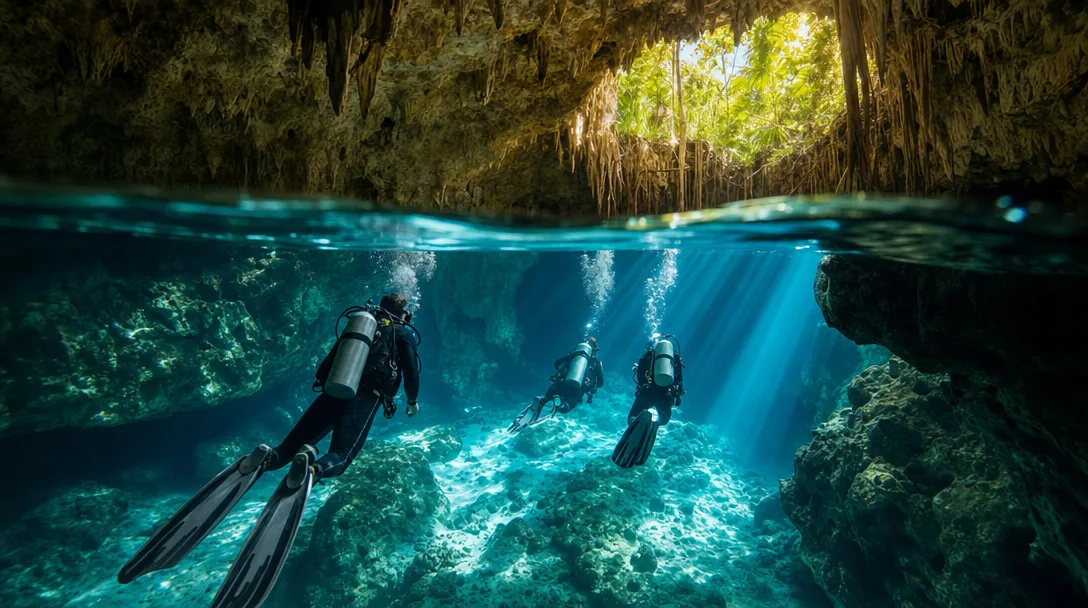
Two tanks is the standard cenote day. Three tanks only works when certification, site pairing, guide pace, and transfer time all line up.
How many cenote dives should you do in one day?
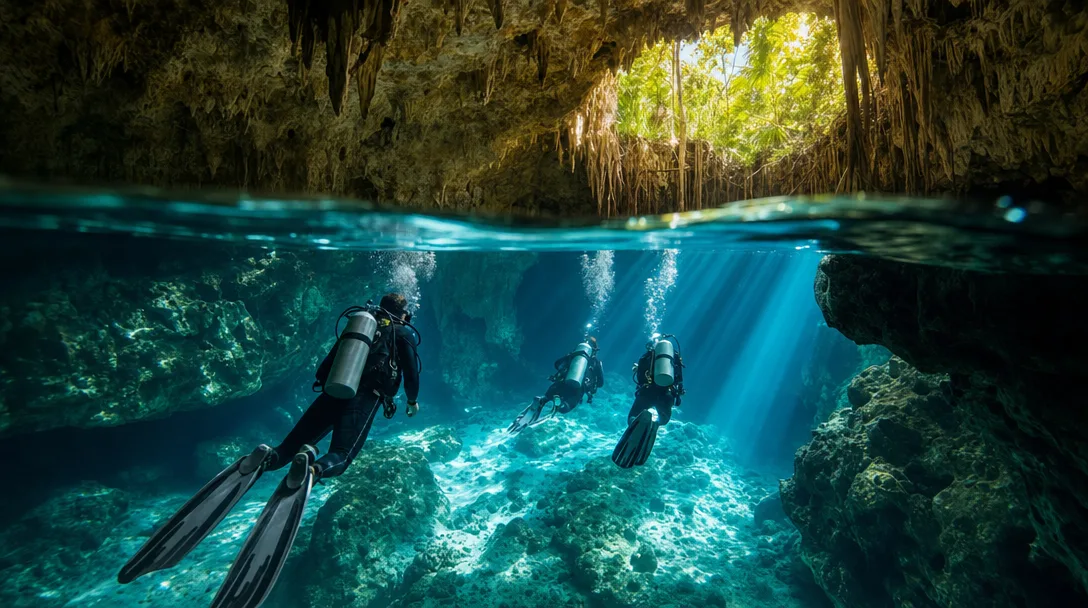
Two tanks is the standard cenote day in the Riviera Maya: two guided dives at two different cenotes, with transport and a real surface interval built into the schedule. A third tank only works when certification, site pairing, guide pace, and transfer time all line up. Aquacore sets a standard day at roughly 7 am to 5 pm, and Tank-Ha puts typical trips at 5 to 6 hours door-to-door.
Most vacation divers plan for two dives and go home happy. That pace gives real bottom time at each site, an unhurried break between dives, and enough energy to enjoy the second dive instead of grinding through it. Many cenotes only allow morning entry because of site access rules, so a two-tank day already starts early regardless of how many dives you add.
A third dive is realistic, not automatic. It depends on whether you're a strong, current diver, whether the extra site sits shallow, and whether your guide keeps a calm pace rather than racing the clock to beat an entry cutoff. Stack those conditions and a third tank adds value. Skip one and it just adds hours.
Three dives vs three cenotes: why these are not the same plan
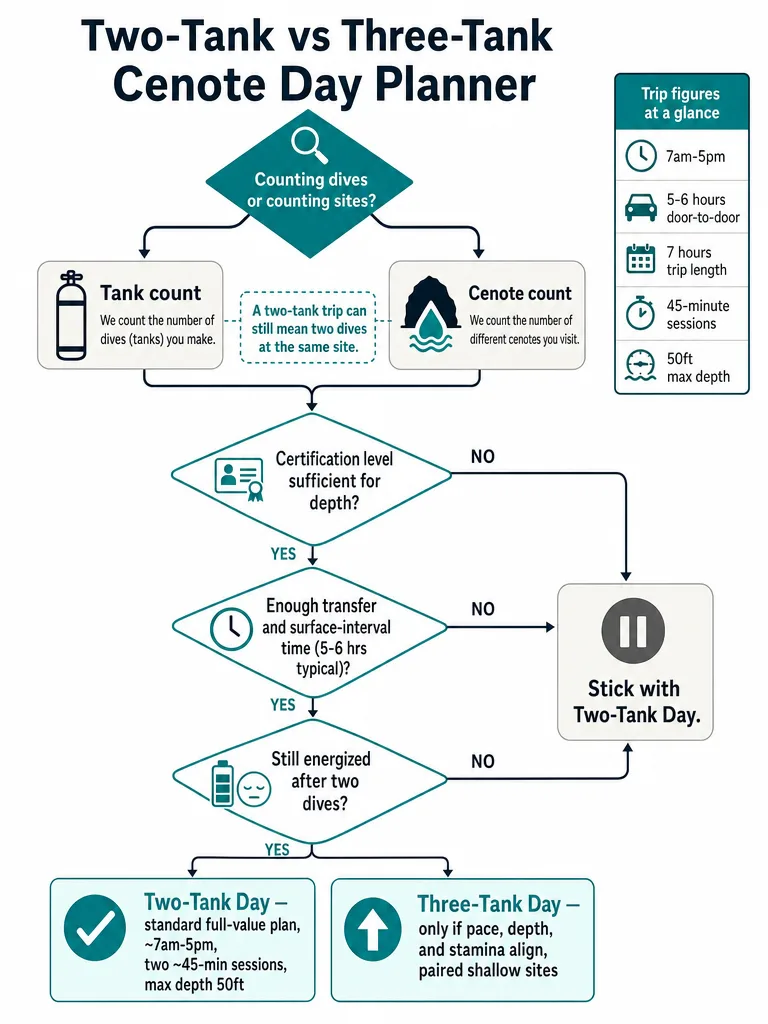
A "3-cenote day" and a "3-dive day" are two different products, and mixing them up is the most common cenote-planning mistake. A single cenote can hold two full dive sessions on its own, so a trip advertised around three named cenotes can still total only two or three dives, not three dives at three separate sites. The Cancún Guide's review of a two-tank trip shows this directly: the itinerary covers one cenote split into two 45-minute underwater sessions with a surface break between them, not two different locations.
| Plan as advertised | Cenotes visited | Tanks used | What you actually get |
|---|---|---|---|
| "2-tank, 1-cenote day" | 1 | 2 | Two sessions at one site, one entrance fee |
| "2-tank, 2-cenote day" | 2 | 2 | One dive at each of two sites |
| "3-cenote day" | 2-3 | 2-3 | Could be one dive per site, or two dives at one site plus a drive-by stop |
| "3-tank cenote day" | 2-3 | 3 | Three full dives, which pushes certification and fatigue budgets harder |
Note the top two rows carefully: operators use the term "2-tank cenote day" both ways, for a single cenote with two sessions and for two cenotes with one dive each. Ask which version you're booking before you confuse it with the number of cenotes on the brochure. The figure that matters for your certification limit and your energy level is tanks, not the list of site names in the description.
What certification do you need for a two-tank or three-tank cenote day?
Open Water certification covers most of the cenotes built into a standard two-tank day. Deeper cenotes may require Advanced Open Water, depending on the site and operator. Mantadivers lists Dos Ojos at about 10 m (33 ft), Chac Mool at about 12 m (39 ft), and Tajma Ha near 15 m (49 ft), all within Open Water limits, while Kin Ha and Zapote sit close to 30 m (100 ft); Zapote specifically requires Advanced certification.
| Cenote | Approx. depth | Minimum certification |
|---|---|---|
| Dos Ojos | 10 m / 33 ft | Open Water |
| Chac Mool | 12 m / 39 ft | Open Water |
| Tajma Ha | 15 m / 49 ft | Open Water |
| Kin Ha | 30 m / 100 ft | Advanced Open Water |
| Zapote | 30 m / 100 ft | Advanced Open Water |
| The Pit / Cenote Angelita | Deep, low-light profiles | Advanced Open Water plus documented cenote experience |
The Pit and Cenote Angelita need Advanced Open Water and a logged history of cenote dives, according to Mantara Dive's 2026 guide, a tighter bar than depth alone would suggest.
Most recreational cenote tours are cavern dives: a guided route that stays inside the natural light zone, follows a permanent line, and keeps an exit within reach. OkToDive draws a clear line between that and cave diving, which leaves the light zone entirely and calls for separate cave-specific training and equipment that most vacationing divers don't carry. For the fuller breakdown, see the difference between cavern and cave diving in Mexico before you commit to a deeper site.
How long does a two-tank vs three-tank cenote day take?
A two-tank cenote day runs about 5 to 7 hours door-to-door, and a third tank usually makes the day meaningfully longer once you count a second transfer, another briefing, and a second surface interval. Tank-Ha puts typical two- to three-dive trips at 5 to 6 hours door-to-door, while a reviewed two-tank trip from The Cancún Guide runs about 7 hours total for two 45-minute sessions capped at 50 feet (15 m) with a group of up to 8 people.
| Format | Total time | Underwater sessions | Session length | Depth cap |
|---|---|---|---|---|
| Two-tank day (Aquacore) | ~7 am to 5 pm | 2 | Site-dependent | Site-dependent |
| Two-tank day (Tank-Ha) | 5-6 hrs door-to-door | 2 | Site-dependent | Site-dependent |
| Reviewed two-tank trip (The Cancún Guide) | ~7 hrs | 2 | ~45 min each | 50 ft / 15 m |
| Three-tank day | Longer than a two-tank day | 3 | Site-dependent | Depends on site mix |
The extra time on a three-tank day goes mostly to logistics, not diving: driving to a second or third cenote, another gear check and briefing, and a longer surface interval to clear nitrogen before the next dive. If your hotel sits at the far end of the pickup corridor, that drive time eats into the day even more. How hotel pickup works for diving from Cancun to Tulum covers what the pickup window looks like depending on where you're staying.
Does a third cenote dive add fatigue and risk?
Fatigue, not air supply or daylight, is the real limit on a third cenote dive. On ScubaBoard, a diver with 200 to 499 logged dives described feeling "wiped" on the third cave dive of a day, writing that their skills weren't as sharp and they wouldn't repeat the plan. That kind of fatigue matters more in a cenote than on an open reef.
Cavern diving asks for steady buoyancy, constant attention to the guideline, and a clear sense of where the exit is, because there's a rock ceiling above instead of open water. A tired diver on dive three has less margin for all three. Buoyancy drifts first, which can stir up silt or brush a formation; guideline attention slips next; exit awareness is the one thing you don't want to be foggy on inside a cavern.
None of this makes a third dive reckless by default. It means the stack of conditions matters more than the tank count alone: a strong, current diver, a guide who isn't racing a cutoff, and a shallow site pairing. Pull any one of those out and a third tank turns a good cenote day into a tired, sloppy one.
Which cenote pairings make sense for a two-tank day vs a three-tank day?
Pair shallow cenotes for a standard two-tank day, and only add a third tank at an equally shallow site when you're a strong, current diver with a calm guide. Dos Ojos (about 10 m / 33 ft) and Chac Mool (about 12 m / 39 ft) are both well within Open Water limits and both appear as common options in the trips reviewed for this guide.
- Start with a shallow pair. Dos Ojos and Chac Mool keep depth low, leaving energy for a relaxed surface interval and a second dive that still feels fresh.
- If you're adding a third tank, pick a site at a similar depth, not a deeper one. Tajma Ha, at roughly 15 m (49 ft), stays inside Open Water limits.
- Save Kin Ha and Zapote, both near 30 m (100 ft), for a separate day. Zapote specifically requires Advanced Open Water certification, and stacking that depth onto a third tank after two shallower dives raises nitrogen loading and fatigue at the same time.
- Match the pairing to your certification, not your wish list. An Open Water diver can handle a solid two-tank or even three-tank day across Dos Ojos, Chac Mool, and Tajma Ha; the deeper, Advanced-only sites deserve a day of their own with fresh legs.
What does a two-tank vs three-tank cenote day cost?
A standard two-cenote guided cavern dive runs $150 to $200 per person, according to OkToDive, with cenote entrance fees of $5 to $15 often charged separately from the tour. Real site fees can run higher than that range: a reviewed two-tank trip from The Cancún Guide lists Chac Mool entrance at 300 MXN and Dos Ojos at 600 MXN, both billed on top of the base trip price.
- Start with the base trip rate. OkToDive's $150-200 figure covers a guided two-cenote cavern dive, the number most quotes lead with.
- Add the entrance fee, which is almost never bundled in. OkToDive cites a general $5-15 range, but the reviewed two-tank trip shows real variation by site: Chac Mool at 300 MXN, Dos Ojos at 600 MXN, paid cash at the gate.
- Factor in a camera fee if you're bringing one. Some cenotes block cameras outright; others charge an extra $20-60 USD, per the same reviewed trip.
- Price the third tank as its own line item. None of the sources here publish a flat three-tank rate, because a third dive usually means a third cenote's entrance fee and sometimes a longer transfer, not just one more tank fill. Budget it as the two-tank total plus another full entrance fee and whatever that site charges for cameras.
For a fuller look at what's typically bundled into a quoted price versus what shows up as a separate charge at the gate, see what's included in private cenote diving cost. If you're planning from Cancún specifically, cenote diving Cancun day trip costs and travel time breaks down how drive time from that base changes the total.
How do you decide between a two-tank and three-tank cenote day?
Decide with four questions, not a gut feeling: your certification level, how many dives you've logged recently, how your body handles a long day in and out of a wetsuit, and how much drive time your hotel adds to the plan. Answer those honestly and the two-tank-versus-three-tank question mostly settles itself.
- Check your certification against the sites you want. Open Water covers Dos Ojos, Chac Mool, and Tajma Ha; Kin Ha, Zapote, The Pit, and Angelita need Advanced Open Water, and the deepest two also call for documented cenote experience.
- Count your recent dives, not your lifetime total. A diver who logged two dives last year and three today carries more real fatigue risk than the certification card alone suggests.
- Be honest about stamina. Three dives means three gear-ups, three briefings, and three exits up slippery limestone stairs, on top of the diving itself.
- Factor in your base location. Divers staying closer to the cenote corridor keep more daylight and energy left for a third tank; a longer transfer from Cancún or the far end of the Hotel Zone eats into that buffer. Diving from Tulum or Playa del Carmen lays out how base location changes drive time for a day exactly like this.
Seth Dive, a Riviera Maya operator running private and semi-private cenote trips with free hotel pickup from Cancún to Tulum, is one option for divers who want a guide pace matched to these conditions rather than a fixed group itinerary.
Frequently asked questions
What's the difference between a 1x2 tank dive and a 2x2 tank dive in cenote diving?
A 1x2 tank dive is one day trip with two dives on two tanks, while a 2x2 tank dive means two separate dive outings, each with two tanks, for four dives total across the trip. The terms describe tank count per outing, not the number of cenotes visited. Confirm which version a quoted price covers before comparing operators, since both get advertised under similar-sounding names.
Do you need cave diving certification to go on a typical cenote dive?
No, most recreational cenote tours are cavern dives, which stay inside the natural light zone, follow a permanent guide line, and keep an exit within reach at all times. Cave diving leaves the light zone entirely and requires separate cave-specific training and equipment that most vacationing divers don't carry, according to OkToDive. Open Water or Advanced Open Water certification covers standard cavern tours at sites like Dos Ojos or Chac Mool.
What's included in a typical two-tank cenote dive trip?
A standard two-tank cenote trip includes guided transport, a safety briefing, two roughly 45-minute underwater sessions with a surface break, and snacks or a sandwich with drinks during that interval, based on a reviewed Playa del Carmen trip running groups up to 8 people. Cenote entrance fees, camera fees, and sometimes gear rental are billed separately at the gate, so ask what's bundled before you book.
Are camera fees separate from cenote dive trip prices?
Yes, camera fees are billed separately from the base trip price in most cases, and some cenotes block cameras outright regardless of what you're willing to pay. A reviewed two-tank trip from The Cancún Guide notes an extra $20 to $60 USD when cameras are permitted, on top of the cenote entrance fee charged in cash at the gate. Check the camera policy and the fee before you pack your housing.
How many divers are typically in a cenote dive group?
A reviewed two-tank cenote trip in Playa del Carmen caps group size at up to 8 people per guide, which is common for mid-size operators in the region. Smaller private or semi-private bookings reduce that number further, giving each diver more attention during buoyancy checks and cavern navigation. Group size changes pacing more than most divers expect, especially on a day built around two full dives and a shared surface interval.
Is cenote water cold enough to need a wetsuit?
Cenote water stays a consistent 24 to 26°C (75 to 79°F) year-round, cooler than typical Caribbean reef-diving temperatures, according to a cenote diving overview from World Adventure Divers. That steady chill makes exposure protection worth packing even in peak summer heat above the surface. The cold becomes more noticeable on a second or third dive, since your body has less time to rewarm between sessions on a two-tank or three-tank day.