What Cenote Dive Certifications Let You Dive The Pit?
The Pit cenote needs Advanced Open Water or an equivalent card; guided dives reach about 30 meters / 100 feet, not Open Water.
What certification do you need to dive in Cenote The Pit?
Cenote The Pit requires an Advanced Open Water certification, or an equivalent advanced-level card, for a standard recreational dive. The reason is depth: guided dives at The Pit reach about 30 meters / 100 feet, which sits past the Open Water recreational limit. Jaguar Divers lists the site plainly as "Certification required: Advanced."
Other operators say the same thing in their own words. Ko'ox Diving describes El Pit as a one-tank dive to roughly 100 feet and calls it "suitable for advanced divers." La Calypso Dive Center is blunter still: for the deepest cenotes like The Pit and Angelita, "a valid level 2 or advanced certification will be required at booking to confirm the tour," and a deep-diving specialty on top of an Open Water card is not enough.
If your only card is Open Water, The Pit is not the dive to book, but the Riviera Maya has plenty of daylight cavern cenotes that are a perfect fit.
The card is only half the picture. Recent diving experience and solid buoyancy matter as much as the certification level, which is why good operators screen for both before confirming a deep cenote day. Want a straight answer for your own logbook? Message Seth Dive Mexico with your certification level, your dive count, and your travel dates.
Why do you need Advanced Open Water for The Pit?
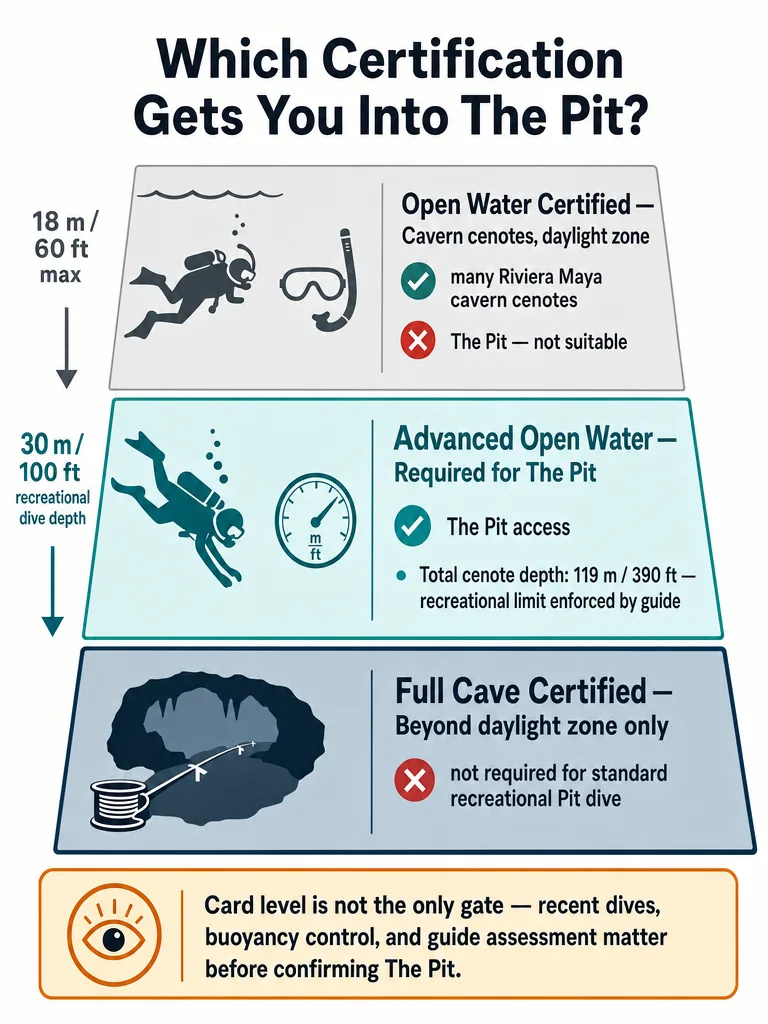
The certification jump comes down to one number: depth. Seth Dive's cenote guide explains that Open Water certification covers recreational cavern dives up to 18 meters / 60 feet, in the zone where natural daylight stays visible. Advanced Open Water extends that recreational limit to 30 meters / 100 feet, which is exactly The Pit's normal dive profile.
So The Pit's guided profile lands right at the ceiling of Advanced training and well below the Open Water limit. That gap is the whole reason operators screen you by site rather than treating every cenote the same.
Depth changes how a dive behaves. Air lasts less time, buoyancy is easier to lose on a steep descent, and there's less margin for a fumbled skill. Advanced Open Water adds a deep-dive adventure dive specifically to build comfort in that 18-to-30-meter range, which is why it's the training standard operators point to.
| Certification | Recreational depth limit | Example cenotes |
|---|---|---|
| Open Water | 18 m / 60 ft | Dos Ojos, Casa Cenote, Carwash |
| Advanced Open Water | 30 m / 100 ft | The Pit, Angelita, Dreamgate, Taak Bi Ha |
Not sure whether Advanced is worth the extra course days for your trip? We break that down in whether Advanced Open Water pays off for cenote diving.
Can Open Water divers dive The Pit cenote?
Open Water is not the right certification for The Pit, because the standard dive there runs to about 30 meters / 100 feet, and Open Water training tops out at 18 meters / 60 feet. La Calypso Dive Center confirms it directly: you need to be Open Water or level 1 certified for most cavern cenotes, but for the deepest dives like The Pit or Angelita, advanced certification is required.
Here's the reassuring part. Open Water opens the door to a genuinely long list of Riviera Maya cavern cenotes, not the leftovers. La Calypso notes that as soon as you're certified, you can dive Dos Ojos or Casa Cenote, and that the light shows, haloclines, and limestone formations in those daylight-zone sites are the same postcard scenery people travel for.
What makes an Open Water cenote dive work is buoyancy control and a guide who keeps you in the cavern zone with clear sight of an exit. Get those two right and a shallow cenote can be the best dive of the trip.
If you hold Open Water and want the strongest options near town, see our roundup of the best cenotes for Open Water divers near Tulum. Tell Seth your certification and how recently you've dived, and you'll get a site list that fits your card.
What is the difference between cavern diving and cave diving in cenotes?
Cavern diving stays inside the daylight zone, where natural light and an open path to the surface are always in view; cave diving goes past that zone into overhead passages with no direct exit. That single line is the difference that decides which certification you need. As one diver in the r/scuba community put it, cavern certification is enough to dive caverns, and you only need cave training to go beyond the cavern zone.
The Pit falls on the cavern side of that line for recreational tours. Scuba Guide notes The Pit is an open cenote that does not require a cavern specialty certification, because guided dives stay in the illuminated, open water of the shaft rather than penetrating the surrounding cave system.
| Cavern dive | Cave dive | |
|---|---|---|
| Light | Natural daylight visible | Total darkness beyond the zone |
| Exit | Open path to surface in sight | No direct exit; guideline required |
| Certification | Open Water or Advanced (by depth) | Full Cave Diver |
| The Pit fits here | Yes, as a recreational deep dive | No, that's the wider Sac Actun system |
The Pit connects to the massive Sac Actun cave system, but a recreational dive never enters it. If you want the full picture before booking, our guide to cavern vs cave diving for tourists walks through what each level actually allows.
Do you need cave certification to dive The Pit cenote?
No. Full Cave certification is not required for a normal recreational dive in The Pit. Seth Dive's cenote guide explains that Full Cave Diver certification is mandatory only for diving beyond the daylight zone in a full cave system, and a guided Pit dive stays in the open, lit shaft at around 30 meters / 100 feet. Scuba Guide makes the same point: The Pit is an open cenote and needs no cavern specialty card.
What you do need is discipline about the recreational limits. A guided Pit dive works because the guide controls the depth, the route, and the profile, keeping the group inside the zone that Advanced Open Water training covers. The card that gets you in the water is Advanced, not cave.
Many of the guides who run these sites hold cave certifications themselves. La Calypso, for one, describes its multilingual guides as full-cave-certified divers with a minimum of 10 years leading cenotes. That's the safety net working in your favor: your guide trains for the environment so your dive can stay comfortably recreational.
How deep is The Pit cenote dive?
El Pit's maximum depth is reported at 119 meters / 390 feet, but guided recreational dives are conducted only to about 30 meters / 100 feet, according to Jaguar Divers. That gap between the site's true depth and the diving depth is exactly why recreational tours are so tightly guided.
The dive itself is short and structured. Scuba Guide puts the run time at about 40 minutes, including a safety stop at 5 meters, and describes it as a single-tank descent and controlled return rather than a long swim through passages.
The scenery in that 30-meter window is the reason people book it. Ko'ox Diving describes a 100-foot pillar of light cutting through the water, with the water sitting at a cool 25°C / 78°F. Scuba Guide places the halocline and hydrogen sulfide layer at around 27 meters, so you drop through a shimmering, distorted band of mixed fresh and salt water before the eerie cloud and ancient tree trunks come into view near the bottom of the recreational profile.
For thermal protection, plan for a 5mm wetsuit; that 25°C water feels chilly over a 40-minute dive.
Is The Pit cenote an advanced dive?
Yes, The Pit is an advanced dive, and not only because of the card on the wall. The site combines real depth of about 30 meters / 100 feet, a steep vertical descent, and buoyancy demands that leave little room for error. Jaguar Divers states plainly that "the depth and steep vertical descent of this cenote mean it's not recommended as a first dive."
The vertical profile is what sets it apart from a flat cavern swim. You descend down an open shaft, passing through the halocline near 27 meters, and buoyancy control has to hold the whole way down and back up. A diver who's rusty or heavy-handed on the inflator will feel that far more here than in a shallow site.
Air management adds to it. At 30 meters you consume gas faster, so the roughly 40-minute window depends on staying calm and efficient. That's a skill built through recent, regular diving, not one you recover on the fly.
The Advanced card is the entry requirement, but recent dives and steady buoyancy are what actually make The Pit a good idea for you.
If nerves are part of the equation, our tips for feeling confident before a dive are worth a read before you commit to a deep vertical site.
Can beginners dive The Pit cenote?
Beginners should not plan The Pit as a first dive, and it splits cleanly into three cases. A newly certified Open Water diver doesn't hold the right card for a 30-meter dive. A brand-new diver has neither the certification nor the buoyancy experience the vertical descent demands. And non-divers can't experience El Pit at all: Jaguar Divers answers "Can you snorkel in El Pit? No."
The better first-experience options are easy to find. Non-certified travelers can try Discover Scuba in a cenote, a guided intro dive with an instructor. Newly certified divers do well starting in shallow daylight cenotes like Dos Ojos or Casa Cenote, where the light shows are spectacular and the profile is forgiving.
Think of The Pit as a dive to grow into. Log some dives, tighten your buoyancy, add the Advanced card, then come back for the descent when you'll actually enjoy it rather than fight it.
Not sure what your first dive should even be? Our guide to choosing your first scuba experience matches the right option to your comfort level.
Which Riviera Maya cenotes fit Open Water and Advanced divers instead?
The cleanest way to plan is by certification tier. Open Water divers fit the daylight cavern routes; Advanced Open Water unlocks the deeper and more technical sites. La Calypso Dive Center draws that line directly: Open Water or level 1 works for most cavern cenotes, while The Pit, Angelita, Dreamgate, Taak Bi Ha, and Nicte Ha require advanced certification.
| Certification | Cenotes that fit | Why |
|---|---|---|
| Open Water | Dos Ojos, Casa Cenote, Carwash | Daylight cavern zone, within 18 m / 60 ft |
| Advanced Open Water | The Pit, Angelita, Dreamgate, Taak Bi Ha, Nicte Ha | Deeper or more technical, to 30 m / 100 ft |
Casa Cenote plays a useful second role. La Calypso notes it's mandatory to have dived within the last year to cenote dive, and if you haven't, a quick refresher in Casa Cenote gets you ready before the cavern sites. It's also where your logged-dive count comes in: newly certified divers can jump into Dos Ojos or Casa Cenote right away, while the advanced sites expect a minimum amount of experience first.
So the progression is simple. Start in the daylight cenotes, build dives and buoyancy, add the Advanced card, then step up to The Pit and Angelita. For the full menu, see our 10 best cenotes for diving in Riviera Maya.
The Pit vs Angelita vs Dos Ojos: which certification fits your trip?
Dos Ojos is the accessible Open Water pick; The Pit and Angelita are the deeper Advanced Open Water dives. La Calypso Dive Center groups The Pit and Angelita together as advanced-only deep cenotes, while Dos Ojos sits among the cavern sites any certified diver can enjoy right after training.
| Cenote | Certification | Character |
|---|---|---|
| Dos Ojos | Open Water | Shallow daylight cavern, famous light beams |
| The Pit | Advanced Open Water | Deep vertical shaft to 30 m, halocline and sulfide cloud |
| Angelita | Advanced Open Water | Deep dive with an eerie hydrogen sulfide layer |
The moods are as different as the depths. Dos Ojos is bright and social, with the sunlit beams Seth Dive's guide is known for. Angelita is surreal and dark, defined by its hydrogen sulfide cloud. The Pit is the vertical descent with the shaft of light and the drifting mist below.
Many trips pair a deep site with an easy one, which is why The Pit is so often combined with Dos Ojos in the same day. For a fuller side-by-side, see how to choose between Angelita, The Pit, and Dos Ojos.
What should you confirm before booking The Pit near Tulum?
Before you book The Pit, confirm five things: your Advanced certification, your recent dive history, whether you need a refresher, the park and camera fees, and how the day is paired. Operators screen for the first three because The Pit's depth and vertical descent leave no room for a rusty diver, as Jaguar Divers notes it's "not recommended as a first dive."
Run this quick checklist:
- Proof of Advanced certification. La Calypso Dive Center says a valid level 2 or advanced card is required at booking to confirm deep cenotes like The Pit.
- Recent dive history. La Calypso also states it's mandatory to have dived within the last year; if not, plan a refresher first.
- Refresher dive if inactive. A quick session at Casa Cenote gets rusty divers ready before the deep profile.
- Fees. Jaguar Divers lists a camera entrance fee starting at 300 MXN, with GoPros free; Triton Diving puts Dos Ojos Park entry around 600 pesos, often included in packages.
- Site pairing. The Pit is commonly combined with Dos Ojos: Jaguar Divers lists that combo at $219 USD all-in, or The Pit added as a third dive for $85.
Seth Dive Mexico's specific policies and inclusions for a Pit trip aren't published here, so message Seth with your hotel, certification level, and last dive date for a straight answer. Also useful when planning the day: how many cenote dives you can do in one day and how hotel pickup works from Cancun to Tulum.
Frequently asked questions
What certification do you need to dive The Pit cenote?
Advanced Open Water certification is required — The Pit's guided dives reach 30 meters / 100 feet, which exceeds the 18-meter / 60-foot limit of an Open Water card. Multiple operators confirm this: Ko'ox Diving calls it suitable for advanced divers, and La Calypso states a valid level 2 or advanced card is required at booking to confirm the tour. A deep-diving specialty added to an Open Water card is not a substitute.
Can an Open Water diver dive The Pit cenote?
No — The Pit's 30-meter / 100-foot profile sits well past the Open Water depth limit of 18 meters / 60 feet. Open Water divers have strong alternatives, though: Dos Ojos and Casa Cenote offer the same postcard formations — light beams, haloclines, limestone stalactites — within the cavern zone any certified diver can reach. Those sites aren't consolation prizes; they're the reason most people travel to the Riviera Maya in the first place.
Do you need cave certification to dive The Pit cenote?
No. A guided recreational dive in The Pit stays inside the open, illuminated shaft at around 30 meters and never enters the surrounding Sac Actun cave system. Scuba Guide confirms The Pit is an open cenote requiring no cavern specialty card. Advanced Open Water is the credential that gets you in the water. Your guide, however, will typically hold full cave certification — that experience is part of the safety net on every guided descent.
How deep is The Pit cenote dive?
El Pit's maximum explored depth is 119 meters / 390 feet, but guided recreational dives turn around at 30 meters / 100 feet, according to Jaguar Divers. The dive runs about 40 minutes including a safety stop at 5 meters. The halocline and hydrogen sulfide layer sit near 27 meters, so divers pass through a shimmering band of mixed fresh and salt water just before the eerie mist and ancient tree trunks come into view at the bottom of the recreational profile.
Is The Pit cenote suitable for beginner divers?
Beginners shouldn't plan The Pit as a first dive — Jaguar Divers states plainly that the depth and steep vertical descent make it not recommended as a first dive. Non-certified travelers can't snorkel it either; Jaguar Divers confirms snorkeling in El Pit is not possible. Better starting points are a Discover Scuba experience in a shallow cenote or a guided Open Water dive at Dos Ojos, where the profile is forgiving and the scenery is just as rewarding.
What cenotes can Open Water certified divers explore near Tulum?
Open Water divers fit comfortably in daylight cavern sites within 18 meters / 60 feet. La Calypso lists Dos Ojos, Casa Cenote, and Carwash as accessible as soon as you're certified. These cenotes offer the same crystal visibility, sunlit formations, and halocline effects that draw divers to the Yucatán. Casa Cenote also doubles as a refresher site if you haven't dived in the past year — a requirement operators enforce before any cenote dive.
Sources
- Would it be foolish to do cenote diving without cave ...www.facebook.com
- Diving Mexico's cenotes with open water certificationwww.kooxdiving.com
- Deep Diving in The Pit Cenote, Mexico | Ko'ox Divingwww.lacalypsodivecenter.com
- Cenote Diving in Mexico: The Complete Guide for 2026jaguardivers.com
- Scuba Diving in Cenote El Pit. All Inclusive Tour - Book Nowwww.tritondiving.mx
- Cenote The Pit : Everything You Need to Knowscuba-guide.com