What Is a Cenote? Meaning, Geology, and Types
What is a cenote? A cenote is a natural limestone sinkhole in the Yucatán; learn how it forms, why it’s common there, and the main types.
What Is a Cenote?
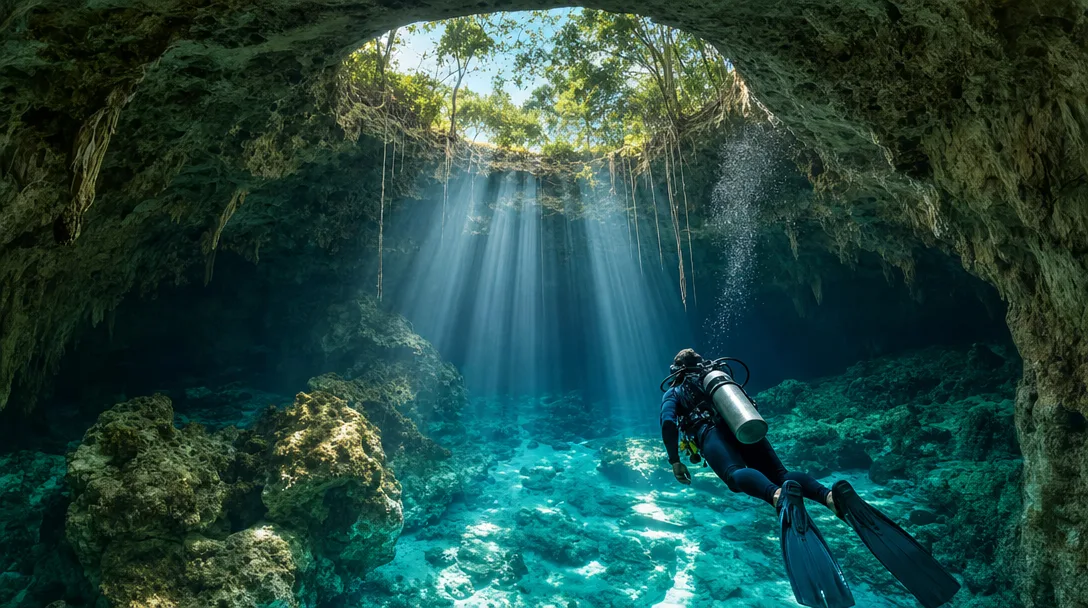
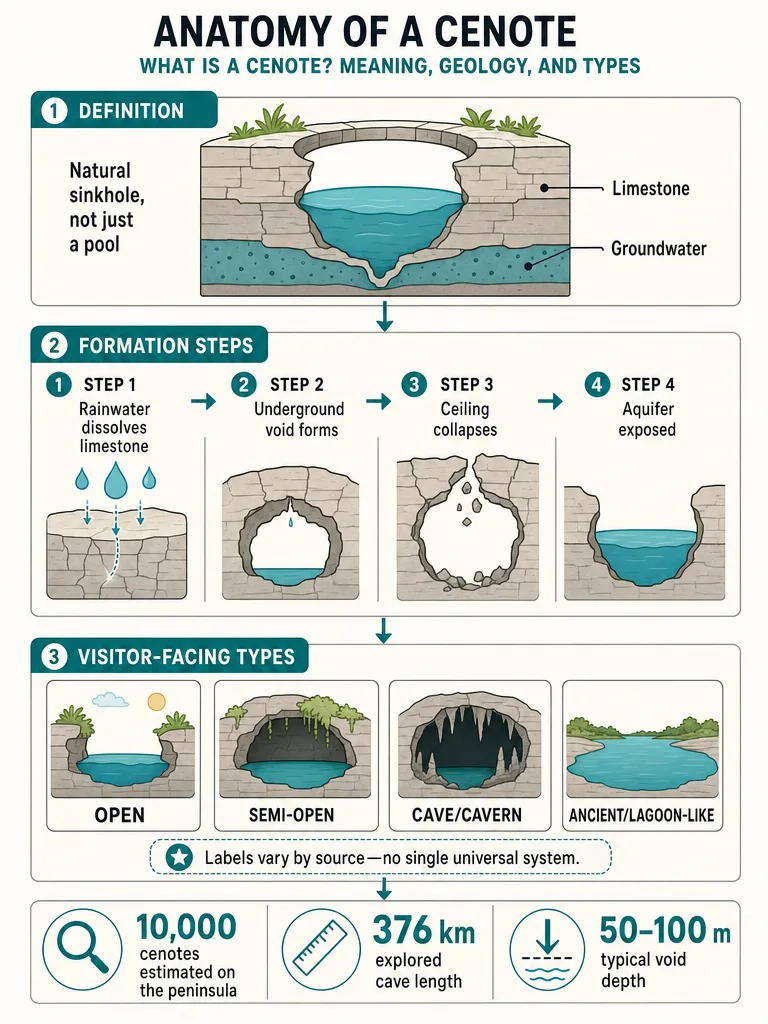
A cenote is a natural sinkhole that forms when collapsing limestone bedrock exposes the groundwater sitting beneath it. The term comes from the Yucatec Maya word tsʼonoʼot, sometimes written dzonot, which referred to any spot with accessible groundwater, and it entered English by at least 1841. Found almost exclusively across Mexico's Yucatán Peninsula, cenotes range from small tree-root openings barely a meter wide to open pools tens of meters across, like the famous Sacred Cenote at Chichén Itzá. The peninsula holds an estimated 10,000 cenotes, according to Wikipedia, though a lower, less-verified figure of 6,000 also circulates.
Most cenotes hold water that is remarkably clear, since it arrives through slow rainwater filtration rather than surface runoff carrying sediment. That clarity, more than the sinkhole shape itself, is why so many travelers in the Riviera Maya end up planning a whole vacation day around visiting one.
How Is a Cenote Formed?
Rainwater sets cenote formation in motion over thousands of years, not through a single collapse event. It picks up carbon dioxide as it filters through soil, turning slightly acidic, then dissolves the calcium and magnesium carbonates in the Yucatán's limestone bedrock. The Northwestern University speleogenesis research site describes that dissolution process, called karstification, in stages:
- Infiltration: Rainwater seeps through cracks in the limestone, slowly widening them into channels.
- Void formation: Continued dissolution carves out underground caves and tunnels beneath the surface.
- Weakening and collapse: Rock blocks fall into the water below and keep dissolving, which opens room for more collapse and speeds up the process.
- Surface exposure: The cave ceiling eventually gives way entirely, opening a pit that connects to the aquifer below.
Sea-level history adds another layer. According to the same Northwestern source, during the Last Glacial Maximum, roughly 20,000 years ago, sea level sat about 120 meters below where it is today, so many caves that are now flooded cenotes were once dry. As glaciers melted and the ocean rose, those caves filled with water, turning ancient dry caverns into the swimmable cenotes divers explore now.
Why Are Cenotes So Common on the Yucatán Peninsula?
Cenotes concentrate on the Yucatán Peninsula because the region sits on a young, porous limestone platform with almost no relief and almost no surface rivers. The Northwestern speleogenesis source notes that the northern peninsula is nearly flat, with altitudes that barely exceed 30 meters, so rainwater has nowhere to run off and instead sinks straight into the ground.
That land is only the visible edge of a much larger structure: the Yucatán Carbonate Platform, built up over millions of years from the compacted skeletons of marine organisms. On the eastern coast, in Quintana Roo, the seafloor drops off abruptly compared to the shallow platform that extends for kilometers toward the Gulf of Mexico side. The bedrock here is soft, young, and saturated with groundwater, so karstification happens efficiently in a way it doesn't in regions with older, harder, or less porous rock. Instead of carving surface rivers, water in the Yucatán moves almost entirely underground, and cenotes are where that underground system becomes visible.
What Are the Main Types of Cenotes?
Guides typically group cenotes by how much of the original cave ceiling remains intact, since that determines how open the pool is to sunlight and jungle above. Tour operator Xenotes describes four common categories used around Cancún, Tulum, and Playa del Carmen, ranging from young, mostly enclosed cenotes to older, fully collapsed ones.
| Type | Roof condition | What you'll see |
|---|---|---|
| Cavern cenote | Youngest; roof mostly intact with holes | Emerald-to-blue water glimpsed through openings in the vault |
| Semi-open cenote | Middle-aged; partly collapsed | Some open sky, sometimes connected to neighboring cenotes |
| Open cenote | Oldest; vault fully collapsed | Full sunlight, exposed pool, often rich with visible plant and animal life |
| Ancient cenote | Long-collapsed, lagoon-like | Broad, oasis-like water surrounded by jungle |
Bahia Principe describes the same spectrum with simpler language: some cenotes are fully open to the outside, some remain partially covered, and fully enclosed ones are usually called cave cenotes. Both descriptions agree on the underlying mechanic. The less roof that's left, the more a cenote looks like an open pool rather than a cave.
Why Cenote Type Labels Vary Between Guides and Sources
No single, universal naming system governs cenote types, so two reliable sources can sort the same cenote differently. Xenotes uses four labels: cavern, semi-open, open, and ancient. Bahia Principe collapses that into a simpler split between open, semi-exposed, and cave cenotes, and notes that fully enclosed ones are what most people mean by "cave cenote." Both are drawing the line at different points along the same collapse spectrum.
This matters more than it sounds, because a guide calling a site a "cavern cenote" and another calling the same site a "semi-open cenote" can leave a first-time visitor unsure what to expect underwater. When you're booking a trip, ask what the site actually looks like below the surface, full sunlight, partial cover, or true cave passage, rather than relying on a single label to tell you.
Open Cenote vs Cave Cenote: What's the Difference?
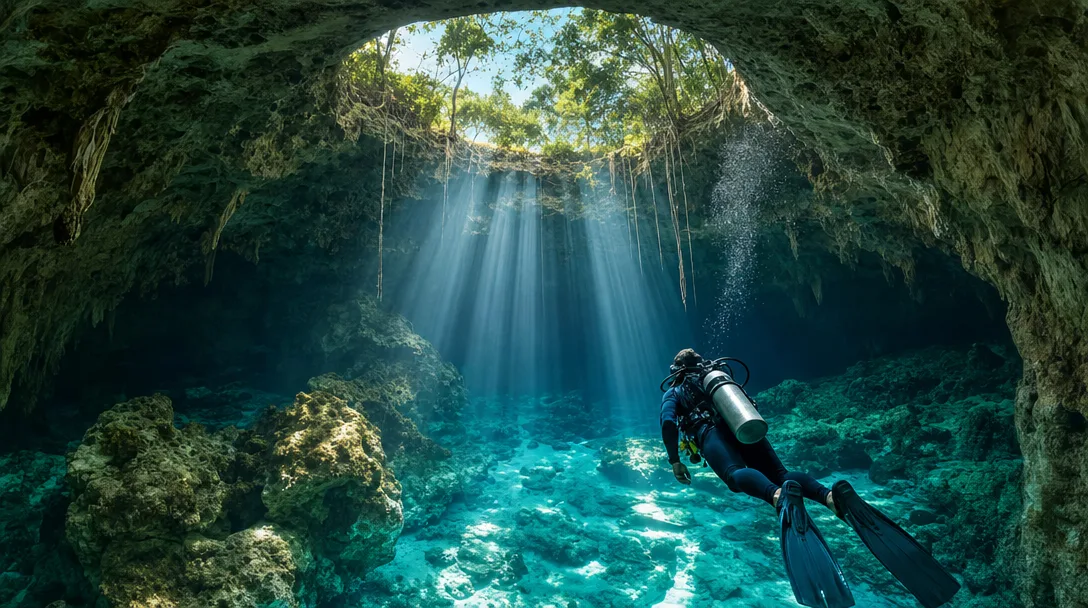
An open cenote has a fully collapsed roof, so sunlight reaches the water directly and the pool looks like a jungle-ringed swimming hole. A cave cenote, also called cavern, keeps most of its ceiling intact, so light enters only through gaps or an entrance, and the interior often preserves stalactites, stalagmites, and other formations that developed before the space flooded.
The practical difference comes down to feel. Open cenotes tend to be brighter and easier to read visually since there's nothing overhead. Cave cenotes are darker, quieter, and more enclosed, with the rock structure itself part of the draw. GoVisitCancun notes that some cenotes retain sections of their original cave systems complete with crystal-clear water and dramatic rock formations, while others opened up entirely once the ceiling gave way. The right type for you depends on whether you want open-water ease or an enclosed, cave-like setting.
Are Cenotes Freshwater or Saltwater?
Most cenote water starts fresh, but in cenotes deep or close enough to the coast, freshwater sits on top of a denser layer of saltwater, separated by a halocline. Wikipedia describes cenotes as surface connections to the Yucatán's groundwater, and along the coast that groundwater interacts with seawater pushing in from the Caribbean.
Xenotes explains the geological result: where seawater enters the continental limestone and meets the freshwater flowing through underground rivers, the halocline zone dissolves rock faster than freshwater alone would, which helps carve out the large flooded chambers found in systems like Dos Ojos and Sac Actun. Divers who pass through a halocline layer often notice a shimmering, blurry visual effect where the two densities of water meet before mixing. Most cenotes you'll swim in near the surface are freshwater, but many of the larger coastal systems have a saline layer waiting below.
Do Cenotes Connect to Larger Underground Cave Systems?
Many cenotes are surface entrances into much larger flooded cave networks rather than standalone pools. Wikipedia reports that divers have mapped some of these Yucatán cave systems for 376 km (234 mi) or more, and water inside them can flow at rates up to 10 kilometers (6 mi) per day. Named systems like Sac Actun and Dos Ojos, both cited by Xenotes as products of halocline-driven dissolution, show how far a single cenote entrance can lead.
That's a meaningful distinction for anyone planning a Riviera Maya trip. A cenote billed as a simple swimming stop might be exactly that, a contained pool, while another with the same surface appearance could open into miles of connected passage. Río Secreto, cited by GoVisitCancun as one of the region's best-known underground river systems, shows how much cave can exist behind what looks like a modest entrance. If you're deciding between cavern diving and true cave diving, this is the underlying reason the distinction exists: some sites stay within daylight zones, and others keep going.
What Did Cenotes Mean to the Maya?
The ancient Maya depended on cenotes as a primary freshwater source across a peninsula with no surface rivers, and treated many of them as sacred ground at the same time. Wikipedia notes the Maya sometimes used cenotes for sacrificial offerings, most famously at the Sacred Cenote of Chichén Itzá.
Xenotes describes the cultural weight in more detail: cenotes represented a duality of life and death. They were a water source for entire cities, and they were also a symbolic gateway to Xibalba, the Maya underworld. Rituals took place at these sites, with the earliest known written record appearing in the Popol Vuh. That combination of essential utility and spiritual meaning is part of why cenotes carry a different weight than an ordinary swimming hole, whether you're snorkeling a bright open pool or following a guide into a dim cavern passage.
Which Cenote Type Is Best for Snorkeling or Diving?
Open and semi-open cenotes generally suit snorkelers and first-time visitors best, since sunlight reaches the water and there's no overhead rock to navigate around. Cavern and cave cenotes fit certified divers better, because low light, overhead cover, and the need for controlled buoyancy call for real training, not just comfort in water.
If you're deciding what fits your trip, the type of cenote matters more than the name of the site. A bright, open pool like the ones covered in our guide to the best cenotes to snorkel near Playa del Carmen works well for families, beginners, and non-swimmers who just want to float and look down. A cavern-zone dive, the kind detailed across our 10 best cenotes for diving in the Riviera Maya, calls for at least Open Water certification and a guide who knows the specific route.
Seth Dive Mexico plans cenote days around your certification level and comfort, from a first snorkel in an open pool to a guided cavern-zone dive, with free hotel pickup from Cancún to Tulum built into the plan. If you're weighing options, message Seth with your travel dates, hotel, and experience level and he'll match you to the right cenote type for your trip.
Frequently asked questions
What is a cenote?
A cenote is a natural sinkhole formed when collapsing limestone bedrock exposes the groundwater underneath. The word comes from the Yucatec Maya term tsʼonoʼot, meaning a spot with accessible groundwater, and entered English by 1841. The Yucatán Peninsula holds an estimated 10,000 cenotes, ranging from tree-root openings barely a meter wide to open pools tens of meters across, like the Sacred Cenote at Chichén Itzá.
How does a cenote form?
Rainwater slowly dissolves limestone bedrock over thousands of years through a process called karstification. Rain picks up carbon dioxide from soil, turns slightly acidic, and eats away at calcium and magnesium carbonates, carving underground caves and tunnels. Rock blocks fall into the water below and keep dissolving until the cave ceiling collapses entirely, opening a pit connected to the aquifer beneath - that's a cenote.
What are the main types of cenotes?
Cenotes fall into four common categories based on how much of the original cave roof survives: cavern (youngest, roof mostly intact with holes), semi-open (partly collapsed), open (roof fully collapsed, full sunlight), and ancient (long-collapsed, lagoon-like). The less roof that remains, the more a cenote looks like an open swimming pool instead of an enclosed cave.
What's the difference between an open cenote and a cave cenote?
An open cenote has a fully collapsed roof, so sunlight reaches the water directly and it looks like a jungle-ringed swimming hole. A cave cenote, also called a cavern, keeps most of its ceiling intact, so light enters only through gaps, and the interior often still holds stalactites and stalagmites that formed before the space flooded. Open cenotes suit relaxed swimming; cave cenotes suit divers drawn to dark, enclosed passages.
Are cenotes freshwater or saltwater?
Most cenote water starts fresh, but in cenotes near the coast, a denser layer of saltwater sits below the freshwater, separated by a halocline. That halocline zone dissolves limestone faster than freshwater alone, which helped carve the large flooded chambers found in systems like Dos Ojos and Sac Actun. Divers passing through a halocline often notice a shimmering, blurry effect where the two water densities meet.
Do cenotes connect to larger underground cave systems?
Many cenotes are surface entrances into much larger flooded cave networks rather than standalone pools. Divers have mapped some Yucatán cave systems for 376 km (234 mi) or more, with water flowing at rates up to 10 kilometers (6 mi) per day inside them. A cenote that looks like a simple swimming hole can open into miles of connected passage, as seen in systems like Sac Actun and Dos Ojos.