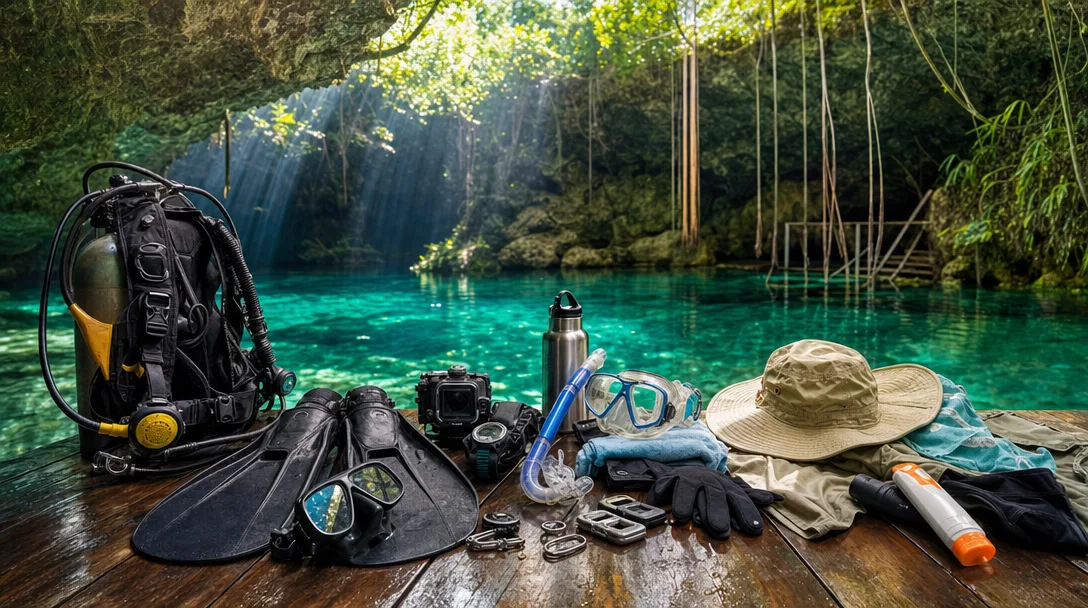
What to Pack for a Cenote Dive Day (and What to Leave)
What to pack cenote diving: thermal protection, secure footwear, dry storage, and a dive light for Dos Ojos or Gran Cenote.
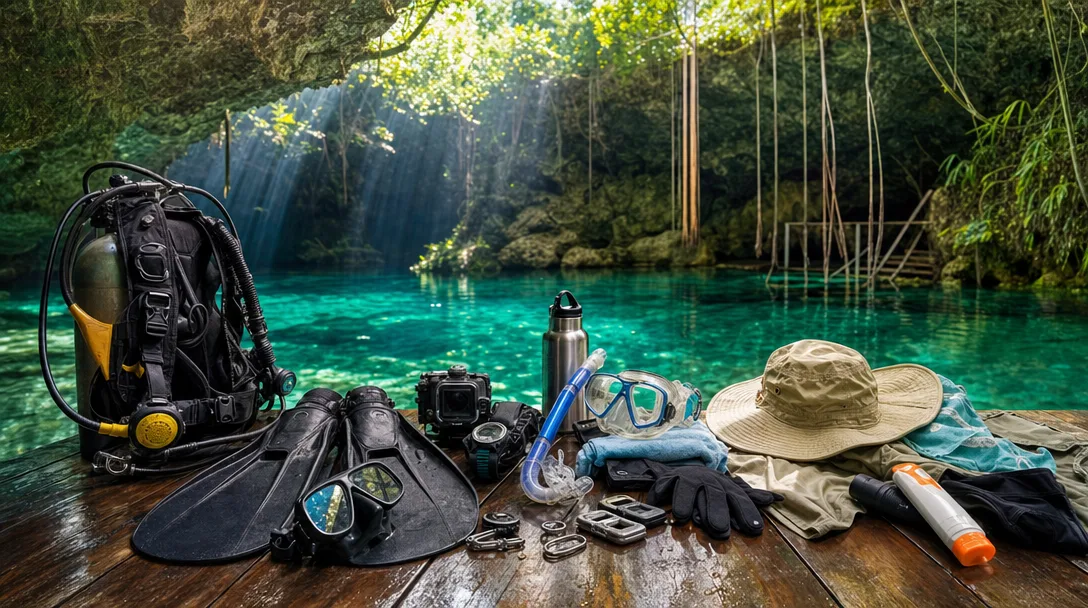
What Do You Actually Need to Pack for Cenote Diving?
Packing for cenote diving comes down to three things regardless of what your operator supplies: thermal protection, secure footwear, and dry storage. Cenote water holds a steady 24-26°C (75-78°F) year-round, according to InfoMexico's cenote guide, and pulls heat from the body faster than warm jungle air.
A cenote is a natural limestone sinkhole across the Yucatán Peninsula, formed where a cave ceiling collapsed and exposed groundwater below the jungle floor. Every cenote day layers three separate needs: staying warm in freshwater that feels colder than the thermometer suggests, keeping your footing on wet limestone steps, and keeping your phone, wallet, and clothes dry between the parking area and the water.
Packing priorities shift by activity. A certified diver descending at a site like Dos Ojos or Gran Cenote needs a dive light and weighting adjusted for freshwater buoyancy. A snorkeler or first-time visitor needs less gear overall but still needs a wetsuit, a life jacket where required, and a dry bag for valuables.
Gear inclusions vary by operator and by trip type, so ask exactly what's provided, the tank, BCD (buoyancy control device), weights, and wetsuit, before you decide what to pack yourself. That one question upfront saves you from either hauling gear you didn't need or showing up short on something the trip assumed you'd bring.
Do You Need Your Own Gear for Cenote Diving in Mexico?
Whether you need your own gear for cenote diving depends on the operator, since inclusions differ from trip to trip. The safest approach is to ask directly what's included before you book, rather than assume every operator supplies the same list. Standard scuba equipment, the tank, regulator, BCD, and weights, is commonly supplied on guided cenote trips, while items tied to personal fit and comfort are worth bringing yourself.
Your own mask, a dive computer you already know how to use, and a wetsuit that actually fits are worth packing regardless of what's included. A mask that leaks or fogs is a bigger problem underground than on a reef, and a computer you've never touched before adds one more thing to think about in an overhead environment.
Guided cenote routes generally stay within recreational depth and distance limits rather than full cave-diving penetration, which is part of why operators can supply much of the technical gear. If your certification card lists Open Water only, ask your operator which cenote sites and routes fit your training level, and how gear responsibilities split between you and the guide, before deciding what to pack. This guide to gear ownership for cenote diving in Mexico walks through the split in more detail.
What Should Certified Divers Pack for a Cenote Dive Day?
Certified divers need a shorter gear list than a reef trip but more precision, since overhead sections leave little room for a lost light or bad buoyancy. A detailed cenote diving guide narrows the personal list to a handful of items built around visibility, warmth, and freshwater buoyancy.
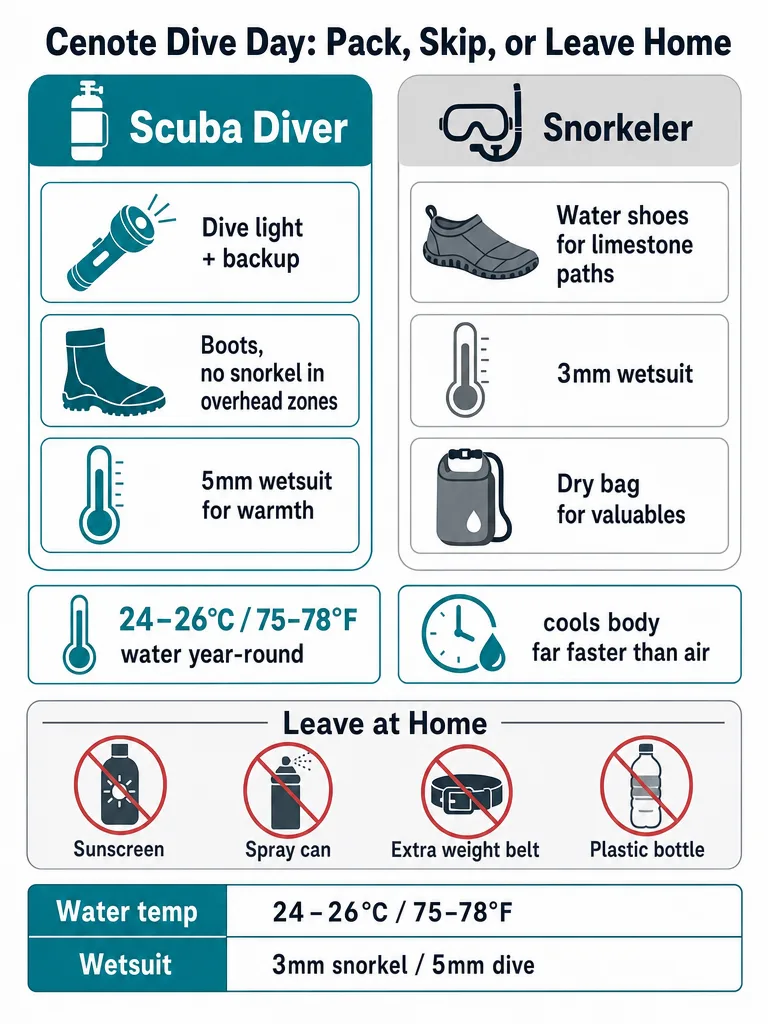
- A primary dive light plus a backup light. Cenotes can be dimly lit even where daylight reaches the entrance pools, and a second light matters if the first one fails underground.
- A low-volume mask, fit-tested before the trip. Best Cenote Dives' mask-fit method is simple: press the mask to your face without the strap and inhale gently to check whether it seals without leaking.
- Dive boots or closed-heel fins. Limestone entry platforms get slick, and open-toe sandals don't survive the walk down.
- Reduced weighting versus your saltwater setup. Freshwater is less dense than seawater, so the weight that floats you comfortably on a reef dive will overweight you in a cenote.
- No snorkel. A cenote diving guide recommends leaving it behind entirely, since it can catch on roots or rock in overhead sections.
- Ask your operator which certification level and route fit your training before you book. Guided cenote dives range from open, well-lit cavern zones to routes that call for more advanced training.
What Changes on a Cenote Snorkeling Packing List?
Snorkeling drops most of the dive-specific gear but keeps the same cold-water and cash-only realities as diving. A cenote-focused snorkeling packing list recommends a 3mm-5mm wetsuit, a low-volume mask, and a dry bag as the core kit, while Hard Rock Hotel Riviera Maya's cenote guide adds practical basics that group tours often skip explaining, like footwear and food.
- A 3mm-5mm wetsuit or long-sleeve rash guard, lighter than a diver's 5mm suit but enough to blunt the chill on a multi-hour outing.
- A low-volume mask with a dry snorkel. Expect to spend $30 to $150 for a mask worth owning, per that same cenote snorkeling packing list.
- A life jacket if your cenote requires one. Most do; ask your operator or the site attendant whether rental is available if you don't own one.
- A waterproof phone case or dry bag. Locker availability varies by cenote, so don't assume one will be there for your backpack and towel.
- Two swimsuits, a quick-dry towel, and water shoes with grippy soles, per that same packing list. Hard Rock Hotel Riviera Maya's simpler version recommends wearing your swimsuit from the hotel, packing a small towel, and bringing tennis shoes or water shoes for the walk.
- An insulated water bottle and a light snack, since some cenotes sit well outside the nearest food stand.
There's no dive light, no weight belt, and no computer on this list, which is the real difference from a diver's kit. If you're deciding which open-air cenote fits a snorkeling group, the best cenotes to snorkel near Playa del Carmen breaks down depth, shade, and crowd levels site by site.
What to Leave at Home for a Cenote Trip
Sunscreen applied before you enter the water is the most common cenote packing mistake, and it isn't the only thing worth leaving behind. InfoMexico's cenote guide notes that most sites are cash-only and that many restrict sunscreen and insect repellent to protect the water and the ecosystem inside it; some cenotes ban both products outright, while others allow only biodegradable formulas applied after you're out of the water.
- Sunscreen and bug spray before you swim. Apply reef-safe sunscreen after you're back on dry land, and bring a rash guard and a hat as your before-swim sun protection instead.
- A snorkel, if you're scuba diving. It's dead weight on a certified dive and a snag risk in overhead sections.
- Saltwater-style weighting. The lead you wear on a reef dive will overweight you in freshwater; ask your guide for a cenote-specific weight check instead of guessing from memory.
- Non-biodegradable personal-care products generally. Some cenotes restrict them beyond sunscreen and bug spray, per a cenote snorkeling packing list's note on protecting fragile freshwater ecosystems.
- Large bills. Small-denomination pesos move faster at entry booths and locker counters than a note an attendant can't change.
Is Cenote Water Cold? How Much Wetsuit You Actually Need
Cenote water sits at a steady 24-26°C (75-78°F) year-round, according to InfoMexico's cenote guide, cold enough to matter over a multi-hour day even though it never approaches ocean-cold extremes. A cenote-focused packing guide notes that water pulls heat away from the body up to 25 times faster than air, which is why a wetsuit matters more here than the number on a thermometer suggests.
| Activity | Typical water temp | Recommended wetsuit | Why |
|---|---|---|---|
| Cenote snorkeling | 24-26°C / 75-78°F | 3mm-5mm shorty or long-sleeve rash guard | Shorter exposure, more surface movement to generate warmth |
| Cenote scuba diving | 24-26°C / 75-78°F | 5mm full suit | Longer, often repeated dives with less body movement to generate heat |
| No exposure protection | Same water | Not recommended | Water pulls heat away up to 25 times faster than air |
A full 5mm wetsuit, rather than the 3mm suit divers often wear on a warm reef, makes the difference between a comfortable two-dive cenote day and a cold, cut-short one, according to a dedicated cenote diving guide. Snorkelers get away with less thickness because they spend more of the trip at the surface, moving and generating their own warmth. Divers holding relatively still at depth don't get that advantage, which is part of why diving and snorkeling packing lists for the same water land on two different wetsuit recommendations.
How to Pack for the Walk In, the Dive, and the Cold Ride Back
A cenote day has three distinct packing moments: the walk down limestone stairs to the water, time spent in the water, and the ride back to your hotel while you're still damp. Each moment calls for different gear, and packing for only one of them is the most common reason vacationers end up cold, wet, or barefoot on rocky ground.
- Wear water shoes or closed-heel sandals for the walk in. Limestone platforms and jungle paths get slick, and flip-flops don't grip wet stone, per InfoMexico's cenote guide.
- Carry a quick-dry towel separate from your regular hotel towel. It packs smaller and won't leave your bag soaked for the rest of the day.
- Pack a dry bag or two zip-top bags: one for your phone and wallet, one for anything wet mid-trip, like a rash guard peeled off between dives.
- Bring a warm, dry layer, a sweatshirt or light jacket, for the ride back. Freshwater cools the body fast, and an air-conditioned van after a cenote day can feel colder than the water did.
- Confirm transfer time and total trip length with your operator before you go. Cenote sites sit inland, away from the coast, and travel time varies by which cenote and which hotel zone you're starting from, so pack dry clothes for the ride, not just for the water. This look at cenote diving day trip costs and travel time covers the logistics in more detail.
How Much Cash Should You Bring for Cenote Entry Fees and Rentals?
Pack small-denomination pesos for cenote entry fees, lockers, and gear rentals: most cenotes run cash-only, according to InfoMexico's cenote guide, and change is often limited at remote entrance booths. Exact fees vary by site and shift over time, so treat any single number as a rough guide rather than a locked-in price.
One 2020 travel guide from Taylor On A Trip listed Gran Cenote's entrance fee at 180 pesos, around $10 USD at the time. That figure is several years old now and shouldn't be used to plan a current-year budget; check current signage at the cenote itself or ask your operator for today's rate. Taylor On A Trip's broader advice still holds: carry at least a few hundred pesos in small bills to cover entry, lockers, and rentals, since ATMs are rare near cenote parking lots.
Group and self-guided visits usually mean paying these fees separately at the gate. A private cenote trip booked through an operator like Seth Dive Mexico may quote one price that already covers guide time, gear, and transportation, but entry fees and rentals can still land separately depending on the operator, so confirm directly before you land. This breakdown of what's included in private cenote diving costs walks through which inclusions vary between private and group pricing.
Frequently asked questions
Do I need to bring my own wetsuit, or does the operator provide one for cenote diving?
Most guided cenote diving operators supply a wetsuit as part of standard gear, along with the tank, BCD, and weights, so renting separately usually isn't necessary. Confirm this before booking rather than assuming every operator supplies the same list. If you already own a wetsuit that fits well, bring it anyway: fit matters more in cold freshwater than on a warm reef, and rental sizes don't always match your body.
Do you need a scuba certification to visit a cenote, or can beginners go too?
Scuba diving in a cenote requires at least a PADI Open Water certification, while snorkeling requires no certification at all. Certified divers can descend at sites like Dos Ojos or Gran Cenote within recreational depth limits, and non-certified visitors take the snorkeling route instead, wearing a life jacket where required. Ask your operator which route and certification level fit your training before you book.
Is cenote water cold enough that you'd need a drysuit?
No, a drysuit isn't necessary for cenote diving or snorkeling. Cenote water holds a steady 24-26°C (75-78°F) year-round, according to InfoMexico's cenote guide, and a 5mm full wetsuit keeps divers comfortable through a multi-hour, multi-dive day. Snorkelers get away with a lighter 3mm-5mm wetsuit or long-sleeve rash guard since they spend more time at the surface, generating their own warmth.
Are there lockers at cenotes to store my backpack and valuables?
Locker availability depends on the specific cenote, so don't assume one will be waiting for your backpack, phone, or towel. Some sites, like the cenote included with certain resort excursions, offer lockers that only charge a fee if you fail to return the lock. Pack a dry bag or two zip-top bags as backup storage for valuables in case the cenote you visit has none.
What should you wear under your wetsuit for a cenote day?
Wear your swimsuit under your wetsuit, and put it on before you leave the hotel to save time changing at the cenote. Hard Rock Hotel Riviera Maya's cenote guide recommends this shortcut, along with packing a light cover-up for the walk between the parking area and the water. A rash guard underneath adds sun protection, since many cenotes restrict sunscreen applied before you swim.
Can you bring your phone or a camera to take photos inside the cenote?
Yes, phones and cameras are welcome at cenotes, but they need a waterproof case or dry bag rather than an open pocket or backpack. Locker availability varies by site, so that dry bag doubles as your only secure storage if the cenote has no lockers. Action cameras like a GoPro are common for capturing underwater cenote footage, since the clear freshwater visibility works well without a dive light.