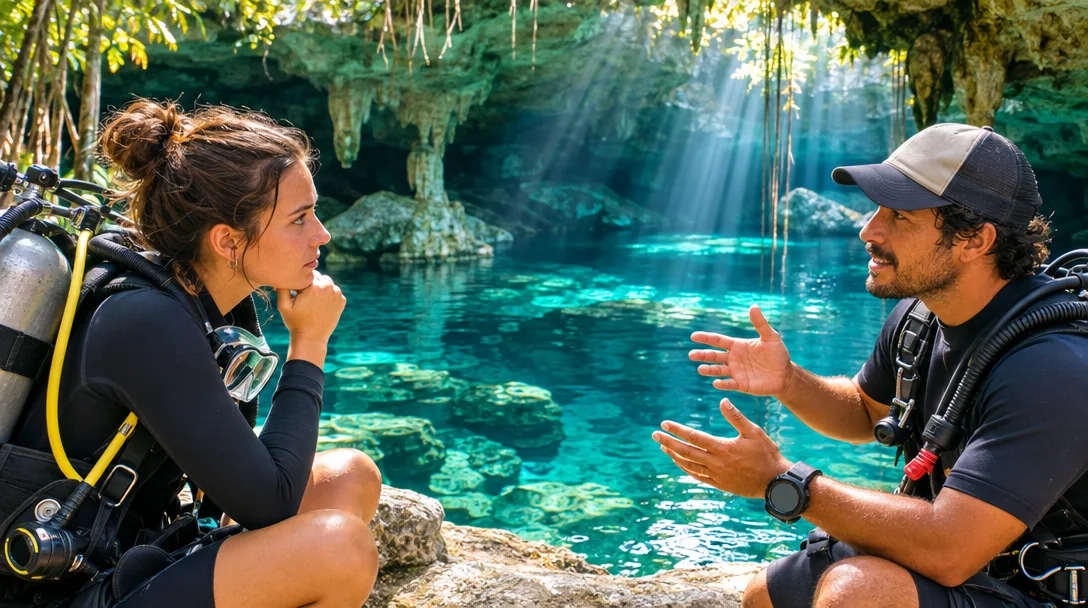
Is Dos Ojos a good dive for a nervous certified diver?
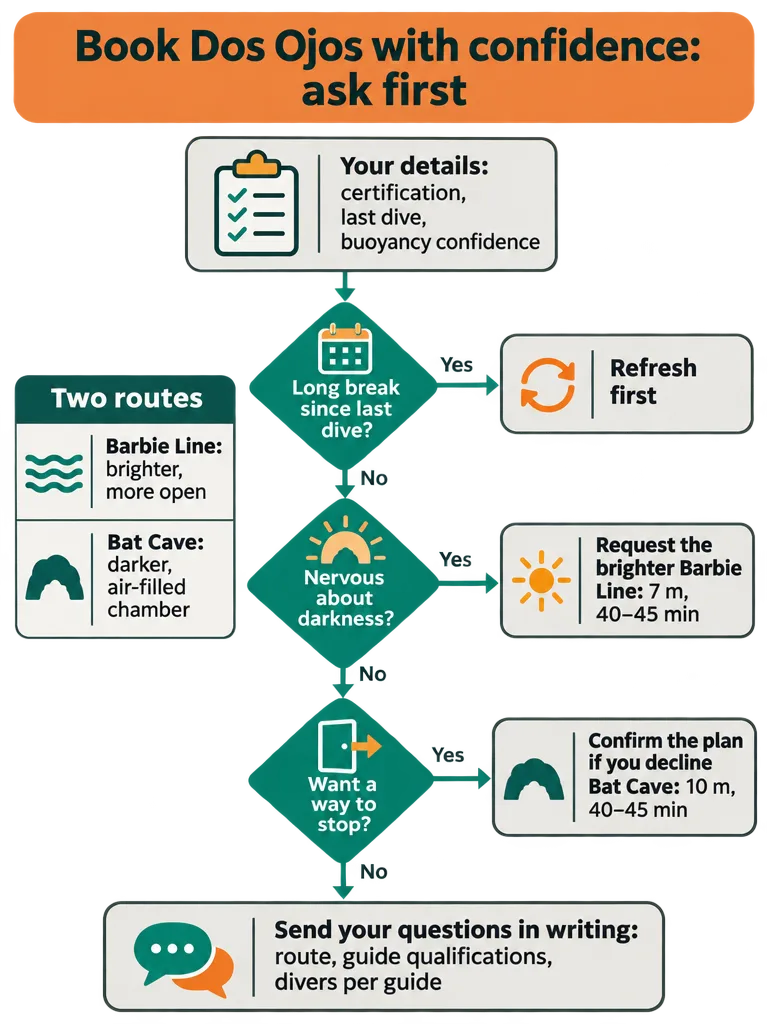
Before booking Dos Ojos as a nervous certified diver, ask how your certification, recent diving, and buoyancy affect route choice or a refresher recommendation. Also confirm your assigned guide's credentials and group size, stop-and-exit arrangements, refund terms, and a written quote covering pickup, equipment, entrance fees, lights, and camera charges.
Dos Ojos is a cavern site, meaning you stay within sight of natural daylight and follow a permanent guideline. Ko'ox Diving's Dos Ojos page says you need Open Water Diver certification. Flying Fish Tulum describes its Dos Ojos cavern dives at 9-10 m. Depth alone doesn't settle comfort, though. The route, your recent dive history and your buoyancy confidence matter more.
Diving Cenotes Playa says a guide should assess these before the dive:
- your certification
- your last-dive date
- your usual air consumption
- your previous cenote experience
- anything affecting your comfort
It also recognizes that a certified diver may decide not to continue after hearing the dive plan or checking how they feel. Treat that as a normal outcome, and settle what it means for your booking before you pay.
Barbie Line or Bat Cave: which route suits a nervous diver?
Barbie Line is the brighter, more open Dos Ojos route, while Bat Cave is darker and includes an air-filled chamber, according to Flying Fish Tulum. Mexidivers lists Barbie Line at 7 m and Bat Cave at 10 m, each at 40-45 minutes. Route choice therefore changes darkness and enclosure more than it changes depth.
| Route | Depth and time (Mexidivers' listing) | Light and openness (Flying Fish Tulum) | Air-filled chamber | Who it may suit |
|---|---|---|---|---|
| Barbie Line | 7 m, 40-45 min | Brighter, more open chambers | Not described in the sources | A sensible first request if darkness worries you |
| Bat Cave | 10 m, 40-45 min | Darker passages | Yes | A later dive, once the first one felt comfortable |
Treat the 40-45 minutes as that operator's listed duration, not a guaranteed dive time. Ko'ox Diving adds that Bat Cave is easily accessed with a local guide and that hundreds of bats live around the cavern roof.
Brighter water still calls for good buoyancy. This site's cenote safety guide notes that fine silt can cloud the water instantly if disturbed. It recommends a frog kick, with fins directed behind you, to limit that.
For how Dos Ojos compares with deeper sites, see how to choose between Angelita, The Pit and Dos Ojos. That guide cites Aquacore Adventures for a 10 m maximum depth at Dos Ojos.
Do I need a refresher if it's been a while since my last dive?
Whether you need a Dos Ojos refresher is the operator's call, made after assessing your recent diving. Flying Fish Tulum says divers returning after a break may be advised to start at Casa Cenote or complete a refresher before Dos Ojos, depending on experience and logged dives. No source sets one universal cutoff.
Logged-dive thresholds are operator-specific:
- My Deep Life (page dated 08/21/2025) says its Dos Ojos tour is best for divers with at least 10 logged dives and good control.
- AquaCore Adventures calls Open Water plus 25 logged dives the typical minimum for Dos Ojos cavern.
- Xico Dive Center asks for reasonable buoyancy and comfort following a guide in a cavern. It also asks you to disclose rustiness or low buoyancy confidence before booking.
Use these as examples of how screening differs, not as a rule that applies to your trip.
Casa Cenote is the alternative Flying Fish Tulum names. The Cenote Guy rates it Open Water level, 9 m deep, 5/5 for brightness and 1/5 for claustrophobia.
Your next step is to give the guide your recent-dive history and concerns, then ask which they recommend: Dos Ojos now, Casa Cenote first, or a refresher. Get the answer in writing. If you go ahead, here's what to pack for a cenote dive day.
Is shallow the same as easy in a cenote cavern?
No. Cavern diving keeps you within visible natural daylight, but it is still an overhead environment, so shallow depth doesn't mean you can ascend straight up from anywhere. This site's cenote safety guide separates guided cavern diving from cave diving beyond the daylight zone, which needs specific cave training.
The skills that matter most are practical:
- Buoyancy and silt. Cenote floors often carry fine silt that clouds the water if disturbed.
- The guideline. The guide calls the permanent cavern line your main reference for locating the exit. Losing sight of it is dangerous.
- Low-light communication. A proper pre-dive briefing covers procedures and communication in low light.
- Snorkel off. Remove it before diving to avoid entanglement with low-hanging rock or roots.
AquaCore's FAQ defines cavern diving as staying within sight of surface light, with distance from open water never exceeding 60 m.
Water is 24-25 °C according to Flying Fish Tulum. This site's guide typically recommends a 5-mm full wetsuit, while AquaCore says 3 mm is sufficient, so confirm which suit your trip supplies.
The research here doesn't include route-specific exit procedures or PADI and DAN guidance on anxiety or eligibility. Ask your guide to walk you through the exit plan, and check agency guidance yourself.
What questions should I send my guide before paying?
Before paying, send your guide eight checks: the proposed route, the assigned guide's qualifications, divers per guide, the briefing content, stop-and-exit arrangements, refund terms, private-guide options, and a refresher recommendation. Ask for every reply in writing. The sources show that operators' policies vary, and none confirms them for your trip.
- Which route are you proposing? Ask whether you can start with Barbie Line and what alternatives are actually available.
- Who is my guide? The sources describe guide training inconsistently, and none sets a minimum. This site's guide says professional guides are Full Cave Divers with Divemaster or Instructor ratings. AquaCore says its guides hold cavern, intro-cave or full-cave certifications. Ask for the assigned guide's professional rating and cave qualifications, and don't assume every listed credential is sufficient.
- How many divers per guide? Xico advertises a maximum of four divers per guide on its own Dos Ojos trips. That is one operator's figure, so ask for the actual ratio on your day and who else is in the group.
- Does a private guide change the pace? Ask whether it adds route flexibility or changes what happens if you stop, and what it costs.
- What does the briefing cover? Look for communication in low light, the guideline, gas management, separation, and the way back out.
- What's the stop signal, and what happens next? Ask what happens to you, your buddy and the rest of the group if you decide not to continue.
- What happens to what I've paid? Scuba Freedom's published terms cover advance cancellations. They don't say what happens if you decline entry, turn a dive or skip the second one. Treat refund and unused-dive arrangements as unknown until the operator confirms them in writing.
- Given my last-dive date and logged dives, should I do a refresher first?
Start your message with these details so the guide can answer specifically:
- dates and hotel or Airbnb address
- certification and agency
- date of your last dive and approximate logged dives
- your worries (darkness, enclosed spaces, buoyancy)
- route preference
- who is in the group, and whether anyone isn't certified
What should the quote include: pickup, fees, gear, and lights?
A written Dos Ojos quote should name six items: hotel pickup address, entrance fees, rental gear and wetsuit, lights, camera fees, and payment method. Operators handle each differently. Xico excludes rental gear, Ko'ox Diving includes a full gear set and torches, and Scuba Freedom lists camera fees of 250-1,000 pesos paid in cash. This site's cenote diving guide cites guided dives at $85-$130 USD, with gear rental and entrance fees included in most packages. Treat that as a general range, not a quote.
| Confirm in writing | What operators' pages show |
|---|---|
| Hotel pickup address | Seth Dive Mexico offers free hotel pickup from Cancun to Tulum, so confirm your exact address is covered. By contrast, Scuba Freedom limits free pickup to the Playa del Carmen Centro area. |
| Entrance fees | Ko'ox Diving and Scuba Freedom include them. The Cenote Guy lists them as not included on its Casa Cenote and Angelita trip, paid in cash in pesos. |
| Rental gear and wetsuit | Xico excludes rental gear. Ko'ox includes a full gear set. Ask exactly what "full gear" covers. |
| Lights | Ko'ox includes torches in its equipment. Ask what lighting your trip provides. |
| Camera fees | Scuba Freedom says cenotes charge them directly, subject to change without notice. |
| Payment method | Scuba Freedom takes USD or pesos in cash only on tour day. |
For a worked breakdown of what private trips include, see private cenote diving cost and what's included.
What if my partner isn't certified or I decide to stop?
Certified divers and non-certified partners need separately assessed, separately confirmed activities, and a diver who decides to stop needs written withdrawal terms. Ask the operator to confirm the partner's activity and supervision, your route or refresher recommendation, and what happens to the price if you skip the second dive.
Picture a certified diver who last dived 14 months ago, traveling with a partner who isn't certified. Nothing is settled yet. The guide first assesses the diver. Depending on that assessment, the recommendation could be a refresher, Casa Cenote, or a Dos Ojos route, as Flying Fish Tulum's guidance on returning divers suggests.
The partner needs an activity confirmed on its own terms. Ko'ox Diving says Dos Ojos snorkeling suits all ages and sells a Discover Scuba at Casa Cenote plus Dos Ojos snorkel combination for non-divers. The sources don't confirm that any given operator offers an equivalent, who supervises the partner, or whether the two activities can share transport. Ask each question and get the answers in writing. For the snorkeling side, see can beginners snorkel Dos Ojos. Can non-divers join a cenote day with certified divers covers mixed days more broadly.
If you decide to skip the second dive, ask in advance what happens to the price and the schedule. Scuba Freedom sells Dos Ojos as a two-dive pair, Barbie Line and Bat Cave, so check how any operator treats an unused dive.
Sources
- Cenote Dos Ojos Snorkeling, Diving and Tourskooxdiving.com
- aquacoreadventures.comaquacoreadventures.com
- thecenoteguy.comthecenoteguy.com
- www.scubafreedom.comwww.scubafreedom.com