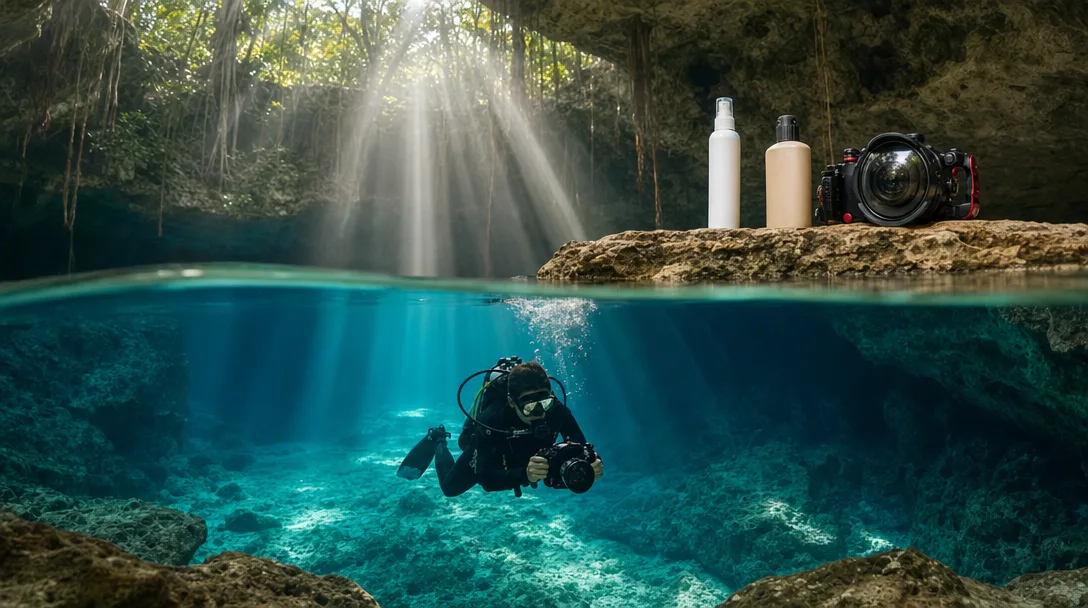
Cenote Rules: Sunscreen, Cameras, and Buoyancy
Cenote diving rules cover sunscreen, cameras, and buoyancy. Learn what’s allowed, why showering matters, and when cave certs are required.
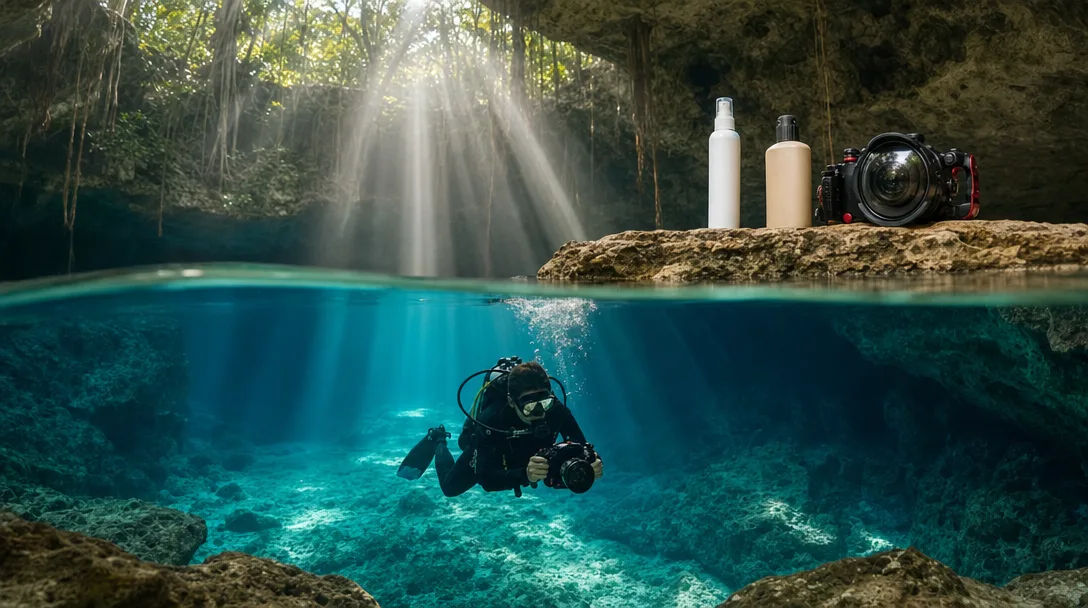
What Are the Rules for Cenote Diving in Mexico?
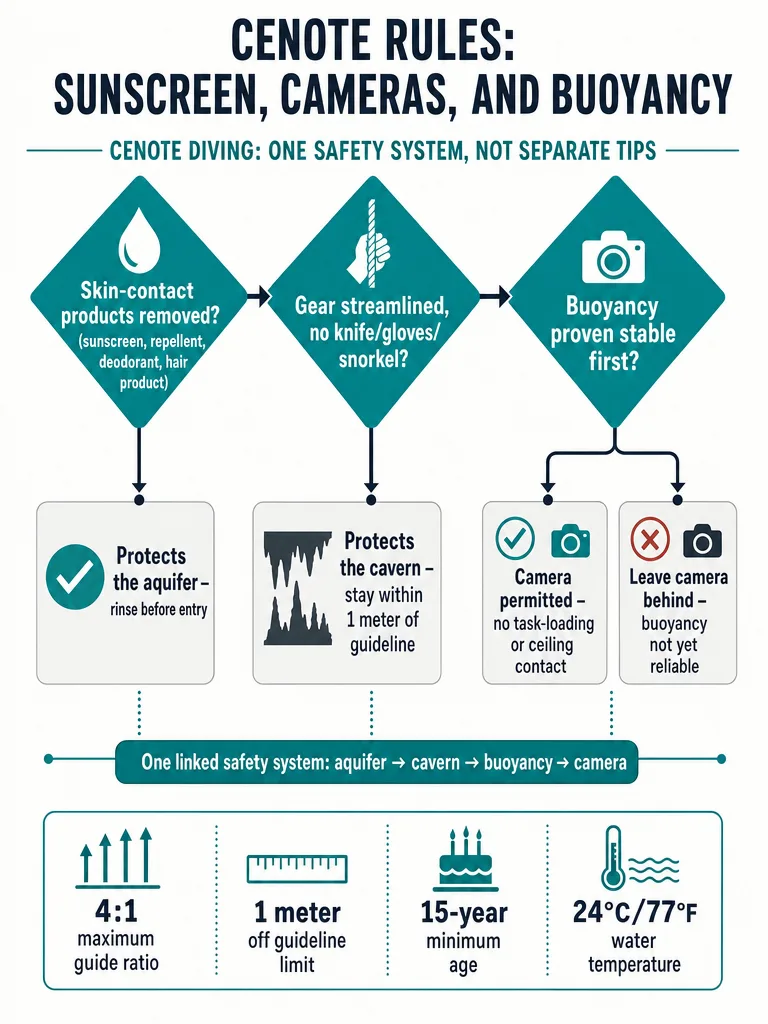
Cenote diving rules split into three groups: what touches your skin before you get in, what you carry on the dive, and how you move once you're submerged. Sunscreen and skin products fall under aquifer protection, cameras fall under site-specific and guide-skill policy, and buoyancy control protects the cavern formations and the dive's safety margin all at once.
A cenote is a natural sinkhole that exposes groundwater through collapsed limestone, and most lead into larger connected cave systems, according to Blue Life, a Playa del Carmen dive operator. Blue Life estimates there are roughly 10,000 cenotes across the Yucatán Peninsula, though it notes that pinning down an exact number is nearly impossible.
Nearly every rule a guide gives you before a cenote dive traces back to one of those three categories. Skin products and swimwear choices protect a groundwater system that feeds local wells. Gear and camera restrictions keep the overhead environment predictable for the guide. Buoyancy rules protect formations that took centuries to grow and keep you close enough to an exit if something goes wrong. None of the three stand alone, and the rest of this guide treats them that way.
Is Reef-Safe Sunscreen Actually Allowed in Cenotes?
A "reef-safe" label on your sunscreen bottle does not automatically clear you to swim in a cenote. Reef-safe sunscreen is sun protection formulated without oxybenzone and octinoxate, two ingredients the Woods Hole Oceanographic Institution links to coral bleaching and marine toxicity even in small concentrations. That standard was built for open, tidal ocean reefs, and cenotes behave nothing like open water.
Cenotes are enclosed, groundwater-filled cave systems with far less circulation than the sea, which means whatever enters the water tends to stay there instead of diluting out with a tide. Cenote Pass, a cenote-visit guide, takes the strict position that no sunscreen belongs in a cenote at all, reef-safe or not, and recommends skipping lotion entirely in favor of a rash guard. That stance is stricter than what some general Riviera Maya diving guides suggest, which list reef-safe sunscreen as an acceptable eco-friendly option rather than a banned one.
The practical rule is to stop trusting the bottle and start asking the site. Policies genuinely differ cenote to cenote, and a guide who allows mineral sunscreen at one location may require a bare, rinsed-off diver at another. A rash guard with long sleeves solves the problem either way, since it gives you sun protection without putting anything into the water. Reef-safe habits for cenote and ocean dive days walks through how to prep your skin before any Riviera Maya dive day, cenote or ocean.
Do You Have to Shower Before a Cenote Dive?
Yes, nearly every cenote requires a rinse before you enter the water. Cenote Pass lists sunscreen, insect repellent, deodorant, hair product, and dried sea salt from a morning swim as the items guides most commonly ask you to wash off before approaching the entry stairs, because the Yucatán's shared aquifer carries whatever touches the water straight into local wells.
That rule exists because of how connected these systems are underground. Cenote Pass points out that whatever runs into one cenote can resurface in a well as far as 30 kilometers away, since the Yucatán's limestone aquifer links thousands of entry points into one shared groundwater supply. A rinse that feels like an inconvenience at the cenote gate is a direct filter for the region's drinking water.
Most operators have a shower station or rinse area built into the entry path for exactly this reason, so plan for a few extra minutes before suiting up.
Are Cameras Allowed on Cenote Dives?
Camera policy on cenote dives is not one rule; it's a patchwork that depends on the specific cenote, the landowner, and the guide's read of your skill. On ScubaBoard, a diving forum, experienced cenote divers describe conflicting instructions: some guides refuse all cameras, citing landowner photo-sales arrangements and cutting-tool restrictions, while other long-time cenote divers report never once being asked to leave a camera behind across dozens of dives.
One ScubaBoard contributor notes seeing signs posted at certain cenotes stating that the guide should never be holding a camera, so attention stays entirely on the group rather than on a shot. The common thread across those accounts is that the deciding factor is often your buoyancy, not the camera itself.
| Policy type | What it usually means | Source |
|---|---|---|
| Guide's own camera | Posted signs at some cenotes state the guide should never hold a camera, keeping attention on the group | ScubaBoard diver reports |
| Diver's personal GoPro or compact | Often allowed, but varies by cenote and landowner rules | ScubaBoard diver reports |
| Diver's large rig or DSLR housing | More likely to draw restrictions or an added fee | ScubaBoard diver reports |
| Low-light camera settings | Cenotes run darker than typical clear-water dives, demanding higher ISO and wider apertures | Divers Alert Network (DAN) |
Divers Alert Network's underwater photography coverage notes that cenotes are consistently darker than photographers expect, which complicates both focus and exposure. One example exposure for a sunbeam shot needed ISO 1600, f/8, and a 1/25-second shutter speed, settings far outside a typical open-water comfort zone. That difficulty alone is a reason to think hard before adding a camera to your first cenote dive.
Why Buoyancy Control Is the Rule Everything Else Depends On
Buoyancy control is the one cenote rule that every other rule assumes you already have. DivePoint Mexico, a Riviera Maya dive operator, lists a specific set of cavern-zone rules that only work if a diver can hold position without constantly adjusting depth by hand or fin kick.
- Stay within 1 meter of the guideline. DivePoint Mexico states divers are not allowed to range farther than that from the line strung through the cavern. Unstable buoyancy pushes divers wide of that margin without them noticing.
- Respect the rule of thirds. On a full tank of 210 bar or 3,000 psi, DivePoint Mexico says one third of your air is budgeted for the way in, one third for the way out, and one third stays in reserve. Divers who work harder to stay level burn through that reserve faster.
- Never pass a STOP sign. These mark the edge of the guided cavern zone. DivePoint Mexico is explicit that going beyond them crosses into true cave territory, off-limits on a recreational cenote dive.
- Never touch a formation. Stalactites and stalagmites grow at roughly 1 centimeter per century, according to Cenote Pass, and a single hand or fin tap can undo centuries of growth. Poor buoyancy is the most common cause of accidental contact.
- Stay within your guide's group ratio. Blue Life and DivePoint Mexico both describe a standard maximum of 4 divers per certified guide, dropping to 3:1 at more complex sites, specifically so the guide can watch each diver's trim closely enough to catch a buoyancy problem before it becomes a formation problem.
If you're not confident your buoyancy holds up in an overhead environment, this guide to diving cenotes with an Open Water certification explains what skill level actually clears you for the cavern zone.
Do You Need Cave Certification to Dive Cenotes?
No, guided recreational cenote dives do not require a cave diving certification. Blue Life, a Playa del Carmen dive operator, distinguishes cave diving, a technical discipline requiring its own dedicated certification, from what operators mean when they advertise "cenote diving": a recreational cavern dive that stays in open, well-lit sections where natural light is visible and an exit remains close at all times.
That distinction matters because the two activities carry very different risk profiles and training requirements. A cavern dive follows a fixed guideline through spacious, illuminated passages. A cave dive pushes beyond daylight into tighter, unlit passages and demands specialized certification most vacationing divers don't hold and don't need for a standard cenote trip.
Local policy adds one more boundary: Blue Life notes a minimum age of 15 for diving the cavern area of a cenote. For younger participants, Blue Life points to Casa Cenote as an alternative that offers cenote scenery without entering the cavern zone.
Cave certification is for cave diving, not for the cenote dives most vacationers book. Exact entry requirements for a cavern route still vary by operator and by site: DivePoint Mexico requires divers to hold an Open Water certification along with a minimum of 10 logged dives and a checkout dive before joining a cenote trip, while Blue Life notes that some cenotes require Advanced Open Water certification specifically. Confirm the requirement for your chosen cenote with the operator before booking. For more on how these sinkholes form and why some stay open while others lead underground, see what a cenote actually is and how it forms.
Should You Bring Your Camera on Your First Cenote Dive?
Camera readiness on a cenote dive comes down to buoyancy, not what's in your dive bag. ScubaBoard's experienced cenote divers converge on one standard: a camera is fine the moment it stops interfering with your diving, and a liability the moment it causes task-loading, bouncing off the ceiling, or stirring up the floor.
That framing flips the usual advice around. Most guides to cenote diving treat "can I bring a camera" as separate from "am I a good diver," when the two questions come down to the same thing. A diver who is still working to hold trim, manage air consumption, and track the guideline has no spare attention left to frame a shot, check settings, or react if a strobe or housing snags on a rock wall. One ScubaBoard contributor, a working dive instructor, put it simply: if using a camera could cause buoyancy problems, leave it with the gear bag.
The safer sequence is to earn stable buoyancy first and add the camera on a later dive, once your guide has watched you hold position without correction. First-time cenote divers get more out of the dive by focusing entirely on the cavern, the light, and the guide's signals rather than splitting attention with gear. For a broader look at what to pack versus leave behind, this guide to cenote diving gear breaks down what most guided trips already include.
Since camera clearance, cenote choice, and buoyancy readiness all depend on where you stand as a diver, send any operator your certification level, recent dive history, and hotel location before booking, so the itinerary and any camera decision get matched to your actual skill rather than guessed at.
Frequently asked questions
How many logged dives do you need before booking a cenote trip?
DivePoint Mexico, a Riviera Maya dive operator, requires an Open Water certification, a minimum of 10 logged dives, and a checkout dive before joining a cenote trip. Requirements vary by operator and by site: Blue Life notes that some cenotes raise the bar to Advanced Open Water certification specifically. Confirm the exact experience requirement with your operator before booking, since a cenote open to a newly certified diver at one site may require more history at another.
Is there a minimum age requirement for cenote diving?
Yes, Blue Life sets a minimum age of 15 for diving the cavern zone of a cenote. That limit reflects the skill and air-management demands of an overhead environment, not a general swimming restriction. Families traveling with younger kids aren't shut out of cenote scenery entirely: Blue Life points to Casa Cenote as an alternative that offers the same natural setting without entering the cavern zone, making it workable for younger or non-diving members of a group.
Can you bring a GoPro into a cenote, even if big camera rigs get restricted?
Often yes: ScubaBoard divers report that small personal cameras like GoPros are commonly allowed at cenotes that restrict larger DSLR rigs or charge an added fee for them. Policy still depends on the specific cenote and landowner, since some sites sell their own photo packages and ban outside cameras entirely. The deciding factor guides mention most often isn't camera size but whether you can hold steady buoyancy while using it.
What is the standard guide-to-diver ratio on a cenote dive?
The standard is 4 divers per certified guide, dropping to 3 divers per guide at more complex sites, according to both Blue Life and DivePoint Mexico. That ratio lets a guide watch each diver's trim and air consumption closely enough to catch a buoyancy problem before it turns into accidental contact with a formation. Private or semi-private bookings can bring that ratio down further, worth asking about if you want closer guidance on a first cenote dive.
What wetsuit thickness is recommended for cenote diving in the Riviera Maya?
Most operators recommend a full 5mm neoprene wetsuit for cenote dives, according to Blue Life, a Playa del Carmen dive operator. Cenote water holds a steady 24°C/77°F year-round because it flows through connected cave systems rather than sitting still, so the temperature doesn't swing with the seasons. Some divers get by in a 3mm suit or even a shortie, but 5mm plus a hooded vest is the safer default for longer dives.
What does a STOP sign mean during a guided cenote dive?
A STOP sign marks the edge of the guided cavern zone and means recreational divers must turn back there, according to DivePoint Mexico. Beyond that point lies true cave territory, which requires cave-specific certification and is off-limits on a standard cenote trip. The signs exist because cavern diving and cave diving carry different risk profiles, and guides treat them as a hard boundary rather than a suggestion.