Drift Diving in Cozumel vs Still Water in Cenotes
Cozumel drift diving vs cenotes: reef color and marine life versus 100+ meter visibility, still water, and calmer cavern dives.
Cozumel Drift Diving vs Cenote Diving: What's the Real Difference?
Cozumel drift diving is ocean reef diving carried along current-swept coral walls, while cenote diving is a still, freshwater cavern dive with visibility beyond 100 meters. Deciding between cozumel drift diving vs cenotes for one dive day comes down to a single trade: reef color and movement, or clarity and stillness.
Both are considered world-class, and neither is a watered-down version of the other. Cozumel sits inside the Mesoamerican Barrier Reef System, so the pull of water past the reef wall, not a current you fight, shapes the dive. Cenotes sit under jungle instead of ocean, with light beams and limestone formations replacing fish and coral as the main attraction.
If you have only one dive day on this trip, a simple rule holds up well: pick Cozumel when marine life and reef color matter more to you than clarity, and pick a cenote when the clearest water and the strangest scenery you'll see on any dive trip matter more. Both are reachable from the same stretch of Riviera Maya coastline, which is unusual anywhere in the world, and the sections below break down exactly how certification, current comfort, and group mix should tip that choice.
What Are Cozumel's Diving Conditions Right Now?
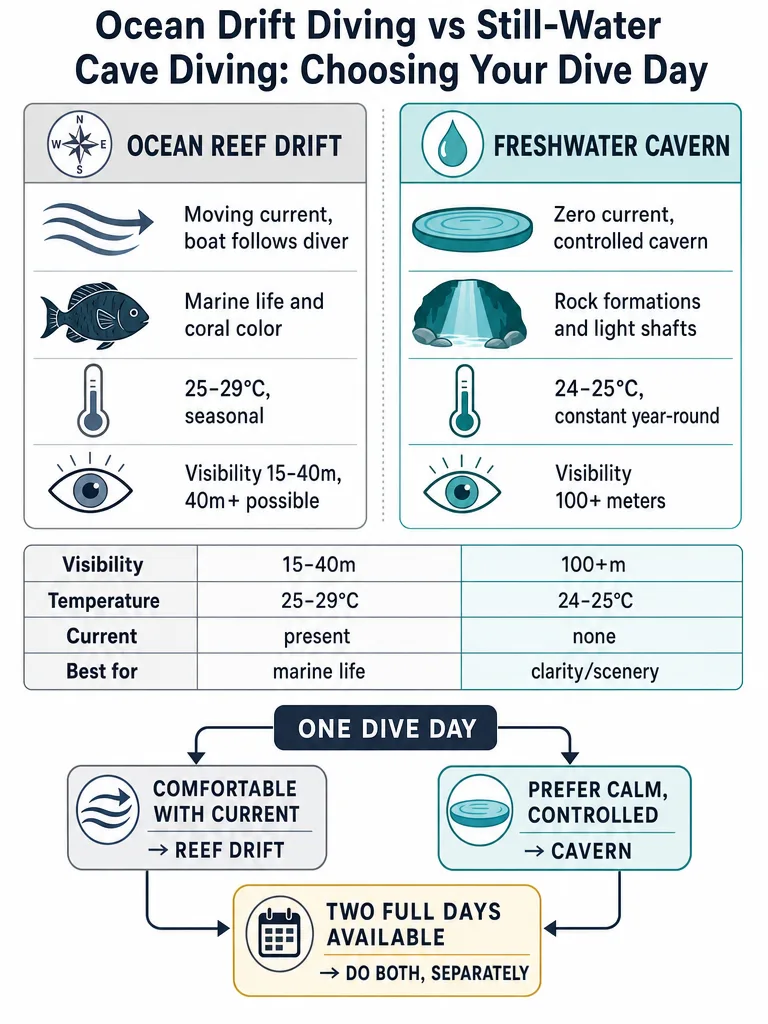
Cozumel's ocean temperature swings with the season, running from about 25°C (77°F) in winter to 29°C (84°F) in summer, while cenote water holds steady at 24-25°C (75-77°F) year-round, according to a Riviera Maya comparison of cenote and ocean diving conditions. Surface conditions on the reef side shift with wind, swell, and current strength from one day to the next; cenotes stay the same regardless.
That seasonal swing matters more for comfort than for whether a dive happens at all. A few degrees of water temperature changes what wetsuit thickness makes sense, but it rarely closes a reef on its own; wind and swell do that. Cenotes are far less affected by surface weather: no current, no wave action, and a temperature that doesn't move with the forecast. On a windy day when chop builds on the Cozumel crossing, a cenote dive still runs close to its usual conditions, since the cavern environment sits below the weather entirely.
How Much Clearer Is Cenote Water Than Cozumel's Reefs?
Cenote water reaches visibility beyond 100 meters, more than double the 15 to 40 meter range typical of Riviera Maya reefs, with Cozumel's walls frequently topping 40 meters, the same regional comparison notes. Freshwater filtered through limestone for thousands of years carries none of the plankton, sediment, or wave action that limits ocean visibility.
| Environment | Typical visibility | Water temperature | Notable feature |
|---|---|---|---|
| Cenotes | 100+ meters | 24-25°C (75-77°F) year-round | Light beams, limestone formations, no current |
| Riviera Maya reefs (general) | 15-40 meters | ~25-29°C (77-84°F), seasonal | Coral, sponges, open-water feel |
| Cozumel reefs | Frequently 40+ meters | ~25-29°C (77-84°F), seasonal | Drift-friendly walls inside Arrecifes de Cozumel National Park |
Arrecifes de Cozumel National Park covers 120 square kilometers and has protected the island's reefs since July 19, 1996, according to Wikipedia's entry on the park. The same entry places the park inside the Mesoamerican Barrier Reef System, described as the world's second-largest coral reef system. GlobeSaga's dive guide to the region puts Palancar's dive sites at roughly 15 to 34 meters deep, within that same protected area.
The island's well-known wall sites, among them Punta Sur and Santa Rosa Wall, are known for dropping from shallow reef tops into deep blue water, the regional comparison notes. Off Cancún, the underwater sculpture museum MUSA adds an artistic reef feature unique to this coastline, per the same source. A closer look at Cozumel's best reef sites and how to reach them breaks these sites down individually.
Cozumel Drift Currents vs Cenote Still Water: Which Suits You Better?
Cozumel diving means moving with the Yucatán Current while the boat tracks you from above; cenote diving means zero current and a guide-led route through an overhead cavern. GlobeSaga's dive guide to the region notes that Cozumel sits about 20 kilometers off the mainland, directly in the path of the Yucatán Current, which is why drift diving is the island's default style rather than an advanced specialty.
On a recreational Cozumel drift dive, you turn into the current, relax, and let it carry you along the wall while your guide tracks entries, exits, and ascent by reading the drift rather than following a fixed route. Recreational diving on these reefs stays within a 40-meter (130-foot) depth limit, the boundary GUE technical instructor Alberto Nava describes in GUE's InDEPTH as separating tourist drift dives from the deep trimix exploration he documents, where multi-hour drift dives on Cozumel's walls run to 70 meters and beyond. You won't go anywhere near that depth on a standard trip, but it shows how far the same current system carries a diver with the right training.
Cenotes remove the current question entirely. There's no drift, no surface chop, and no boat to follow, only a fixed guided route through a cavern with a ceiling overhead, which makes buoyancy and route discipline the real skill rather than current management. A month-by-month look at how current strength shifts by season is worth checking if timing matters to your trip.
Is Cozumel Drift Diving Right for Your Certification Level, or Should You Start in a Cenote?
Certification requirements for Cozumel's reef dives and cenote cavern dives aren't the same question, and public sources don't document an exact minimum certification each operator requires for a given site. One pattern does hold across the region: a freshly certified Open Water diver is generally ready for most moderate reef dives, while deeper walls, wrecks, and cavern routes call for more comfort and experience than a basic certification course provides on its own.
Undercurrent's account of a 2018 cenote trip makes a related point directly: guides treat cenotes as different and not to be taken lightly, running strict briefings even for divers with hundreds or thousands of logged dives. That discipline exists because a cavern restricts your exit, not because the water itself is dangerous.
Site choice should follow a similar logic, even without a formal certification table for each one. Sites like Dos Ojos and Casa Cenote are commonly recommended as entry-level cenote dives for newly certified divers because they stay shallow and well-lit. Chac Mol and Kulkulcan, where Undercurrent's writer logged a dive at about 14 meters (45 feet), sit at a similarly moderate depth. The Pit and Cenote Angelita run deeper and darker, better matched to divers with more comfort and experience at depth.
If Marine Life Is Your Priority, Will Cenotes Feel Disappointing?
Cenotes will disappoint a diver chasing fish and coral. Cenote diving is built around rock, light, and freshwater clarity rather than marine life, since most cenotes hold little more than a few small fish and occasional turtles. A regional comparison of the two environments is blunt about the trade: cenotes win on scenery and visibility, while reef diving wins on marine life by a wide margin.
Cozumel is the opposite case. Its reef walls sit inside the Mesoamerican Barrier Reef System, and the protected water of Arrecifes de Cozumel National Park has supported dense coral, sponge, and fish life since the park's creation in 1996. Divers drifting past Palancar, Punta Sur, or Santa Rosa Wall see sea fans, sponges, and the color most people picture when they imagine Caribbean diving.
That split is the real decision point, more than difficulty or certification. If a trip's main goal is marine life, color, and the classic reef experience, Cozumel is the stronger pick. If the goal is otherworldly geology, stillness, and water so clear it feels like flying, a cenote delivers something reef diving can't replicate. A breakdown of the best cenotes for diving in the Riviera Maya covers which sites lean more toward dramatic light and which lean toward open chambers.
Can You Combine Cozumel Drift Diving and Cenote Diving in One Trip?
Yes, but not on the same day without rushing one of them. Cozumel diving and cenote diving sit on opposite sides of a ferry crossing, and Undercurrent's account of a Cozumel-to-cenote trip timed that crossing to Playa del Carmen at 45 minutes each way, with a basic round trip costing 200 pesos, about $10 at the time of that 2018 report.
The better plan is two separate full days:
- Book Cozumel as its own day. Take an early ferry or pickup to Cozumel, dive the reef in the morning while conditions are calmest, and plan the return crossing for the afternoon.
- Book your cenote day separately, inland. Undercurrent's cenote guide drove about 20 minutes from Playa del Carmen to reach the first site, Chac Mol, for a dive at Kulkulcan that ran about 40 minutes to 14 meters (45 feet) deep. That timing works as a half-day or full-day trip depending on how many tanks you add.
- Line up hotel pickup to cut the logistics. Many regional operators, including Seth Dive Mexico, offer free hotel pickup across the Cancún-to-Tulum corridor, which removes the taxi and ferry-terminal transfer from either day's planning.
- Space the two days apart, ideally with a rest day or a slower activity between them, rather than scheduling back-to-back early mornings on a vacation.
Splitting the trip this way protects both dives from feeling rushed, and it avoids the ferry-timing stress that comes from trying to squeeze an afternoon cenote booking in right after a morning Cozumel crossing.
How to Choose Between Cozumel and Cenotes for Your One Dive Day
Divers who want reef color, marine life, and comfort with following a current should book Cozumel first; divers who are newly certified, prone to seasickness, or chasing the clearest water they'll ever see should start with a cenote. Four factors decide which path fits best: certification level, comfort with current, whether marine life or scenery matters more, and the makeup of your group.
| Your situation | Better fit | Why |
|---|---|---|
| New Open Water diver, nervous about current | Cenote | Zero current, controlled pace, shallow sites like Dos Ojos or Casa Cenote |
| Comfortable diver chasing reef color and fish | Cozumel | Drift-with-current reef walls inside Arrecifes de Cozumel National Park |
| Advanced diver, wants depth and drama | Either, site-dependent | The Pit or Angelita for geology, Santa Rosa Wall or Punta Sur for reef |
| Prone to seasickness or rough crossings | Cenote | No boat, no swell, no ferry dependency |
| One dive day, marine life is the priority | Cozumel | Reef life and color that cenotes can't replicate |
None of these rules are absolute. A calm forecast day makes the Cozumel crossing easy even for a nervous first-timer, while a rough week of wind and swell can tip the same decision toward cenotes regardless of certification. Matching the day to the conditions usually matters more than picking a side weeks in advance.
A closer look at how Cozumel's reefs compare with Playa del Carmen's covers the reef side of this decision in more depth if Cozumel is the direction you're leaning.
Frequently asked questions
Is Cozumel diving suitable for a beginner or newly certified diver?
Most of Cozumel's recreational reef dives suit a newly certified Open Water diver, since the current carries you along the wall rather than something you fight against. Recreational diving on these reefs stays within a 40-meter depth limit, well inside basic certification limits, while deeper walls and multi-hour technical drifts exist far beyond that for trained divers. A standard guided Cozumel trip, with the boat tracking your drift from above, works as a reasonable first ocean dive after certification.
What marine life can you expect to see diving in Cozumel?
Cozumel's reefs sit inside Arrecifes de Cozumel National Park, a protected area that has hosted more than 1,000 marine species since the park's creation in 1996. Expect sea turtles, queen triggerfish, queen conch, sponges, sea fans, and black coral along the drift-friendly walls. The island is also home to the Cozumel splendid toadfish, an endemic species found nowhere else on Earth and listed as vulnerable by the IUCN.
How does Playa del Carmen diving compare to Cozumel for visibility and current?
Playa del Carmen's mainland reefs typically run 15 to 40 meters of visibility, while Cozumel frequently tops 40 meters, according to a regional diving comparison. Both sit along the Mesoamerican Barrier Reef System, but Cozumel's walls sit directly in the Yucatán Current's path, giving them a stronger, steadier drift and clearer water further from mainland runoff. Divers chasing the most consistent visibility and current lean toward Cozumel over the mainland reefs near Playa.
What are the best dive sites in Cozumel?
Palancar, Punta Sur, and Santa Rosa Wall are among Cozumel's best-known sites, with Palancar's dive sites running roughly 15 to 34 meters deep inside Arrecifes de Cozumel National Park. Punta Sur and Santa Rosa Wall are known for dropping from shallow reef tops into deep blue water, the dramatic wall profile Cozumel is built around. All three sit inside the park's protected water, keeping coral and sponge cover dense along the drift route.
How much does the ferry between Cozumel and Playa del Carmen cost?
A basic round-trip ferry ticket ran about 200 pesos, roughly $10, in a 2018 travel account, with the crossing taking about 45 minutes each way. Fares and schedules shift over time, so treat that figure as a reference point rather than a current quote. Budgeting ferry time matters most if you're planning a Cozumel dive day and a separate cenote day during the same trip.
Does Seth Dive Mexico offer hotel pickup for cenote or Cozumel dive trips?
Free hotel pickup is available across the Cancún-to-Tulum corridor, which removes the taxi or ferry-terminal transfer from your planning for either a cenote day or a Cozumel reef day. This matters most when splitting the two experiences into separate full days, since transfer logistics tend to eat more vacation time than the diving itself. Message Seth with your hotel, dates, and certification level to line up pickup for whichever dive you book.