Best Cenotes for Open Water Divers Near Tulum
Find the best cenotes for open water divers in Tulum, compare easy sites, and book a safe guided dive with pickup from Cancun to Tulum.
What Are the Best Cenotes in Tulum for Open Water Divers?
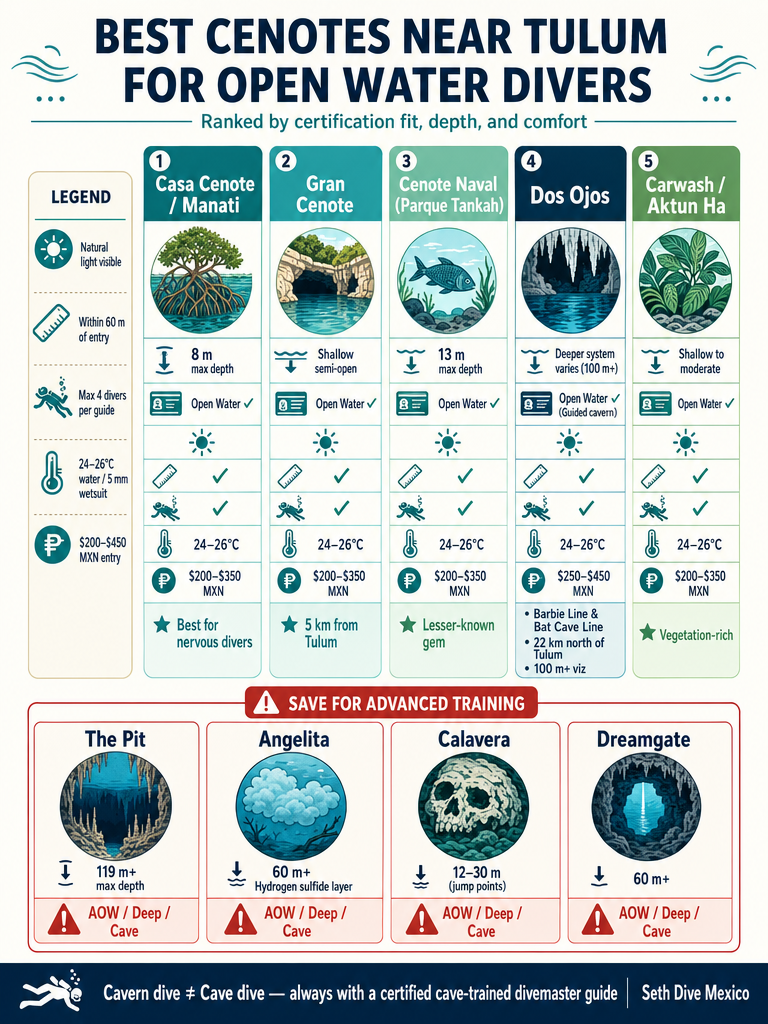
The most Open Water-friendly cenotes near Tulum are Casa Cenote (Cenote Manati), Dos Ojos, Gran Cenote, Cenote Naval at Parque Tankah, and Carwash (Aktun Ha) — all dive-able with a basic Open Water certification when led by a qualified cenote guide. These sites share shallow depths, natural light, short or optional overhead sections, and forgiving buoyancy demands, which is exactly the profile a recently certified diver needs.
Rank them by how much overhead environment you want on your first cenote dive:
| Cenote | Max Depth | Overhead | Why it fits Open Water | Distance from Tulum |
|---|---|---|---|---|
| Casa Cenote (Manati) | 8 m (The Dive Machine) | None — fully open-air | Marine life, mangroves, halocline, natural light throughout | ~15 min north |
| Cenote Naval (Parque Tankah) | 13 m (Rigo the Cenote Guide) | Minimal — mostly open water | Lesser-known, calm, good for nervous first-timers | ~15 min north |
| Gran Cenote | up to 10 m (Seth Dive Mexico) | Semi-open channels | Shallow, family-friendly, snorkelers welcome | ~5 km from Tulum (Seth Dive Mexico) |
| Dos Ojos — Barbie Line | 8 m (My Favourite Escapes) | Guided cavern | Shallow cavern route, visibility exceeding 100 m (Seth Dive Mexico) | ~22 km north of Tulum (Seth Dive Mexico) |
| Dos Ojos — Bat Cave Line | 10 m (My Favourite Escapes) | Guided cavern | Slightly more atmospheric but still Open Water-appropriate | ~22 km north of Tulum |
| Carwash (Aktun Ha) | Shallow, vegetation-rich | Mostly open, optional cavern | Listed as Open Water by Torntackies; easy profile | ~10 min north |
If you are recently Open Water certified and want the gentlest introduction to cenote diving near Tulum, book Casa Cenote or Cenote Naval first, then progress to the Barbie Line at Dos Ojos for your first proper cavern experience.
This shortlist deliberately leaves out The Pit, Angelita, Dreamgate, Pet Cemetery, and Calavera. They are famous, but they sit outside the comfortable Open Water envelope for reasons we break down later — depth, buoyancy demand, or disputed cave-certification requirements.
Do You Need Cave Certification to Dive Cenotes in Tulum?
No — Open Water certified divers do not need cave certification to dive most cenotes near Tulum, because recreational cenote dives are guided cavern dives, not cave dives. The distinction is specific and enforceable: according to The Very Hungry Mermaid's cenote guide, on a cavern dive you must be able to see natural light the entire time, stay within 60 m of the entry point, and remain within no-decompression limits. Cross any of those lines and you are cave diving, which requires specialized training beyond recreational scuba.
Here is how the certification ladder maps to what you can actually dive:
| Certification | What you can dive in Tulum cenotes |
|---|---|
| Open Water | Guided cavern dives at Casa Cenote, Gran Cenote, Dos Ojos (Barbie/Bat Cave lines), Carwash, Naval |
| Advanced Open Water | All of the above plus deeper sites like The Pit and Cenote Angelita (per Ko'ox Diving and Torntackies) |
| Deep specialty | Recommended for Angelita's 30 m+ hydrogen sulfide cloud profile |
| Full Cave certification | Required for true cave routes beyond cavern lines |
You do not need cave certification to dive cenotes in Tulum as an Open Water diver — you need a properly qualified guide who keeps the dive inside cavern limits. Sethdive's own comparison of cenote diving vs ocean diving makes the same point: reputable recreational cenote dives stay within sight of natural light and follow permanent guidelines.
Which Cenote Is Best for a First Cenote Dive if You're Recently Certified or Nervous?
Casa Cenote (Cenote Manati) is the single best first cenote dive for a nervous or recently certified Open Water diver, followed closely by Cenote Naval at Parque Tankah. Both sites keep you in open water with natural light and minimal or zero overhead environment, which is exactly what a jittery new diver needs before progressing to cavern routes at Dos Ojos.
Why Casa Cenote works so well as a first cenote:
- It is the only true open-air cenote in the Tulum diving circuit, with complete natural light throughout the dive and no overhead environment concerns (Source: The Dive Machine).
- Maximum depth is just 8 m, so no-decompression limits and air consumption are non-issues.
- Fresh water flowing from underground rivers meets the Caribbean, creating a visible halocline and bringing in tarpon, snook, and tropical fish — a marine-life-rich experience unlike the "empty" cavern dives people fear.
- The Dive Machine specifically positions Casa Cenote as ideal for recently certified divers and divers who prefer open water to overhead environments.
Cenote Naval at Parque Tankah is the quieter alternative, useful when Casa is busy or when you want something lesser-known:
- 13 m maximum depth, Open Water certification required (Source: Rigo the Cenote Guide).
- Mostly open-water profile, explicitly described as suitable for a first cenote dive or divers nervous about overhead environments.
- Listed at $150 USD + 400 MXN for a 6-hour experience (Rigo the Cenote Guide), so expect guided dive pricing in that neighborhood.
Gran Cenote is the third option — semi-open with shallow channels, depths to 10 m, and only 5 km from Tulum (Source: Seth Dive Mexico). The trade-off is crowds; Gran Cenote is popular with snorkelers, so it is better for mixed groups than for divers who want a peaceful first immersion.
If you know you are anxious about overhead environments, Sethdive's guide on feeling confident about scuba diving pairs well with starting at Casa Cenote: shallow, lit, familiar marine life, and a guide who can slow the whole dive down.
Dos Ojos vs Casa Cenote vs Gran Cenote: Which Open Water-Friendly Site Fits Your Dive Style?
Pick Dos Ojos for cavern drama, Casa Cenote for marine life and photography, and Gran Cenote for the easiest beginner day with snorkeling partners. All three are Open Water-appropriate; the right choice depends on what you want to see and how much overhead environment you are ready to accept.
| Factor | Dos Ojos | Casa Cenote (Manati) | Gran Cenote |
|---|---|---|---|
| Vibe | Classic cavern with stalactites, light beams, Mayan underworld atmosphere | Open-air mangrove lagoon, jungle-meets-sea ecosystem | Semi-open, shallow channels, turtles and fish |
| Max depth | 8 m Barbie Line, 10 m Bat Cave Line (My Favourite Escapes) | 8 m (The Dive Machine) | up to 10 m (Seth Dive Mexico) |
| Visibility | Exceeds 100 m (Seth Dive Mexico) | High but varies with halocline | High, shallow, often crowded |
| Overhead | Guided cavern, permanent lines | None — full open air | Semi-open channels |
| Marine life | Minimal — geology is the show | Tarpon, snook, tropical fish, possible turtles | Small freshwater fish, turtles |
| Snorkelers welcome | Yes, in shallow areas (Seth Dive Mexico) | Yes | Yes, most popular for snorkeling |
| Distance from Tulum | ~22 km north (Seth Dive Mexico) | ~15 min north | ~5 km (Seth Dive Mexico) |
| Typical entry | $400–$450 MXN (Seth Dive Mexico) | Lower legacy fees, confirm at gate | Within the $200–$450 MXN range |
Dos Ojos is part of Sistema Sac Actun, which Seth Dive Mexico notes measures over 378 km as of 2026 — the longest explored underground river system on the planet. The two recreational routes, the Barbie Line and Bat Cave Line, are both Open Water-appropriate when led by a cenote-certified guide (Source: Seth Dive Mexico). The trade-off is popularity: Dos Ojos gets busy, so an early start matters.
The magic at Casa is looking forward through mangroves and a halocline; the magic at Dos Ojos is looking up through a cathedral ceiling of limestone. They are different dives, not better or worse dives.
Casa Cenote earns its spot because it solves two problems at once: it is Open Water-friendly with zero overhead, and it is genuinely interesting to photographers and divers who normally only care about reef life. If your certification dives were in the ocean and you miss the fish, Casa is the cenote for you.
Gran Cenote is the practical family choice. At 5 km from Tulum, it is the easiest logistics of any Open Water-friendly site, and the shallow channels let non-divers snorkel productively while certified divers do a proper dive. If you're weighing it against Dos Ojos specifically, Sethdive's Dos Ojos vs Gran Cenote comparison goes deeper on crowd timing and access.
Ready to match one of these sites to your certification and hotel location? Start planning your dive and Seth will build the day around your group.
Which Famous Tulum Cenotes Should Open Water Divers Save for Advanced Training?
Save The Pit (El Pit), Cenote Angelita, Dreamgate, Pet Cemetery, and Cenote Calavera (Temple of Doom) for later — not because they aren't worth diving, but because they demand certifications, depth experience, or buoyancy control beyond typical Open Water training.
The Pit is repeatedly included in "best cenotes" lists, but Torntackies is explicit: Advanced Open Water certification is required because the dive reaches 30 m in its natural-light area. That is beyond the 18 m recreational Open Water limit. The famous light beams at El Pit happen at depth — there is no shallow version of this dive.
Cenote Angelita is the dramatic hydrogen sulfide cloud cenote everyone wants to see. According to Ko'ox Diving, Angelita has a 60 m maximum depth, with dives typically going to 35 m, and an Advanced Open Water certification is required to get the full experience. The hydrogen sulfide cloud itself sits at around 25 m and is thicker than 3 m (Source: Ko'ox Diving). This is a Deep specialty dive disguised as a cenote dive.
Dreamgate and Pet Cemetery are the edge case: both have a listed maximum depth of just 7 m (My Favourite Escapes), yet one source still marks them as advanced because the formations are delicate and the buoyancy control required is higher than at Casa or Gran Cenote. Open Water divers with only 10–20 logged dives will kick silt, bump stalactites, or damage formations. Build up buoyancy hours at easier sites first.
Cenote Calavera (Temple of Doom) is where sources directly conflict. Todo Tulum frames Calavera as a scuba diving location for divers with cave diving certification, while other roundups include it in general recreational lists. Given the conflict, Open Water divers should treat Calavera's underwater passages as cave-certified territory unless your operator can specifically confirm an Open Water cavern route with permanent lines and natural-light limits.
For Open Water divers, the honest rule is: if a cenote's signature experience happens below 18 m or beyond natural-light cavern limits, it belongs in your Advanced Open Water or Deep specialty plan — not your first cenote day.
What Guide Qualifications and Safety Setup Should You Expect for a Cenote Dive?
Every cenote dive in Tulum must be led by a qualified guide — and "qualified" has a specific definition, not a vibe. According to The Very Hungry Mermaid's cenote guide, a proper cenote guide should be at least a divemaster and certified cave diver, hold permits for the cenotes being visited, use a double-tank setup, carry backup lights, keep the group on permanent cavern lines, and guide no more than 4 divers at a time.
Run this checklist before you book:
- Certifications: Guide is minimum divemaster plus full cave certification — not just an Open Water instructor with cenote enthusiasm.
- Permits: Operator holds current permits for each cenote on the itinerary (access is controlled and not all dive shops are cleared everywhere).
- Equipment: Double-tank setup on the guide, backup lights, and appropriate lines.
- Ratio: Maximum 4 divers per guide, strictly enforced.
- Site selection: Guide has recent, repeated experience at the specific cenote and will choose conservatively based on your last dive date, logged dives, and comfort.
- Plan: Clear briefing on the route, turn pressure, signals, and what happens if you signal discomfort mid-dive.
This is why private and semi-private cenote diving matters more than it does on a reef boat. On a reef, a 1:8 group ratio is usually fine. In a cenote cavern with permanent lines and overhead rock, 1:4 is the ceiling, and 1:2 or 1:3 gives you actual attention — including time to manage buoyancy, photograph, or slow down if your breathing ramps up. Sethdive's comparison of private vs group diving tours goes deeper on the trade-offs.
How Much Does Diving Cenotes in Tulum Cost, and What Is Usually Included?
Cenote entry fees near Tulum generally run $200–$450 MXN per cenote, with Dos Ojos at the top of the range at $400–$450 MXN (Source: Seth Dive Mexico). Guided two-tank cenote dives cost significantly more on top, because the price includes tanks, gear, a qualified guide, transport, and park fees. As one concrete example, Rigo the Cenote Guide lists Cenote Naval at $150 USD + 400 MXN for a 6-hour experience.
What to confirm before you book any cenote dive package:
- Hotel pickup and drop-off — included, extra, or not offered?
- Pickup zones — does the operator actually serve your location from Cancun to Tulum?
- Tanks, weights, BCD, regulator, wetsuit, mask, and fins — included or rental extra?
- Primary and backup dive lights for cavern sections.
- Cenote entrance fees — included or paid in cash at the gate?
- Guide ratio — explicitly 1:4 or better?
- Number of dives and which specific cenotes.
- Snacks, water, and lunch between dives on full-day trips.
- Private or semi-private upgrade pricing.
Entry fees at privately owned cenotes change frequently, so confirm current pricing directly with your operator and bring pesos in cash for the gate. Older fee listings floating around the internet are often stale by a season or two.
What to Wear for Diving Cenotes in Tulum?
Cenote water sits at 24–26°C year-round, and The Very Hungry Mermaid's cenote guide recommends a full 5 mm wetsuit for cenote diving. That is noticeably colder than Caribbean reef water off Playa del Carmen or Cozumel, and two tank dives in fresh water cool you down faster than you expect — so do not bring your 3 mm shorty and hope.
Pack this for cenote dive day:
- Full 5 mm wetsuit (rent through your operator if you didn't bring one).
- Swimsuit under the wetsuit.
- Dive computer if you own one — highly recommended even for Open Water profiles.
- Certification card (physical or digital) — you will be asked.
- Cash in pesos for cenote entrance fees in case they are not included.
- Quick-dry towel and dry clothes for the drive back.
- Biodegradable sunscreen for after the dive only — most cenotes prohibit sunscreen in the water to protect the ecosystem.
- Water shoes or sandals with grip for slippery limestone platforms.
- Snacks or a light breakfast — cavern dives burn more air and energy than a lazy reef dive.
For non-diving partners snorkeling at Casa Cenote, Gran Cenote, or the shallow areas of Dos Ojos, a 3 mm wetsuit or a thick rashguard is usually enough. Sethdive's cenote snorkeling packing list covers the full kit for mixed groups where some people dive and some snorkel.
How to Organize Your Cenotes Diving Trip From Tulum, Playa del Carmen, Cancun, or Cozumel
Plan a cenote diving trip by matching sites to your certification, confirming logistics with your operator in one message, and leaving the final site order to your guide on the day. That last part matters — cenote conditions change with rain, crowds, and visibility, and a good local guide will swap the plan if a better site opens up.
The workflow that actually works:
- Pick sites by certification and comfort. Open Water and nervous? Casa Cenote plus Gran Cenote or Naval. Open Water and confident? Add a Dos Ojos cavern line. Advanced Open Water? Now The Pit or Angelita enters the conversation.
- Confirm your diving profile. Last dive date, total logged dives, most recent depth, and whether you have ever dived in an overhead environment. A responsible operator will ask; if they don't, that is a flag.
- Decide about non-diving companions. Pick cenotes where snorkeling and diving happen at the same site — Casa, Gran Cenote, or Dos Ojos — so the whole group is in one place.
- Share your hotel, Airbnb, villa, or resort location. Ask whether the operator serves your pickup zone from Cancun through Playa del Carmen to Tulum. Drive times vary from 10 minutes to over 90 minutes, which shapes the whole day.
- Confirm inclusions line by line. Tanks, gear, lights, transport, park fees, guide ratio, and whether private or semi-private upgrades are available.
- Time it for fewer crowds. Early morning starts beat the mid-day tour buses at Dos Ojos and Gran Cenote. Seasonally, December–April (Seth Dive Mexico) is the dry season with better conditions and clearer water.
- Leave flexibility for guide-led adjustments. If your guide says visibility at Casa is exceptional today but Dos Ojos is packed, let them swap. Local read beats a rigid itinerary.
- Bring cash, certification card, and a realistic expectation. Cenote diving is calmer and more meditative than ocean diving. If you are coming straight from a Cozumel drift dive, slow down mentally before you gear up.
Coming from Cozumel adds a ferry leg from Playa del Carmen — workable as a day trip but easier if you overnight in Playa or Tulum the night before. If you're still deciding where to base yourself, Sethdive's guides on Tulum vs Playa del Carmen and Cancún vs Tulum lay out the trade-offs for divers specifically.
Seth Dive Mexico handles private and semi-private cenote diving across this whole stretch — free hotel pickup from Cancun to Tulum, multilingual guiding, and small groups built around your certification and comfort level. Message Seth with your dates, hotel location, certification level, last dive date, and whether you have non-diving companions, and you'll get a cenote plan matched to your actual trip instead of a generic itinerary. Start planning your dive.
Frequently asked questions
Can I dive cenotes in Tulum if I only have an Open Water certification?
Yes — most popular cenotes near Tulum, including Casa Cenote, Gran Cenote, Dos Ojos, and Cenote Naval, are accessible to Open Water certified divers when led by a qualified guide. The key is staying within recreational cavern limits: natural light visible at all times, no deeper than your certification allows, and no more than 60 meters from the entry point.
What is the difference between cavern diving and cave diving in cenotes?
Cavern diving keeps you within sight of natural light, within 60 meters of the entry point, and inside no-decompression limits — no extra certification beyond Open Water is required. Cave diving goes beyond those limits into true overhead environments and requires specialized cave certification; Open Water divers should never be taken past cavern lines.
How long is a typical cenote dive day near Tulum, and how many dives will I do?
Most guided cenote dive packages are structured as a half-day or full-day experience with two tank dives, often at two different cenotes or two routes at the same cenote. Full-day trips typically run five to seven hours including transport, surface intervals, and lunch, so arriving early is important for beating crowds at popular sites like Dos Ojos and Gran Cenote.
Is cenote diving safe for someone who hasn't dived in a year or two?
It can be, but a responsible operator will ask about your last dive date and logged dives before selecting a site — and may suggest a refresher pool session or an easy open-water cenote like Casa Cenote before progressing to cavern routes. Buoyancy control matters more in a cenote than on a reef, so being honest about your recent experience protects both the formations and your enjoyment.
Do I need to rent gear for cenote diving or should I bring my own?
Most guided cenote dive packages include tanks, BCD, regulator, wetsuit, mask, fins, weights, and dive lights, so you can travel light if you prefer. If you own a dive computer, bring it — it adds useful data even on shallow Open Water profiles — and always carry your certification card since every cenote will ask to see it.
What is the best time of year to dive cenotes near Tulum?
The dry season from December through April generally offers the most stable conditions, with clearer water and less rain-driven sediment in the cenote systems. That said, cenote water temperature stays consistent at roughly 24–26°C year-round, so any month works — the main seasonal difference is crowd levels and surface weather rather than underwater visibility.
Sources
- A Guide to Cenote Scuba Diving in Mexico.theveryhungrymermaid.com
- A Guide to The Best Cenotes in Tulum - Gypsy Solswww.gypsysols.com
- Cenote Diving: 7 Best Sites in Tulum Mexicowww.mexicokantours.com
- Best cenotes to dive in Mexico? - Facebookwww.todotulum.com