Should you book a cenote day or a reef trip when sargassum covers the beach?
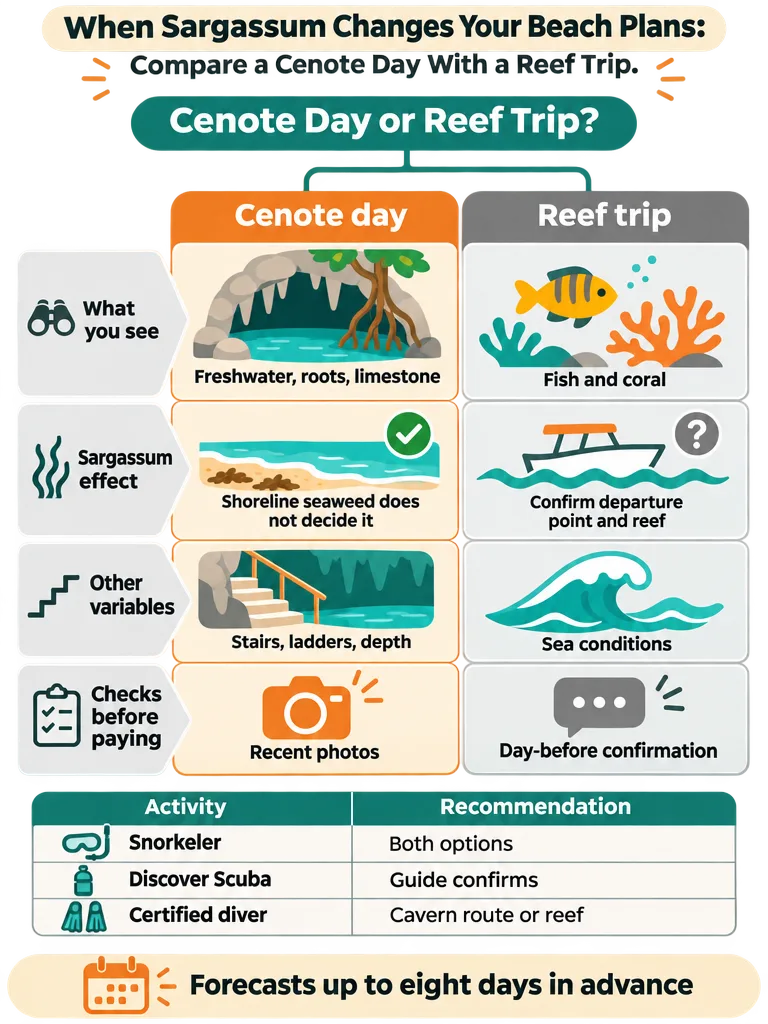
When sargassum changes your beach plans in the Riviera Maya, a cenote day is the lower-risk swap, because shoreline seaweed doesn't decide whether an inland cenote works. A reef trip stays viable only if the departure point and reef are confirmed, since NOAA documents floating offshore sargassum and nearshore buildup that can smother coral reefs.
"Lower risk" here means less dependence on sargassum. It doesn't mean lower diving or swimming risk. Three places matter for a reef day: the sand at your hotel, the departure point for the boat, and the reef itself. Each can be fine or not independently, and a photo of your hotel's beach only tells you about the first.
How each plan fits different people:
- Snorkelers: Cenote snorkeling doesn't depend on the beach. A reef snorkel is a real option if the departure point and reef check out.
- Discover Scuba beginners: Ask the operator to confirm the beginner setting, depth and route for your date. Keep this separate from certified cavern routes, which have their own requirements.
- Certified divers: Cenote cavern routes and reef dives are different dives. The guide confirms suitability for the exact route, and certification alone doesn't settle eligibility for a cavern dive.
What sea conditions should you confirm before committing to a reef day?
The sources behind this article establish no date-specific marine conditions for Cozumel, Playa del Carmen or Tulum. A reef day therefore needs conditions confirmed by the operator for your date. Ask about wind and chop on the departure morning, recent water clarity at the reef, sargassum at the departure point, and whether the trip is running.
Cancun Trip Insider says that reef conditions on any given morning are decided more by wind and sargassum than by which town you leave from. A calm forecast and clear water are separate questions, so ask for both.
What to request:
- Sea state: expected wind and chop for the morning of the trip. Mexidivers says mornings are calmest at Tulum, before afternoon winds pick up.
- Reef clarity: photos or a description from the last day or two, not a general reputation.
- Departure point: whether sargassum is on the beach or in the water where the boat leaves.
- Go or no-go: who decides the trip is running, and when you'll hear.
For a separate comparison of current-swept reef diving and still cenote water, see drift diving in Cozumel vs still water in cenotes.
Does sargassum reach the reef, and how do you check before you pay?
Sargassum can reach offshore and reef areas, so ask for recent photos from the departure point and the reef, plus a day-before confirmation that the trip is running, instead of accepting a blanket "offshore is always clear" promise. NOAA says massive amounts can form nearshore brown tides that smother fauna and flora, including coral reefs.
Sargassum is a type of floating brown algae that drifts in the open ocean and can be carried to shore by winds and currents. NOAA dates the expansion of its range to 2011, when a newly established open-ocean population, the Great Atlantic Sargassum Belt, formed.
That corrects a common promise. Cancun Trip Insider says sargassum never affects offshore water, but NOAA's description of floating rafts is less absolute. Treat "the boat goes beyond the seaweed" as something to confirm, not assume.
Tools for checking before you pay:
- NOAA and University of South Florida daily risk map. A satellite-based map of where sargassum is likely to wash ashore in coastal areas of the US, Caribbean and Central America.
- Sargassum Tracker seven-day outlook. NOAA produces it with the Caribbean Coastal Ocean Observing System.
- Sargassum Early Advisory System. Per EPA, Texas A&M University at Galveston's system forecasts inundation events up to eight days ahead, and Mexico is among its covered locations.
- Local trackers. A guide to sargassum months in Cancún and Tulum lists Sargassum Monitoring®, the LANOT/UNAM Visualizador and the Tulum Times Beach Pulse tracker.
The evidence that should flip the decision is recent photos from the departure point and the reef, plus the operator's day-before confirmation of what they saw.
Cenote day vs reef trip: which fits your group's comfort and certification?
Cenotes and reefs offer different experiences, and the right fit depends on the exact activity and route. Mexidivers describes cenote snorkeling as cool freshwater with tree roots and limestone formations, and reef snorkeling as warm saltwater with fish, turtles, rays and coral. The supplied sources don't establish site-specific prerequisites, medical requirements, age limits or training boundaries, so ask the operator to confirm each.
| Activity | What you see | Certification | What sargassum can change | What else can change |
|---|---|---|---|---|
| Cenote snorkeling | Freshwater, tree roots, limestone, light beams | None needed for snorkeling | Inland cenotes don't depend on beach seaweed. Mexidivers describes Casa Cenote as connected to the sea, so ask the operator about that specific site | Stairs, ladders, depth, facilities; mostly cash entrance fees |
| Discover Scuba (cenote) | Freshwater and limestone formations, in a setting the operator confirms for beginners | Meant for people who aren't certified; operator confirms age and medical rules | Shoreline seaweed doesn't decide whether an inland cenote works; confirm the specific site | Depth, route, guide ratio, your comfort |
| Certified cavern dive | Cavern formations in freshwater | Operator confirms eligibility; certification alone doesn't establish it | Inland cavern sites aren't governed by beach seaweed; confirm the specific site | Recent dive experience, site suitability, route |
| Reef boat trip (snorkeling, or a certified recreational dive) | Fish, turtles, rays, coral | None for snorkeling; a certified recreational dive requires certification | Departure point, nearshore water, reef clarity | Wind and chop; Mexidivers reports typical Tulum reef visibility of 10 to 20 m, which is not a current reading |
Cenotes aren't weather-proof either. Tulum Cenote Tours says open-air cenotes can see short visibility dips to roughly 20 to 28 m after heavy rain, while cavern sites stay largely unaffected. For a separate look at rain and cenote dives, see cenote diving after rain. Paradise Catamarans notes that stairs, ladders, depths and facilities vary by cenote, so check access for children, older adults and anyone with mobility limits.
How can you choose a private trip when some of your group are not certified divers?
Give each person their own activity and have the guide confirm each one in writing: snorkeling, Discover Scuba, or a guided cavern route. The sources here don't establish eligibility, medical screening or age limits, so verify those with PADI or DAN and with the operator. Also ask whether one guide team can staff every activity on your date.
Here is a hypothetical party of four, labeled as an example: two certified divers, one beginner who wants to try scuba, and one non-swimmer whose beach day was lost to sargassum.
| Person | Activity to request | Confirm with the guide |
|---|---|---|
| Certified diver 1 | A guided route the operator confirms as suitable | Certification level, date of last dive, route and site suitability |
| Certified diver 2 | The same route, or a separate one | Same checks; ask whether a refresher is advised |
| Beginner | Discover Scuba, as an introductory program | Minimum age, medical screening, depth, guide ratio, operator-confirmed setting and route |
| Non-swimmer | Cenote snorkeling, only if the operator assesses and approves it | The operator's assessment of swimming ability, what flotation and in-water support is provided, entry stairs |
A flotation vest or an in-water guide doesn't establish eligibility. The operator decides that after assessing the person. If a diver wants Angelita, The Pit or Dos Ojos, ask what certification, recent experience and site-specific suitability the guide requires. The supplied sources don't establish those requirements.
For a two-person version of the same question, see this guide on one diver and one snorkeler.
Can you do a cenote and a reef trip in the same day?
A combined reef and cenote snorkeling morning exists as one operator's advertised schedule. Mexidivers in Tulum describes an 8:30 AM departure, a reef snorkel until about 11:00, a cenote tour until about 12:30, and a return to the hotel around 1:30 PM. That is one shop's example, not a promise for any other date or operator.
Mexidivers says to ask about combining tours when you book, and it will sort the timing. Ask any operator for the same thing in writing.
For scuba, the supplied sources don't confirm whether a cenote dive and a reef dive fit in one day. Wait for an operator-provided itinerary with start, stop and return times before you plan around both.
What should you ask the guide before paying to switch plans?
Before paying to switch plans, get a written quote for the whole party, confirmation of pickup from your exact hotel, a suitability check for each person's activity, the guide staffing, and the operator's change terms. The supplied sources don't establish any operator's terms for a reef trip that can't run, so get them in writing.
- Send the basics in one message: dates, hotel name and area, each person's intended activity, certification level, and date of last dive.
- Ask for a written total for the whole party: gear, entrance fees, guide allocation, transport and any private upgrade.
- Confirm pickup from your exact hotel, with pickup and return times.
- Confirm suitability: each person's activity and route, plus stairs, ladders, depth and facilities at the site.
- Ask about staffing: who guides each activity and how many people each guide has.
- Ask what happens to your payment if the reef trip can't run, whether you can switch to a cenote day, and what deposit or refund terms apply.
- Ask about sunscreen, rinse rules and cash fees. Tulum Cenote Tours says walk-in entrances run roughly 100 to 500 MXN per adult, mostly cash, and that conventional sunscreen can draw fines of up to 1,200 MXN at enforcing sites. This guide to reef-safe habits for cenote and ocean dive days covers safer defaults.
On pickup and price, Seth Dive Mexico states free hotel pickup from Cancun to Tulum, but the supplied sources don't confirm coverage for any individual hotel. Its sargassum guide lists cenote diving tours starting at $85 to $130 USD per person, including hotel pickup, equipment, dive lights and entrance fees. Those are starting figures, not a quote for a mixed party, so confirm the total for your group in writing.
Sources
- Sargassum: From Sea to Shoreoceanservice.noaa.gov
- www.cancuntripinsider.comwww.cancuntripinsider.com
- www.cancuntripinsider.comwww.cancuntripinsider.com
- tulumcenote.tourstulumcenote.tours
- www.mexidivers.comwww.mexidivers.com